
The development world is witnessing a quiet revolution. While traditional programmers debate tabs versus spaces, a new paradigm is emerging that questions the very necessity of writing code by hand. Welcome to Vibe Coding — a movement where development happens through natural language, visual interfaces, and AI-driven workflows rather than meticulous syntax management.
This isn’t just another no-code platform promising to democratize development. Vibe Coding represents a fundamental shift in how we conceptualize software creation: from writing instructions to communicating intent, from debugging semicolons to orchestrating intelligent systems.
Let’s explore why this trend is exploding across Product Hunt, Twitter, and startup ecosystems — and what it means for the future of programming.
1️⃣ What is Vibe Coding and Why It’s More Than No-Code
Vibe Coding emerged as a term in late 2024, spreading rapidly through developer communities on Twitter and Product Hunt. But what exactly does it mean?
At its core, Vibe Coding describes a development approach where you capture the “vibe” or essence of what you want to build, and AI-powered tools translate that vision into functional code. Instead of writing functions line by line, you describe outcomes, sketch interfaces, and iterate through conversation.
The Viral Phenomenon
The term gained traction because it perfectly captures the experiential shift developers are feeling. Traditional coding requires precise syntax, deep framework knowledge, and hours of debugging. Vibe Coding feels more like directing a talented assistant — you set the direction, provide context, and refine the output.
Product Hunt launches in Q4 2024 and early 2025 showcased dozens of tools embracing this philosophy: platforms that generate entire applications from descriptions, convert Figma designs to production code, or build backend APIs through conversational interfaces.
Beyond Traditional No-Code AI Tools
Here’s where Vibe Coding differs fundamentally from conventional no-code platforms:
Software Development Evolution
Comparing the rigid constraints of traditional No-Code platforms against the emergent, fluid paradigm of AI-driven “Vibe Coding.”
| Architectural Aspect | Traditional No-Code | Vibe Coding (AI-Native) |
|---|---|---|
| Input Modality |
GUI Based
Drag-and-drop, visual block logic, proprietary UI.
|
Natural Logic
Conversational intent, sketches, code snippets, and iterative examples.
|
| Logic Flexibility | Limited to pre-defined platform components and integration templates. |
Turing-Complete Vibe.
Adapts to arbitrary custom requirements via LLM reasoning.
|
| Code Sovereignty | Often abstracted/hidden; platform lock-in is the default state. |
Whitebox Access
Full source code generation, auditability, and manual override.
|
| Learning Curve | Steep mastery of tool-specific proprietary patterns and menus. | Context-driven. Minimal tool-specific knowledge required; centers on “Articulating Intent.” |
| Growth Path | Performance ceiling defined by the platform’s feature releases. |
Scaling Law Native
Capabilities grow exponentially alongside frontier AI model improvements.
|
Drag-and-drop visual blocks.
Natural language, intent, and sketches.
Abstracted or locked away.
Full transparent source generation.
Scroll to compare more architectural aspects
Traditional no-code tools trap you in their ecosystem. Vibe Coding tools generate actual, readable code that developers can fork, modify, and deploy anywhere. This makes them viable for serious commercial projects, not just prototypes.
2️⃣ Vibe Coding and Natural Language Programming
Natural Language Programming has been a dream since the earliest days of computing. The idea is simple: why learn Python, JavaScript, or C++ when you could just tell the computer what you want in plain English?
Previous attempts failed because computers couldn’t truly understand context, ambiguity, or intent. Large language models changed everything.
Language as the Interface
Modern AI models like GPT-4, Claude, and specialized coding models don’t just parse keywords — they grasp context. When you write “Create a user authentication system with email verification and password reset functionality,” the AI understands:
- You need database schemas for users
- Email sending infrastructure is required
- Security best practices should be implemented
- Routes and controllers must handle the workflows
- Frontend forms need validation
This contextual understanding makes natural language programming practical for the first time in computing history.
Real-World Interaction Examples
Here’s how Natural Language Programming manifests in Vibe Coding:
Example 1: Building a Dashboard
Developer: "Build a sales dashboard showing monthly revenue,
top products, and recent orders. Use Chart.js for visualizations."

AI Response: Generates React components, fetches data from API
endpoints, creates responsive charts, and implements filtering.
Example 2: Adding Features
Developer: "Add export to CSV functionality for the orders table."

AI Response: Implements download logic, formats data properly,
handles edge cases, and adds a button to the UI.
Context Over Syntax
The revolutionary aspect is that context matters more than syntax. Traditional programming demands precision: miss a semicolon, and your code breaks. Natural Language Programming prioritizes intent — the AI fills in implementation details based on best practices.
This doesn’t mean sloppiness works. Good prompts are specific, provide relevant context, and reference existing patterns. But you’re communicating what you want, not how to implement every detail.
3️⃣ AI-Driven Development as the Foundation of Vibe Coding
AI-driven development has evolved rapidly from simple autocomplete to full-feature generation. This progression laid the groundwork for Vibe Coding to emerge.
The Evolution: From Copilot to Autonomous Agents
Phase 1 (2021-2022): Intelligent Autocomplete GitHub Copilot introduced AI that could suggest entire functions based on comments or function names. Helpful, but still required developers to structure the code.
Phase 2 (2023-2024): Conversational Code Generation ChatGPT, Claude, and similar models enabled back-and-forth dialogue about code. Developers could describe problems, get solutions, and iterate through conversation.
Phase 3 (2025+): Autonomous Development Agents Current tools like Cursor, Replit Agent, and v0 by Vercel can build entire features autonomously. You provide specifications, and they handle architecture decisions, implementation, and testing.
The Shift from Writing to Managing
This progression represents a fundamental role change for developers. Instead of writing every line, developers now:
- Architect the overall system structure
- Communicate requirements and constraints clearly
- Review AI-generated code for correctness
- Integrate components into larger systems
- Optimize and refine based on real-world performance
Think of it like the transition from hand-crafting websites in HTML to using content management systems — the skill set evolved, but the need for skilled practitioners didn’t disappear.
Real-World AI-Driven Development Tools
The AI Developer Stack
Mapping the landscape of frontier AI coding tools by their architectural function and primary production utility.
| Platform / Tool | Primary Modality | Optimal Use Case |
|---|---|---|
|
|
Contextual code completion & proactive suggestions. | Legacy Flow Acceleration |
|
|
AI-first integrated development environment. | Conversational Pair Programming |
|
v0
v0 by Vercel
|
Generative UI system via natural language prompts. | Rapid Frontend Componentry |
|
|
Autonomous end-to-end application construction. | Prototypes & Functional MVPs |
|
Cl
Claude (Anthropic)
|
High-reasoning code generation and debugging. | Complex Problem Resolution |
Conversational code editing and codebase-aware reasoning.
Modern pair programming workflows.
End-to-end autonomous application construction.
Rapid MVPs and validation prototypes.
Scroll to compare all five frontier tools
These tools represent different points on the Vibe Coding spectrum, from augmentation to full automation.
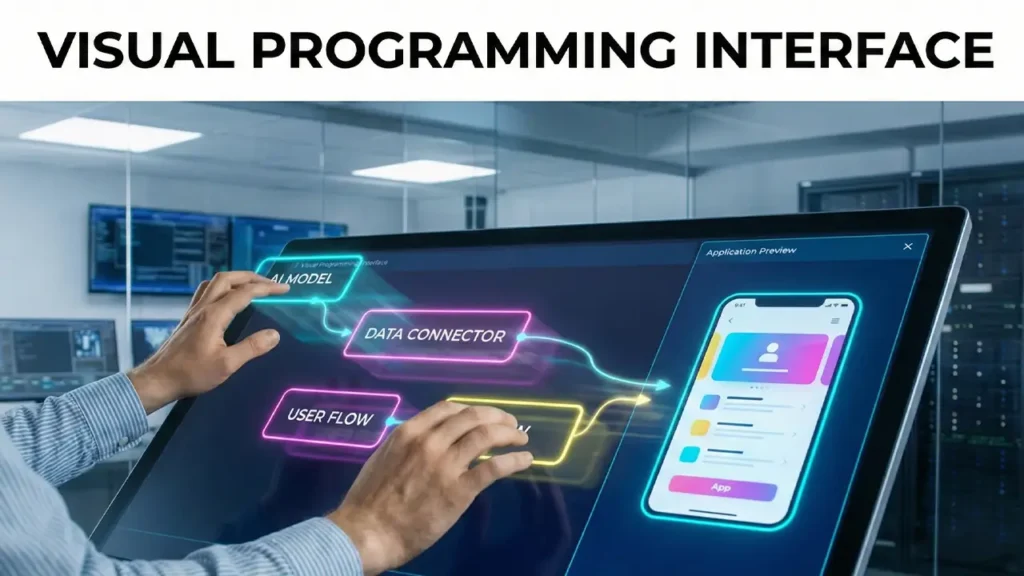
4️⃣ Visual Programming Interface: Design Drives Logic
A visual programming interface has traditionally meant drag-and-drop block coding or flowchart-based development. Vibe Coding redefines this concept: the visual design itself becomes the source code.
UI as Source Code
In traditional development, designers create mockups, then developers translate those designs into code — a time-consuming, error-prone process. Vibe Coding collapses this workflow.
Tools like Anima, Locofy, and Builder.io analyze design files and generate production-ready code automatically. But modern implementations go further: they understand component hierarchies, responsive breakpoints, and interaction patterns.
How Tools Like Anima Transform Workflows
Anima exemplifies the design-to-code revolution. Designers work in Figma (their comfort zone), and Anima:
- Analyzes layer structures and naming conventions
- Identifies reusable components automatically
- Generates React, Vue, or HTML code with proper structure
- Implements responsive behavior based on design constraints
- Syncs changes when designs update
This isn’t just pixel-perfect conversion — it’s intelligent interpretation. The AI recognizes that a group of elements represents a “card component” or “navigation bar” and structures the code accordingly.
The Developer’s New Role
Developers don’t disappear in this workflow. Instead, they:
- Set up design systems and component libraries
- Define how components should behave (not just look)
- Handle state management and data integration
- Optimize performance and accessibility
- Build complex business logic that design tools can’t infer
The visual programming interface handles the tedious parts (writing CSS, matching pixels, handling basic responsiveness), freeing developers for higher-level work.
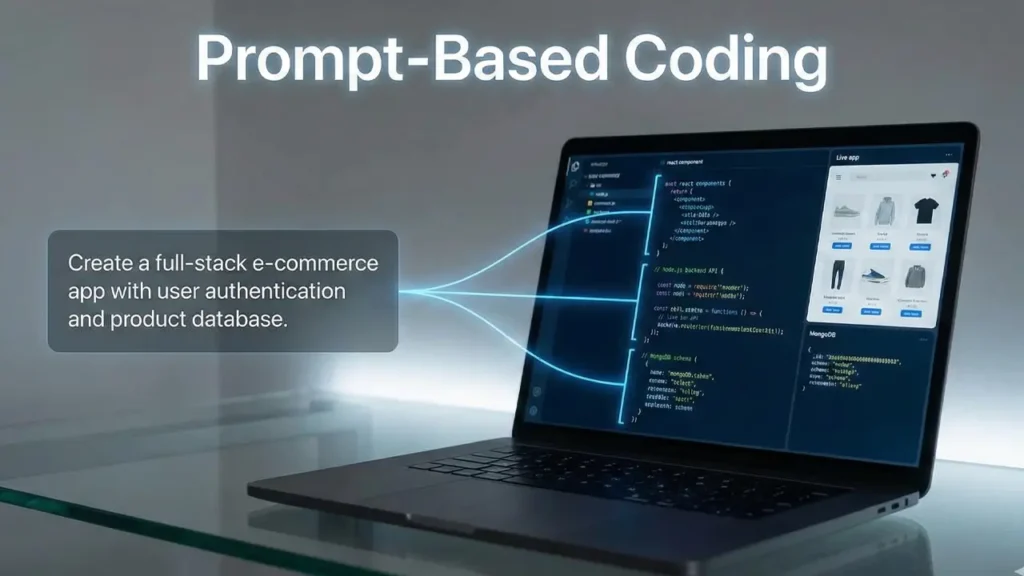
5️⃣ Prompt-Based Coding Instead of Manual Writing
Prompt-based coding is the practical discipline of Vibe Coding. Just as SQL queries require specific syntax, effective prompts require skill and precision.
Good Prompts Equal Project Architecture
A well-crafted prompt doesn’t just get you code — it establishes architectural patterns. Consider this progression:
Beginner Prompt: “Make a login page”
Result: Generic login form with no context, probably missing security features.
Intermediate Prompt: “Create a login page with email/password fields, remember me checkbox, and forgot password link. Use React and Tailwind CSS.”
Result: Better, but still lacks business logic and integration points.
Expert Prompt: “Build a login component for a B2B SaaS application. Use React with TypeScript, Tailwind for styling, and React Hook Form for validation. Integrate with our existing auth context (found in src/contexts/AuthContext.tsx). Include email/password fields, remember me option, forgot password link, and error handling. Follow our component patterns in the design system (src/components/ui/). Add loading states and success/error messages.”
Result: Production-ready component that fits seamlessly into the existing codebase.
Common Mistakes Beginners Make
The Anti-Pattern Registry
Identifying common friction points in AI-augmented development and the architectural strategies to mitigate hallucination and logic errors.
| Common Anti-Pattern | Technical Impact | Production-Grade Strategy |
|---|---|---|
| Vague Requests | Ambiguity forces the model to fill gaps with statistical assumptions, leading to hallucinated logic. |
Explicit Constraints:
Define frameworks, naming patterns, and performance limits.
|
| Context Deprivation | Generated code fails to integrate with existing state, causing circular dependencies or type mismatches. |
Ecosystem Awareness:
Provide relevant file headers, interfaces, and library versions.
|
| Naïve Acceptance | Accepting the first output ignores optimization opportunities and can overlook subtle security vulnerabilities. |
Iterative Refinement:
Audit the output; ask the model to “critique and optimize” its result.
|
| Boundary Neglect | Focusing only on the “happy path” results in production code that breaks under non-standard inputs. |
Defensive Prompting:
Explicitly request error handling, validation, and edge-case tests.
|
| Monolithic Prompts | Massive, multi-step prompts increase “token confusion” and make specific errors harder to debug. |
Modular Execution:
Decompose complex features into smaller, verifiable sub-tasks.
|
Generated code doesn’t integrate, creating “siloed” logic that breaks existing patterns.
Share existing structure and architecture patterns before generation.
Harder to debug and more prone to logic drift across large token windows.
Decompose into smaller, focused, and testable unit requests.
Scroll to audit all common anti-patterns
Prompt Patterns That Work
Successful prompt-based coding follows recognizable patterns:
The Specification Pattern: Provide complete requirements upfront, including technical constraints, integration points, and edge cases.
The Iteration Pattern: Start with a working version, then refine through specific improvement requests.
The Example Pattern: Show similar existing code and ask for new features that match the pattern.
The Constraint Pattern: Define what you don’t want as clearly as what you do want.
Mastering these patterns is becoming as valuable as traditional programming skills.
6️⃣ No-Code AI Tools Evolve into Vibe Coding
Traditional no-code AI tools promised anyone could build software. The reality was more limited — simple apps, yes, but complex business logic remained out of reach. Vibe Coding represents the next evolution.
Why Old No-Code Can’t Keep Up
First-generation no-code platforms like Bubble, Webflow, and Adalo achieved significant success but hit natural limits:
Ceiling of Complexity: Once your app needed custom business logic or unique workflows, you’d outgrow the platform.
Vendor Lock-In: Migrating away meant starting over completely — your “code” was trapped in proprietary systems.
Template Thinking: Platforms encouraged fitting your idea into existing templates rather than building exactly what you envisioned.
Performance Limitations: Abstraction layers added overhead that couldn’t match custom-coded solutions.
The Integration of Business Logic
Modern Vibe Coding tools solve these problems by generating actual code while maintaining no-code convenience. This hybrid approach means:
Custom Logic Works: Need a complex pricing algorithm? Describe it in natural language, and the AI implements it properly.
Real Integration: Connect to any API, database, or service using standard protocols, not just pre-approved integrations.
Exportable Results: Generated code uses standard frameworks (React, Next.js, Node.js), so you can take it anywhere.
Professional Output: Code quality matches what experienced developers write, complete with proper error handling and edge case management.
Platforms like Replit, Lovable, and GPT Engineer exemplify this evolution — they maintain no-code accessibility while removing artificial limitations.
7️⃣ Design-to-Code Automation and Context Understanding
Design-to-code automation has existed for years, but early versions produced bloated, unmaintainable code. Modern AI changes the game by understanding design context, not just pixels.
From Figma to Production in Minutes
The workflow now looks like this:
- Design your interface in Figma with proper layer naming and component organization
- Connect the design tool to AI-powered converters like Anima, Locofy, or Quest
- Configure output preferences (framework, styling library, component structure)
- Generate production code with proper componentization
- Customize the generated code for specific business logic
- Deploy directly or integrate into existing projects
This process, which used to take days of developer time, now happens in minutes. But speed isn’t the only benefit — consistency matters too.
How AI Understands Components
Modern design-to-code tools don’t just convert rectangles to div elements. They recognize patterns:
Component Recognition: Groups named “Button,” “Card,” or “NavBar” become reusable React components, not duplicate code.
Variant Detection: Different states (hover, active, disabled) get implemented as proper component variants or conditional styling.
Responsive Intelligence: Figma’s auto-layout constraints translate to CSS flexbox/grid with appropriate media queries.
Accessibility Basics: Semantic HTML elements replace generic divs where appropriate, ARIA labels get added, keyboard navigation works.
Design System Alignment: Once configured, the tool matches your existing component library patterns automatically.
This contextual understanding transforms design-to-code from a gimmick into a professional tool.
8️⃣ Context-Aware AI Models as the Core Discipline
Context-aware AI models represent the technological breakthrough making Vibe Coding possible. These models don’t just process isolated prompts — they maintain understanding across entire projects.
Why Models Are Starting to “Understand” Business
Traditional code generators treated each request independently. Ask for a login page, get a login page — disconnected from everything else. Context-aware models work differently:
Project Memory: They remember previous conversations, existing code structures, and architectural decisions.
Pattern Recognition: They identify conventions in your codebase and follow them automatically.
Business Domain Understanding: Through training on millions of repositories, they’ve learned common business logic patterns across industries.
Relationship Inference: They understand how components relate — that a “create user” function probably needs a “User” model and database table.
This contextual intelligence means AI can make reasonable assumptions, suggest related changes, and maintain consistency across a project.
Prediction for Development
The trajectory is clear: context-aware models will continue improving in several dimensions:
Deeper Codebase Understanding: Future models will analyze entire repositories, understanding architecture patterns and suggesting improvements.
Business Logic Inference: Describe your business model once, and AI will correctly implement related features across frontend, backend, and database.
Proactive Suggestions: Instead of waiting for prompts, AI will suggest improvements, identify bugs, and recommend refactoring.
Multi-Repository Intelligence: AI will understand connections between microservices, shared libraries, and infrastructure code.
Domain Specialization: Models fine-tuned for specific industries (healthcare, finance, e-commerce) will understand regulatory requirements and best practices automatically.
We’re witnessing the early stages of AI that truly comprehends software systems, not just generates code snippets.
9️⃣ AI Software Development Trends 2026
AI software development trends show explosive growth across metrics. Product Hunt, Twitter, and investment data all point to Vibe Coding as a defining trend of 2025-2026.
Product Hunt and Twitter Momentum
Tracking Product Hunt launches reveals the pattern:
- Q4 2024: 47 AI coding tools launched, 12 became top-rated products
- Q1 2025: 89 new tools launched, category now permanent on homepage
- Prediction for 2025: Over 300 AI development tools launching
Twitter discussions show similar growth. Hashtags like #VibeCoding, #AIDevTools, and #PromptEngineering went from niche developer topics to mainstream tech conversation. Influencers like Pieter Levels, Marc Louvion, and others regularly showcase building entire businesses using AI-assisted development.
Investor Interest and Funding
Venture capital is pouring into the space:
AI Coding Capital Landscape
Tracking major venture capital movements and valuation benchmarks across the specialized AI-augmented development sector (2024-2025).
| Company / Entity | Ecosystem Category | Capitalization / Round |
|---|---|---|
| Replit | AI-Powered IDE |
$97.4M Series B
|
| Anima | Design-to-Code |
$10M Series A
|
| Builder.ai | AI App Assembly |
$250M Valuation
|
| Tabnine | Code Completion |
$25M Series B
|
| Magic.dev | AI Coding Assistant |
$23M Funding
|
AI-powered full-stack development environment.
Automated assembly of functional applications.
Scroll to compare all strategic market players
Beyond individual companies, major platforms are integrating AI development:
- GitHub: Copilot now powers entire features, not just suggestions
- Microsoft: Integrating AI deeply into Visual Studio and VS Code
- Google: Project IDX offers AI-first cloud development
- Vercel: v0 generates Next.js apps from descriptions
Why Vibe Coding Isn’t Just Hype
Several factors distinguish this from previous AI bubbles:
Real Products Shipping: Companies are building and selling actual products using these tools, not just demos.
Developer Adoption: Professional developers use these tools daily, proving they complement rather than replace skills.
Measurable Productivity Gains: Studies show 35-55% faster development with AI assistance (GitHub Copilot research, 2024).
Economic Pressure: Businesses face pressure to build faster with smaller teams — AI development tools deliver measurable ROI.
Model Improvement Trajectory: Each new model generation shows clear capability increases, not incremental tweaks.
The convergence of capability, adoption, and economic incentive suggests Vibe Coding is here to stay.
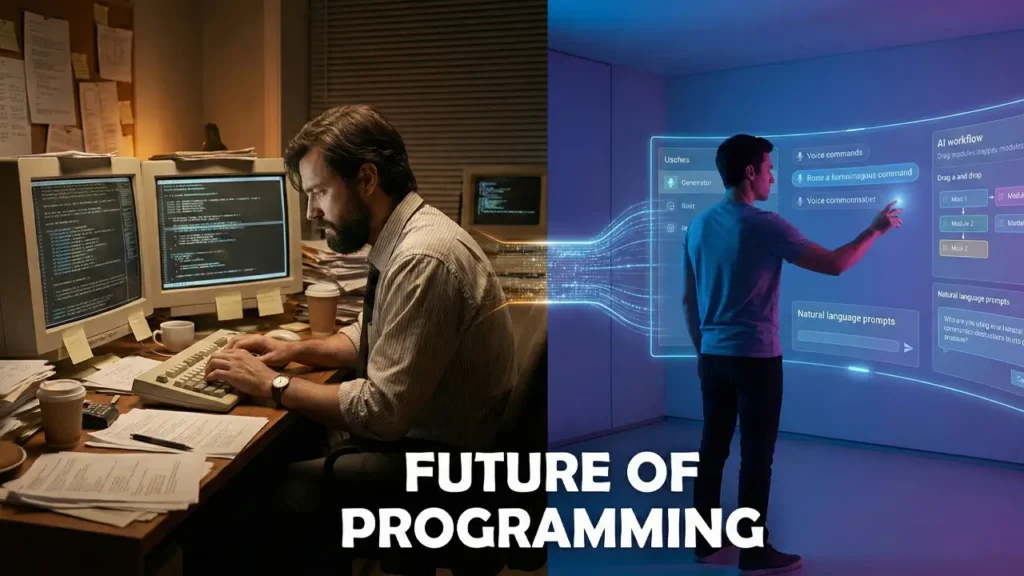
🔟 Future of Programming: Will Code Disappear?
The ultimate question about the future of programming: will traditional coding become obsolete? The answer is nuanced.
Will Developers Still Be Needed?
Yes — but their role continues evolving. Consider historical parallels:
Assembly Language → High-Level Languages: Programmers shifted from managing registers to expressing algorithms. Low-level specialists didn’t disappear; they became rarer and more specialized.
Manual Memory Management → Garbage Collection: Developers stopped manually tracking memory. Some performance-critical applications still require manual management, but most don’t.
Server Configuration → Cloud Platforms: System administrators shifted from racking servers to orchestrating cloud resources. Infrastructure knowledge remains valuable, but the abstraction level increased.
Vibe Coding follows this pattern. Developers will spend less time on syntax and more on:
- System architecture and design patterns
- Business logic and domain modeling
- Performance optimization and scaling
- Security and privacy implementation
- Integration and orchestration
- Quality assurance and testing strategies
These skills require judgment, experience, and domain knowledge that AI can augment but not replace.
Who Wins: Logic Managers or Classical Programmers?
The future likely creates three tiers of software creators:
Tier 1: Citizen Developers (Logic Managers) Non-programmers who use Vibe Coding tools to build functional applications. They understand business logic and can communicate requirements clearly but don’t write traditional code. This group expands dramatically, democratizing software creation for simple-to-medium complexity projects.
Tier 2: Augmented Developers Traditional programmers who leverage AI tools to 10x their productivity. They understand both the business requirements and technical implementation, using AI to handle boilerplate while they focus on complex problems. This becomes the mainstream development approach.
Tier 3: Specialist Engineers Deep technical experts who build the platforms, optimize performance-critical systems, and solve novel problems AI can’t handle yet. Smaller in number but highly valuable, similar to how kernel developers or database engine engineers operate today.
All three tiers will coexist. Simple apps move to Tier 1, most commercial software lives in Tier 2, and cutting-edge systems require Tier 3.
The Skills That Matter Most
As Vibe Coding matures, certain skills become increasingly valuable:
Prompt Engineering: Communicating effectively with AI becomes a core competency, similar to writing clear documentation or user stories today.
System Thinking: Understanding how components interact, where bottlenecks occur, and how to design scalable architectures remains deeply human.
Domain Expertise: Knowing healthcare regulations, financial trading requirements, or e-commerce conversion optimization can’t be automated — it informs better AI prompts.
Quality Judgment: Evaluating AI-generated code for correctness, security, and maintainability requires experienced eyes.
Creative Problem-Solving: When AI hits limits, human creativity finds novel approaches and combines techniques in unexpected ways.
The Optimistic Vision
Rather than eliminating programming jobs, Vibe Coding could dramatically expand the software industry. When building becomes 10x faster, we don’t need 1/10th the developers — we build 10x more software.
Consider: desktop publishing didn’t eliminate graphic designers; it enabled millions more designs. Digital audio workstations didn’t end music careers; they democratized music production. Vibe Coding likely follows this pattern, creating opportunities while transforming how work happens.
The future isn’t code-less — it’s code-abundant, created through natural conversation, visual interfaces, and intelligent assistance. Developers who embrace this transition will find themselves more productive and creative than ever before.
Conclusion
Vibe Coding represents a fundamental reimagining of software development. By combining Natural Language Programming, AI-driven development, visual programming interfaces, and context-aware AI models, it collapses the distance between intent and implementation.
This isn’t the end of programming — it’s programming for a broader audience. The skills shift from syntax mastery to systems thinking, from debugging semicolons to orchestrating intelligent tools, from writing every line to architecting solutions.
The trends are unmistakable: rapid tool proliferation, strong investor interest, measurable productivity gains, and widespread adoption. Whether you’re a seasoned developer, aspiring creator, or business leader, understanding Vibe Coding isn’t optional — it’s essential for navigating the future of software development.
The question isn’t whether this transformation happens, but how quickly you adapt to it.
Technology evolves fast — from Vibe Coding and AI-driven development to the devices that power this innovation. If you’re exploring cutting-edge tools, smart gadgets, and next-gen hardware built for creators and developers, check out https://bestchinagadget.com/ — practical tech curated for the future. Stay ahead, stay upgraded.