
What Is On Device Multimodal AI and Why It Matters
Not long ago, asking your phone to understand a live video scene, identify objects in real time, or describe what it “sees” through the camera meant your request had to travel hundreds of miles to a data center, get processed by massive GPU clusters, and travel all the way back. Today, that entire journey is becoming unnecessary. On device multimodal AI is one of the most quietly transformative developments in modern technology — and 2026 is the year it truly arrives for everyday users.
So what exactly is it? Multimodal AI refers to artificial intelligence systems that can simultaneously process and understand more than one type of input — typically combining vision (images, video), language (text, speech), and sometimes audio. When this capability runs entirely on the device in your pocket, without any internet connection or cloud server involvement, it becomes “on device multimodal AI.” The smartphone essentially gains a brain that can see, hear, read, and reason — all locally.
For years, the dominant paradigm in AI was cloud-first. GPT-4o, for instance, lives on OpenAI’s servers and requires a reliable internet connection to function. That worked fine in many scenarios, but it created real limitations: latency (even a few seconds feels slow for real-time camera tasks), privacy concerns (your video frames are being uploaded somewhere), cost (API calls at scale add up fast), and complete unavailability in offline or low-connectivity environments. On device multimodal AI dissolves all of these constraints at once.
The shift from cloud AI to multimodal AI on smartphone isn’t just a convenience upgrade. It represents a fundamental rethinking of where intelligence lives in our technological ecosystem — moving it from centralized data centers to billions of distributed personal devices. And thanks to a confluence of advances in model architecture, quantization techniques, and mobile chip design, this shift is happening faster than most people realize.
2. From Cloud to Edge: The Rise of Edge AI Video Processing
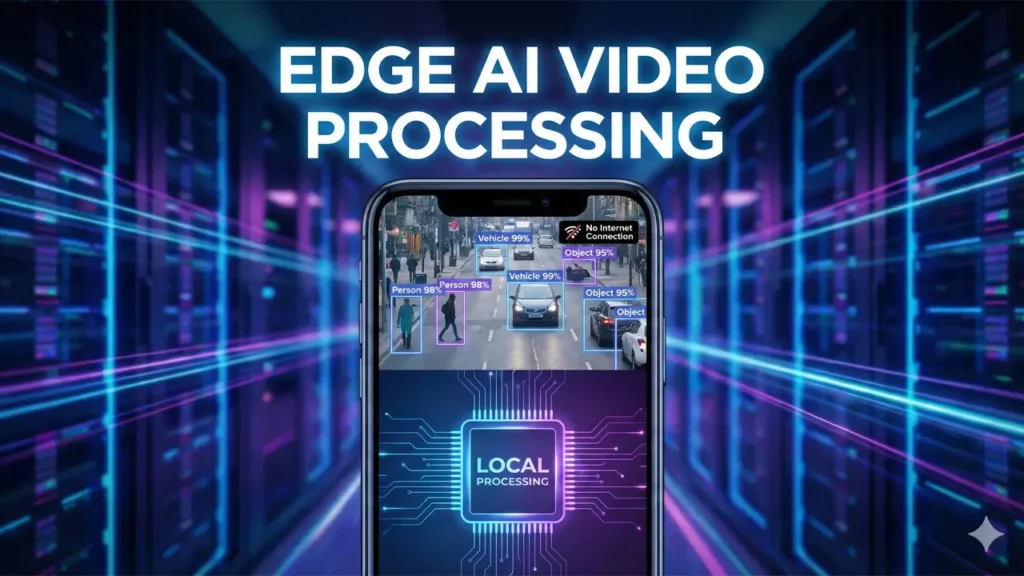
The term “edge” in computing refers to the periphery of a network — the actual devices and sensors that generate data, as opposed to the cloud servers that traditionally processed it. Edge AI video processing means running video analysis models directly on cameras, smartphones, or local hardware rather than streaming footage to the cloud.
Why is this happening now? Three forces have converged simultaneously. First, latency. Cloud-based video AI introduces round-trip delays that make real-time applications impractical. If you want your phone to tell you what it’s looking at right now, a 500-millisecond cloud delay makes the experience feel broken. Edge processing cuts that to near-zero. Second, privacy. Uploading a continuous camera feed to external servers is an enormous privacy exposure — and one that regulators are increasingly scrutinizing. Third, autonomy. Offline AI assistant capabilities mean your device works just as well in a remote cabin, on a plane, or in a country with restricted internet access as it does in a well-connected city.
The business logic is compelling too. According to analysis published in late 2025, the same AI inference that cost $0.50 per request via cloud API can cost just $0.05 when handled on-device — a 90% reduction that becomes enormously significant at consumer scale. For a company deploying AI across millions of users, that difference is measured in hundreds of millions of dollars annually.
Edge AI video processing is already showing up in production applications: automated subtitling, real-time translation of text captured through a camera, live scene description for visually impaired users, and sports tracking. What’s new in 2026 is the sophistication and breadth of what that local processing can now achieve — including full multimodal understanding that would have required a data center just two years ago.
3. The Breakthrough in Quantization and Architecture
The technical story behind on device multimodal AI coming of age is a fascinating one. Large AI models typically require enormous amounts of memory and computing power to run. A standard GPT-4o class model needs hundreds of gigabytes of VRAM and the kind of hardware that costs tens of thousands of dollars. Running something like that on a smartphone was simply impossible.
The breakthrough came from two directions at once: smarter architectures and aggressive quantization.
Quantization is the process of reducing the numerical precision used to store a model’s parameters — essentially compressing the model without catastrophically degrading its performance. Modern quantization techniques can take a model that would normally require 16-bit floating point numbers for each parameter and represent those parameters with 4-bit integers instead, shrinking the model’s memory footprint by 75% while preserving most of its capability. GGUF format quantization, widely used for local deployment, now offers models in up to 16 different size configurations to match a wide range of hardware.
The architectural innovation story is best illustrated by the MiniCPM-o series from OpenBMB. Published research in Nature Communications confirmed what the AI community had been watching develop in real time: “the sizes for high-performing models are rapidly decreasing alongside growing edge computation capacity, enabling advanced multimodal models to operate locally on consumer hardware.” The MiniCPM-o model line represents the leading edge of this trend. MiniCPM-o 2.6, released in January 2025, packed 8 billion parameters into a model that could be deployed on an iPad and match GPT-4o-202405 in vision, speech, and multimodal live streaming capabilities — a stunning achievement.
Then in February 2026, OpenBMB released MiniCPM-o 4.5, built on an end-to-end architecture combining SigLip2 (vision), Whisper-medium (audio), CosyVoice2 (speech synthesis), and Qwen3-8B (language), totaling just 9 billion parameters. Despite its relatively compact size, it achieves an average score of 77.6 on OpenCompass — surpassing GPT-4o and Gemini 2.0 Pro on vision-language benchmarks, and approaching Gemini 2.5 Flash. This is not a niche research result. It is deployable today via llama.cpp and Ollama on consumer hardware, including MacBooks and devices with similar compute profiles to flagship smartphones.
For the vision-only use case, MiniCPM-V 4.0 is even leaner: 4.1 billion parameters, capable of delivering less than 2 seconds of first-token delay and more than 17 tokens per second on an iPhone 16 Pro Max. An open-source iOS app ships with it. These are not approximations of the cloud experience. They are genuinely capable AI vision model mobile deployments.
MiniCPM Architecture Evolution
A technical assessment of parameter scaling, multimodal reasoning (V), and full-duplex omni-directional streaming (o).
| Architecture | Release | Parameters | OpenCompass | Technical Milestone |
|---|---|---|---|---|
| MiniCPM-V 2.6 | Aug 2024 | 8B | — | Video Native Enabled real-time video understanding on iPad; benchmarked above GPT-4V. |
| MiniCPM-o 2.6 | Jan 2025 | 8B | 70.2 | Omni-modal Unified Vision + Speech streaming; achieved functional parity with GPT-4o. |
| MiniCPM-V 4.0 | 2025 | 4.1B | 69.0 | Edge Optimized Inference at 17+ tok/s on iPhone 16 Pro Max; primary focus on on-device app integration. |
| MiniCPM-o 4.5 | Feb 2026 | 9B | 77.6 | SOTA Frontier Full-duplex multimodal streaming; benchmarking performance exceeding GPT-4o and Gemini 2.0 Pro. |
4. Real-Time Camera Understanding
Perhaps the most viscerally impressive aspect of on device multimodal AI is what it enables through a smartphone’s camera. Real time video AI means the model is continuously analyzing frames from your live camera feed and generating meaningful responses — not just descriptions, but dynamic, contextual understanding of what’s happening in the scene.
How does AI video understanding actually work on a mobile device? The process involves several components working in tight coordination. The camera captures frames, which are encoded by a lightweight visual encoder (in MiniCPM-o 4.5’s case, SigLip2) into compact representations called embeddings. These embeddings are then processed by a language model that generates text or spoken responses. In a full-duplex implementation like MiniCPM-o 4.5, this happens simultaneously with audio input and output, meaning the model can see, listen, and speak at the same time — without any turn-taking delay.
The practical applications are remarkable. A user can point their phone at a restaurant menu in a foreign language and receive an instant translation with dish descriptions spoken aloud. A mechanic can hold their phone’s camera under a car hood and get real-time guidance on what they’re looking at. A visually impaired person can receive continuous live narration of their environment. A student can point their phone at a math problem and get a step-by-step solution explained verbally.
What makes MiniCPM-o 4.5’s approach particularly noteworthy is its “proactive interaction” capability — the model doesn’t just respond to questions, it can initiate reminders or comments based on its continuous understanding of the live scene. This goes beyond reactive AI into something closer to a genuine ambient assistant. One review described the experience as the model being able to “initiate reminders or comments based on its continuous understanding of the live scene” — a step change from anything previously available on consumer hardware.
The technical underpinning of real time video AI on smartphones relies on efficient token density — essentially, how much visual information can be compressed into a small number of computational tokens. Advances in visual encoding over the past two years have made it possible to process high-resolution, multi-frame video inputs at the token density required for real-time response, rather than the delayed batch processing that characterized earlier attempts.

5. GPT-4o Local Processing vs Cloud GPT
The comparison between GPT 4o local processing and cloud-based GPT models is not as simple as “one is better than the other.” They represent genuinely different trade-offs, and understanding those trade-offs helps clarify where on-device AI shines and where cloud AI retains an edge.
Cloud GPT-4o offers the most powerful version of the model with the largest parameter count, the most up-to-date training data, and the ability to handle extremely long context windows. For tasks like writing a complex legal document, analyzing a lengthy research paper, or generating high-quality creative writing, the cloud version remains superior. It also benefits from server-grade GPU infrastructure that allows responses to complex queries in seconds.
GPT 4o local processing — achieved through models like MiniCPM-o 4.5 or Apple’s on-device models — trades some of that raw capability for a set of advantages that matter enormously in real-world deployment: zero latency for vision tasks, complete offline functionality, guaranteed privacy (no data leaves the device), and no per-request cost after the initial hardware investment.
One important nuance: “local processing” doesn’t mean the same thing as “a smaller, worse version of the cloud model.” MiniCPM-o 4.5, with 9 billion parameters, actually outperforms GPT-4o on several vision-language benchmarks while running entirely locally. The gap between cloud and edge has narrowed dramatically, and for specific task categories — particularly real-time visual understanding — local models now have an advantage due to latency alone.
Intelligence Locality Matrix
Strategic trade-offs between centralized Cloud SaaS (GPT-4o) and localized Edge Intelligence (MiniCPM-o).
| Architecture Dimension | Cloud GPT-4o | On-Device (MiniCPM-o 4.5) |
|---|---|---|
| Response Latency | Network Dep. 500ms – 3.0s |
Local Native ✓ Near-zero (< 2s 1st token) |
| Privacy Protocol | Transit Req. Telemetry transmitted to servers |
Absolute Air-gap ✓ Zero external data egress |
| Offline Resilience | Requires Persistent Connection | ✓ 100% Fully Offline Capable |
| Operational Cost | ~$0.50 / Query Direct API Consumption |
✓ ~$0.05 / Query Amortized System Hardware |
| Vision (Benchmark) | ~74.0 (OpenCompass) | ✓ 77.6 (SOTA Edge) |
| Context Window | ✓ 128k+ Tokens Scalable datacenter RAM |
RAM Bound Constrained by mobile hardware |
| Real-Time Video | Limited by uplink jitter/lag | ✓ Native full-duplex streaming |
| Model Recency | ✓ Continuous Cloud Updates | Fixed at point of deployment |
The honest conclusion is that these two paradigms are increasingly complementary rather than competitive. Hybrid architectures — where simple, frequent tasks run locally and complex, infrequent tasks are offloaded to the cloud — are likely to become the standard approach for sophisticated AI applications.
6. Smartphones as Offline AI Assistants
The offline AI assistant use case is where the human impact of on device multimodal AI becomes most tangible. Consider scenarios where internet connectivity is absent, unreliable, or actively undesirable:
A traveler in rural Japan pointing their phone at a handwritten sign and getting an instant translation and spoken explanation — no roaming data required. A field engineer in a factory with no Wi-Fi using their phone’s camera to diagnose machinery problems in real time. A healthcare worker in a remote clinic capturing images of skin conditions for instant AI-assisted analysis. A business executive reviewing a confidential contract on a flight, using on-device AI to summarize and flag key clauses without any data exposure risk.
For business use, the offline AI assistant capability has particularly significant implications. Corporate deployments of AI have historically been constrained by security teams unwilling to allow sensitive data to transit external networks. On-device AI eliminates that concern entirely. The model, the data, and the inference all remain within the organization’s physical control. This is a genuinely new capability, not just an incremental improvement.
Travel applications are already emerging. Translation, navigation assistance, cultural context, and real-time scene description all become available in connectivity-poor environments where cloud AI fails completely. For global travelers — both leisure and business — this transforms the smartphone from a device that becomes limited abroad into one that becomes a more capable companion precisely because its core intelligence is self-contained.
Security and surveillance applications are also evolving rapidly. On-device video analysis means a security camera can identify anomalies and trigger alerts without streaming footage to an external server — a massive privacy and bandwidth win for organizations concerned about data exposure.
7. Hardware Evolution: NPUs and Mobile Chips
None of this would be possible without the extraordinary advances in mobile chip design over the past several years. The Neural Processing Unit (NPU) — a dedicated processor core designed specifically for AI workloads — has been the key enabling technology.
Apple’s A18 chip, which powers the iPhone 16 lineup, features a 16-core Neural Engine delivering 35 TOPS (Tera Operations Per Second). To put this in perspective: this NPU is approximately 58 times more powerful than the Neural Engine in the iPhone X’s A11 chip, which introduced the concept in 2017. Apple claims the A18 Pro is 15% faster on Apple Intelligence tasks compared to the A17 Pro. For context, MiniCPM-V 4.0 achieves 17+ tokens per second on the iPhone 16 Pro Max’s A18 Pro — a throughput that would have required a dedicated GPU workstation just three years ago.
On the Android side, Qualcomm’s Snapdragon 8 Elite Gen 5 delivers up to 46% faster AI performance than its predecessor and processes 220 tokens per second — figures that make real-time multimodal inference genuinely viable. The NPU has been elevated to a primary design focus, running on its own independent power rail in the latest Snapdragon architectures to allow always-on AI sensing with minimal battery impact.
For PCs and laptops — increasingly relevant as the boundary between mobile and desktop computing blurs — Qualcomm’s Snapdragon X2 Elite unveiled at CES 2026 features an 80 TOPS NPU with 228 GB/s of memory bandwidth in its “Extreme” variant. This enables running complex LLMs and generative AI tasks entirely offline, with memory bandwidth that ensures models don’t bottleneck on data access.
Edge AI Compute Matrix
Technical specifications and NPU throughput (TOPS) across frontier mobile and PC silicon architectures.
| Architecture / Chip | Provider | NPU Throughput | Process Node | Primary Target |
|---|---|---|---|---|
| Apple A18 / Pro | Apple | 35 TOPS | 3nm (N3E) | iPhone 16 Series |
| Snapdragon 8 Elite G5 | Qualcomm | 80 TOPS
Hexagon Architecture
|
3nm (TSMC) | Android Flagships (2026) |
| Snapdragon X2 Elite | Qualcomm | 80–85 TOPS | 3nm (Oryon) | Copilot+ AI PCs |
| Apple A19 Pro | Apple | 40+ TOPS
Projected Baseline
|
3nm+ (N3P) | iPhone 17 Pro |
| Dimensity 9500 | MediaTek | High-Eff. NPU | 3nm (TSMC) | Premium Android Tiers |
The trajectory is clear: NPU performance is roughly doubling every 18–24 months, following a pattern reminiscent of Moore’s Law applied specifically to AI workloads. This means the models that today require a flagship device will run comfortably on mid-range phones within two to three years.
8. Privacy and Security in Edge Multimodality
One of the most compelling arguments for on device multimodal AI — and one that is increasingly driving regulatory attention — is its privacy architecture. When all processing happens locally, the fundamental privacy risk profile of an AI application changes completely.
The regulatory context makes this urgency concrete. As of December 2025, European regulators had issued 2,679 GDPR fines totaling over €6.7 billion since May 2018. Analysis from 2025 found that most major violations involved data transmitted to cloud providers for processing — a risk category that on-device AI eliminates entirely. The EU AI Act becomes fully applicable on August 2, 2026, establishing risk-based obligations for high-impact AI systems. The EU Data Act, effective September 2025, extends sovereignty rights to data generated by connected devices.
The EU AI Act’s prohibition on “untargeted facial recognition scraping” and restrictions on remote biometric identification are directly relevant to multimodal AI systems that process video. On-device processing sidesteps much of this regulatory complexity: if the data never leaves the device, the question of what happens to it in transit or storage becomes moot.
Edge multimodality trend 2026 is therefore not just a technical phenomenon — it’s a regulatory and architectural response to a compliance environment that has become genuinely hostile to casual cloud data handling. Data sovereignty — the principle that personal data should be subject to the laws of the jurisdiction where it originates — is increasingly driving enterprise architecture decisions. When AI inference runs on the user’s device, sovereignty is preserved by default.
Security researchers have also highlighted a less obvious benefit: on-device models cannot be affected by server-side breaches. If a cloud AI provider’s systems are compromised, the training data, user queries, and model outputs are all at risk. With on-device processing, an attacker who wants to access a specific user’s AI interactions would need physical access to their device — a fundamentally different and much harder attack surface.
The principle of “private by design” — embedding privacy into the technical architecture rather than bolting it on as a compliance afterthought — is exactly what on device multimodal AI delivers natively. For healthcare, finance, legal, and other sensitive domains, this is not an optional feature. It is becoming a baseline requirement.
9. Business and Startup Opportunities
The edge multimodality trend 2026 is not just a technical story — it is an enormous economic opportunity. Multimodal AI on smartphone creates entirely new product categories and business models that simply couldn’t exist when AI required cloud connectivity.
The augmented reality layer is the most obvious opportunity. When a smartphone can continuously understand what its camera sees, AR applications gain genuine semantic intelligence rather than just visual overlay. A retail app that can identify any product in a store, check inventory, compare prices, and describe the product’s features — all through a live camera feed, offline — is a genuinely new product category. Smart retail is perhaps the nearest-term large market, with applications in inventory management, customer self-service, and loss prevention.
Healthcare presents another massive opportunity. Dermatology apps that can analyze skin conditions with medical-grade accuracy, running entirely on a patient’s phone with no data upload required, address both the capability gap in remote areas and the compliance burden of uploading medical images to external servers. The combination of sufficient model capability (MiniCPM-o 4.5 achieves GPT-4o-level visual understanding) and built-in privacy compliance makes medical AI on-device particularly compelling.
For startups, the key insight is that distribution through the app store — rather than cloud API pricing — fundamentally changes the economics. A one-time app purchase or subscription can deliver unlimited AI inference at no marginal cost to the developer. This unit economics model, unavailable in the cloud AI era, enables product categories that were previously unviable.
Manufacturing and industrial inspection are significant enterprise opportunities. Quality control systems that run on handheld devices, analyzing components in real time with no connectivity requirement, are deployable in factory floors, warehouses, and field service scenarios that lack reliable internet access. The potential to automate inspection tasks that currently require skilled human labor is enormous.
Language learning, accessibility tools, cooking assistants that understand what’s in your refrigerator through the camera, fitness apps that analyze exercise form in real time — the application space for multimodal AI on smartphone is limited primarily by developer imagination rather than technical constraints, which is a new situation and a compelling entrepreneurial signal.
10. The Future of On Device Multimodal AI in 2026–2027
The trajectory of on device multimodal AI is, if anything, accelerating rather than plateauing. Several developments on the near-term horizon suggest that what seems impressive in early 2026 will look modest by the end of 2027.
On the hardware side, NPU performance continues its rapid improvement curve. Qualcomm’s vision — articulated at Snapdragon Summit 2025 — is a “local network of AI capable devices” where smartwatches and XR glasses serve as input nodes, smartphones handle inference, and the entire system operates as a distributed agentic AI without cloud dependency. This is not science fiction; the Snapdragon 8 Elite Gen 5 and X2 Elite platform is already architected to support exactly this kind of multi-device, offline AI network.
On the model side, the parameter count required to achieve frontier-level capabilities continues to decline. If MiniCPM-o 4.5 achieves near-Gemini 2.5 Flash performance at 9 billion parameters in early 2026, it is reasonable to project that equivalent performance will fit in 3–4 billion parameters by late 2027. That would put genuinely capable multimodal AI within reach of mid-range smartphones, not just flagships.
The edge AI video processing market is undergoing structural transformation. By the end of 2026, projections suggest that 80% of AI inference will happen locally on devices rather than in cloud data centers — a reversal of the pattern that has characterized the first decade of commercial AI deployment. The cloud infrastructure investments of the past several years are not wasted; they will continue to serve training workloads and complex analytical tasks. But the inference moment — when AI actually responds to a user — is migrating to the edge.
The implications for the mobile device market are profound. The NPU is becoming as important a specification as camera resolution or battery life. Consumers who previously shopped for “camera phones” will increasingly shop for “AI phones” — and the key differentiator will be what the on-device AI can actually do. This creates a new axis of competition for Apple, Qualcomm, MediaTek, and Samsung that will drive investment and innovation for years.
For developers, enterprises, and regulators alike, the edge multimodality trend 2026 represents a genuinely new paradigm. The intelligence that was centralized is being distributed. The data that was uploaded is staying local. The experiences that required connectivity are becoming autonomous. This isn’t the next feature update in mobile technology. It is a structural shift in where AI lives — and the implications are only beginning to unfold.
Sources: OpenBMB/MiniCPM-o (GitHub, Hugging Face), Nature Communications (Nat Commun 16, 5509, 2025), Apple A18 Wikipedia, Qualcomm Snapdragon Summit 2025 & CES 2026 announcements, Futurum Research, Gizmochina, SecurePrivacy.ai, CookieScript.com, EU AI Act official timeline, GDPR enforcement statistics (EDPB 2025).
If you’re excited about the future of on-device AI and next-generation mobile performance, it’s worth exploring the hardware driving this revolution. Discover the latest smartphones, smart gadgets, and breakthrough tech innovations at https://bestchinagadget.com/ and see which devices are truly ready for real-time AI power in 2026.
Every weekend i used to go to see this site, because i wish for enjoyment, for the
reason that this this web site conations really good funny data
too.