
What is MiniCPM-o 2.6 Multimodal AI Model?
If you’ve been following the AI space lately, you’ve probably noticed a fascinating shift happening right before our eyes. While everyone was focused on massive cloud-based models competing for benchmark supremacy, a quieter revolution was brewing — one that fits in your pocket. The MiniCPM-o 2.6 multimodal AI model is one of the most exciting developments in this space, and after spending time exploring its capabilities, it’s clear why it’s generating so much buzz in 2026.
Developed by OpenBMB and the teams at Tsinghua University and ModelBest Inc., MiniCPM-o 2.6 is a compact yet remarkably capable model that handles vision, audio, and text — all at the same time. Think of it as a GPT-4o-style experience, but one that can genuinely run on your phone without phoning home to a server farm.
The comparison to GPT-4o is not just marketing. MiniCPM-o 2.6 was specifically designed to bring omni-modal capabilities — the ability to simultaneously process images, video, audio, and text — to the edge. On several standard benchmarks, it performs comparably to GPT-4o on vision-language tasks, which is a remarkable achievement for a model that weighs in at around 8 billion parameters. For context, GPT-4o is estimated to be many times larger.
Why is this a trend that’s defining 2026? The answer comes down to three converging forces: growing privacy concerns around cloud AI, the massive improvement in mobile chip capabilities (Snapdragon 8 Gen 3, Apple A17 Pro and beyond), and an open-source community that is accelerating development faster than any single company can. MiniCPM-o 2.6 sits right at the intersection of all three. It’s not just a model — it’s a signal of where AI is heading.
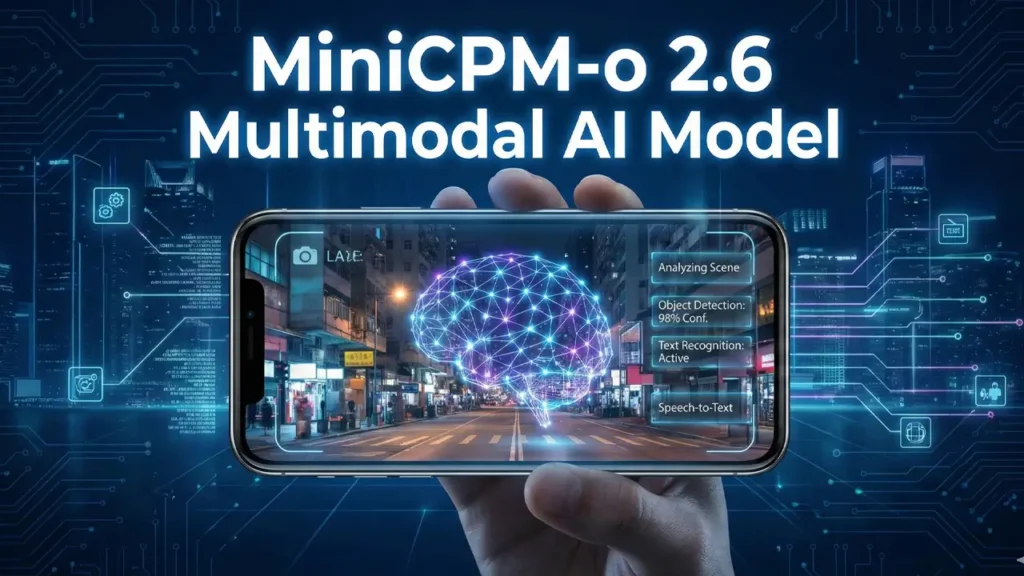
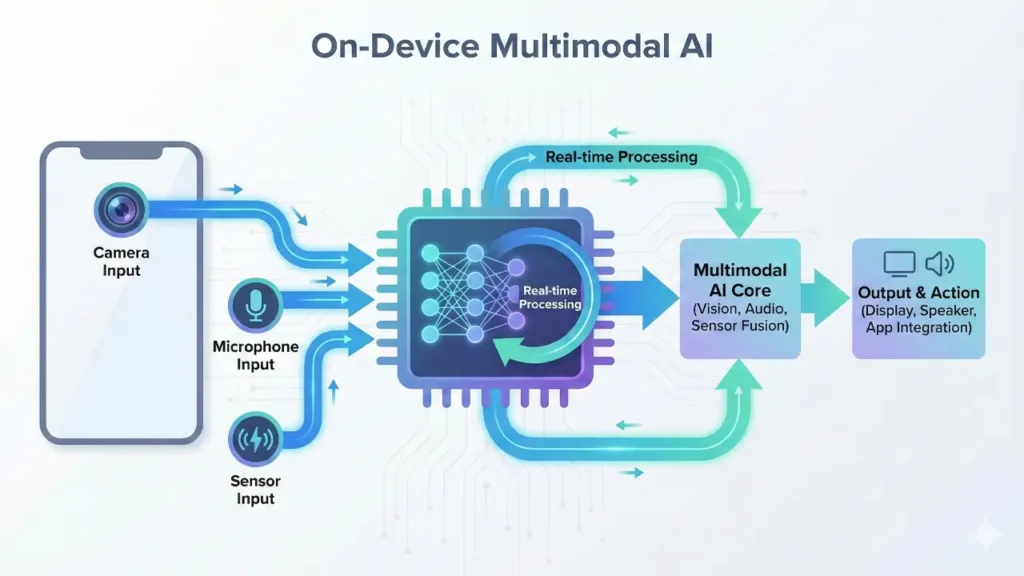
MiniCPM-o 2.6 as an On-Device Multimodal AI
One of the most compelling aspects of MiniCPM-o 2.6 is that it is a true on-device multimodal AI. This might sound like a technical detail, but the implications are profound for both everyday users and enterprise developers.
Running on-device means the model processes everything locally — your camera feed, your voice, your documents — without sending data to a remote server. For users, this translates directly into privacy. Your conversations with the AI, the images it analyzes, the audio it transcribes — none of it leaves your device unless you explicitly choose to share it. In an era where data privacy regulations are tightening globally, this is not a minor benefit. It’s a fundamental shift in how trustworthy AI can be.
Speed is the other major advantage. When you ask a cloud-based AI a question, your data travels to a data center, gets processed, and the response travels back. Even with fast internet, this introduces latency. An on-device model eliminates this round-trip entirely. MiniCPM-o 2.6 can begin responding in real time because computation happens locally, right on the processor in your hand.
There’s also the offline capability factor. Cloud AI is only as good as your internet connection. MiniCPM-o 2.6 works in airplane mode, in remote areas, in environments where connectivity is restricted or unreliable. For field workers, travelers, or anyone operating in bandwidth-constrained environments, this is a genuine game-changer.
Why MiniCPM-o 2.6 is a Breakthrough Edge AI Language Model
The term “edge AI” refers to artificial intelligence that runs directly on endpoint devices — smartphones, tablets, laptops, embedded systems — rather than in centralized cloud infrastructure. MiniCPM-o 2.6 is not just an edge AI language model in name; it was architected from the ground up for this purpose.
Edge computing as a paradigm has been growing for years, driven by IoT devices, autonomous vehicles, and industrial automation. Language models joining this category is a newer development, and it requires solving genuinely hard engineering problems. A model running on a phone has a fraction of the memory, compute, and power budget of a cloud server.
What makes MiniCPM-o 2.6 a breakthrough is how elegantly it solves this problem. Through a combination of efficient architecture choices, quantization techniques, and careful training, the model achieves capabilities that would have seemed impossible on mobile hardware just two years ago. It supports real-time streaming of video and audio input, maintains coherent multi-turn conversations, and can switch between modalities fluidly.
The autonomy angle is also significant. An edge AI model doesn’t depend on any company’s servers staying online, their pricing not changing, or their API terms remaining favorable. Developers who build on MiniCPM-o 2.6 own their stack in a meaningful way. The model can be deployed, fine-tuned, and operated entirely independently. For latency-critical applications — think real-time medical imaging assistance, live sports analysis, or industrial quality control — even a 200ms delay can be unacceptable. Edge AI eliminates this concern entirely.
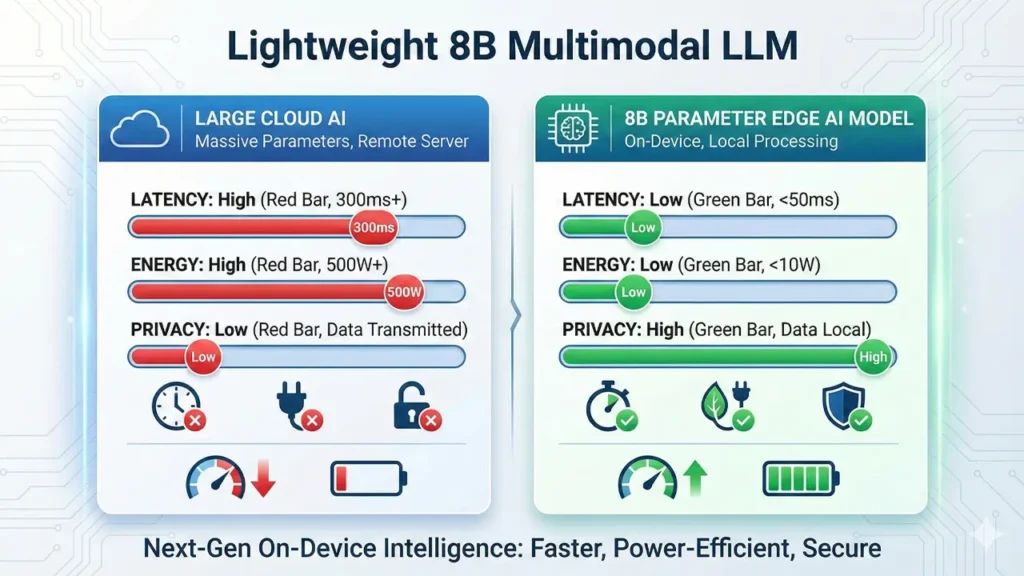
Lightweight Multimodal LLM: How 8B Parameters Change the Game
Let’s talk numbers, because they tell an important story. MiniCPM-o 2.6 is a lightweight multimodal LLM with approximately 8 billion parameters. To put that in perspective, GPT-4 is estimated to have over a trillion parameters. Yet this small parameter LLM 8B delivers performance that rivals models many times its size on key benchmarks.
How is this possible? Several factors come together:
First, the training methodology. The OpenBMB team focused on high-quality data curation and efficient training techniques rather than simply scaling up. Research has increasingly shown that model quality depends as much on training data quality as on raw parameter count.
Second, architectural efficiency. MiniCPM-o 2.6 uses an optimized architecture that avoids redundancy. Every parameter is doing meaningful work. This is in contrast to some larger models where significant capacity is effectively “wasted” on learned patterns that don’t contribute to performance.
Third, quantization. The model supports INT4 quantization, which dramatically reduces memory requirements while preserving most of its capabilities. This is what makes running on consumer hardware feasible.
The GitHub community response has been remarkable. The MiniCPM repository has garnered significant attention from developers who appreciate both the open availability and the practical deployability. Unlike many research models that exist primarily as papers and checkpoints that require expensive GPUs to run, MiniCPM-o 2.6 can be pulled down and run on a MacBook or a high-end Android phone.
Architecture & Locality Matrix
A comparative assessment of parameter scaling, multimodal fusion, and deployment locality across leading AI architectures.
| Model Architecture | Parameters | Supported Modalities | Deployment | License Type |
|---|---|---|---|---|
| MiniCPM-o 2.6 | ~8B | Vision Audio Text | On-Device Native | Open Weights |
| GPT-4o | Unknown (Frontier) | Vision Audio Text | Cloud API Only | Proprietary |
| LLaVA-1.6 | 7B – 34B | Vision Text | Partial On-Device | Open Weights |
| Gemini Nano | 1.8B – 3.25B | Limited Text/Img | On-Device Native | Proprietary |
The table above illustrates clearly what makes MiniCPM-o 2.6 unique in the current landscape. It is the only open-source model of its kind that combines full multimodal capabilities with genuine on-device deployability at the 8B parameter scale.
MiniCPM-o 2.6 as an AI Model for Mobile Devices
This is where things get genuinely exciting for most people. MiniCPM-o 2.6 as an AI model for mobile devices isn’t a theoretical exercise — it actually runs on current-generation smartphones.
The model has been demonstrated running on devices powered by Qualcomm Snapdragon 8 Gen 2 and Gen 3 chips, as well as Apple Silicon (M-series chips in iPads and MacBooks). On these platforms, with INT4 quantization applied, the model can run at a speed that makes real-time interaction genuinely practical. We’re not talking about waiting 30 seconds for a response — we’re talking about fluid, natural conversation with visible image understanding happening in near real-time.
What does this look like in practice? Imagine pointing your phone’s camera at a damaged piece of equipment and asking “what’s wrong with this?” and getting an immediate, contextually aware response without needing Wi-Fi. Or using it as a reading assistant that can explain any text you photograph, in any language, instantly. Or as an accessibility tool that describes the world around you through your camera for visually impaired users.
The memory footprint in INT4 quantization brings the model down to around 4–5GB of RAM, which is within the reach of modern flagship smartphones. As mobile hardware continues to improve — and it will, at a rapid pace — the performance headroom for MiniCPM-o 2.6 will only grow.
Hardware Deployment Matrix
A technical assessment of cross-platform compatibility and system performance for 4-bit (INT4) quantized inference.
| Hardware Platform | Status | RAM Requirement | Observed Performance |
|---|---|---|---|
| Snapdragon 8 Gen 3 | Confirmed | ~4.0 – 5.0 GB | Good |
| Apple M2 / M3 | Confirmed | ~4.0 – 5.0 GB | Excellent |
| Apple A17 Pro (iOS) | Verified / Tested | ~4.0 – 5.0 GB | Good |
| Mid-range Android | Limited / Restricted | ~4.0 – 5.0 GB | Marginal |
Real-Time Vision Language Model in Action
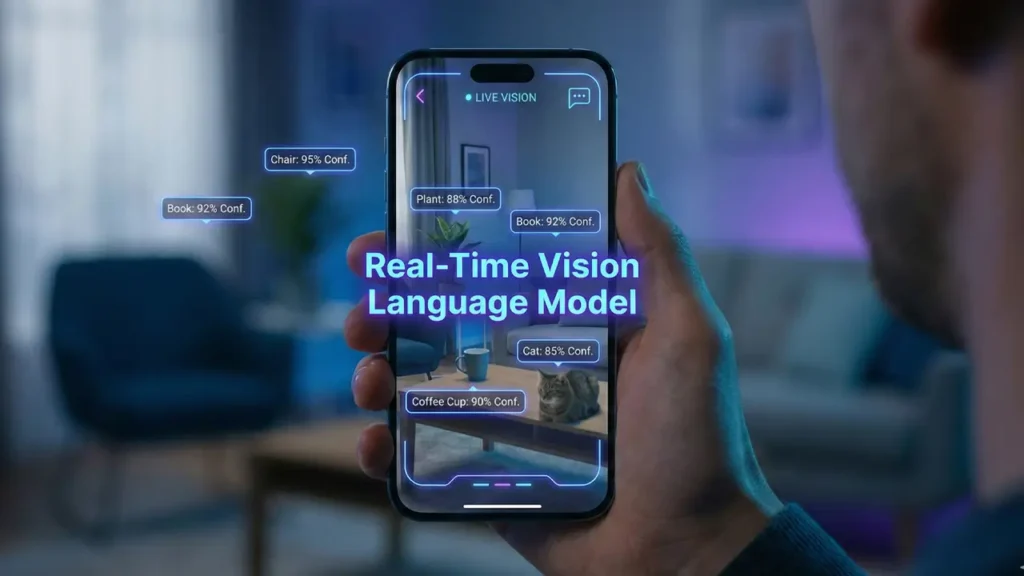
One of MiniCPM-o 2.6’s most distinctive features is its operation as a real-time vision language model. This isn’t just about analyzing static images — it’s about processing live video streams and responding to what’s happening as it happens.
The model can take a continuous camera feed as input and maintain an ongoing conversation about what it’s seeing. This is technically challenging because it requires efficient frame sampling, visual token compression, and fast inference to keep up with a real-time stream without overwhelming the processor. MiniCPM-o 2.6 handles this through a combination of architectural choices that prioritize temporal efficiency.
Practical use cases here are numerous and genuinely useful. Consider a chef using it to get real-time guidance while cooking, pointing the camera at ingredients for identification and recipe suggestions. Or a student using it to get explanations of diagrams and equations simply by looking at their textbook. Or a traveler using it to understand signs, menus, and labels in foreign languages as they move through a space.
For accessibility applications, the real-time vision capability is transformative. An app built on MiniCPM-o 2.6 could continuously describe a scene for a visually impaired user, reading text, identifying objects, and narrating spatial relationships — all without requiring internet access, which is critical in many situations where accessibility devices are used.
The audio understanding component works alongside vision, enabling true multimodal dialogue where a user can speak naturally while the model simultaneously processes the visual context. This kind of natural, embodied interaction is what made GPT-4o feel like a leap forward when it was announced — and MiniCPM-o 2.6 brings that experience to the local device.
Open-Source Multimodal AI Ecosystem
The fact that MiniCPM-o 2.6 is an open-source multimodal AI model isn’t just a licensing detail — it’s central to its identity and its impact.
OpenBMB (Open Big Model of Brains) is the research organization behind MiniCPM, operating in collaboration with Tsinghua University’s Natural Language Processing Lab and ModelBest Inc. The project is openly available on GitHub under licensing terms that allow both research and commercial use, which has been a significant driver of adoption.
The open-source nature means that developers can inspect the model’s weights, fine-tune it on domain-specific data, quantize it differently for different hardware targets, and deploy it without ongoing API costs or rate limits. This is a fundamentally different relationship between developers and AI than the cloud API model. You own your deployment. You control your data. You can customize behavior in ways that closed APIs simply don’t allow.
The community around MiniCPM-o has been active in producing integrations with popular frameworks like llama.cpp (for CPU inference), MLX (for Apple Silicon), and various mobile inference frameworks. This ecosystem of tools makes it significantly easier for developers who aren’t AI researchers to actually deploy and use the model in their applications.
For organizations with strict data governance requirements — healthcare, legal, financial services, government — the open-source on-device combination is often the only viable path to adopting AI capabilities. MiniCPM-o 2.6 makes this path accessible in a way that wasn’t really possible before.
Mobile AI Assistant 2026: Replacing Cloud GPT?
Here’s the provocative question that the rise of MiniCPM-o 2.6 forces us to ask: is the era of the mobile AI assistant in 2026 signaling the beginning of the end for cloud-dependent AI?
The answer, honestly, is nuanced. Cloud models like GPT-4o still have significant advantages in raw capability for complex reasoning tasks, access to real-time web information, and handling of extremely long contexts. For many use cases, a cloud API remains the right choice.
But for a substantial and growing category of applications, the balance is shifting. When you consider that MiniCPM-o 2.6 can perform vision-language tasks at near-GPT-4o quality, runs offline, is free to use, and preserves complete privacy, the cloud starts looking unnecessary for those specific tasks.
The mobile AI assistant market in 2026 is increasingly bifurcated. There’s the cloud-dependent assistant that excels at complex, knowledge-intensive tasks and benefits from continuous updates. And there’s the on-device assistant that excels at real-time, privacy-sensitive, latency-critical, or offline scenarios. These two categories will coexist and often complement each other rather than one simply replacing the other.
What is clear is that the assumption “AI requires the cloud” is no longer valid. The question for developers and product teams is now genuinely “which approach is right for this use case?” rather than “how do we access the cloud AI?” That’s a meaningful shift in how the industry thinks about AI deployment.
Looking at the competitive landscape, Qualcomm, MediaTek, and Apple are all investing heavily in NPU (Neural Processing Unit) capabilities specifically to accelerate local AI inference. This hardware investment is a strong signal that the on-device AI market is being taken seriously at the chip architecture level — which means the performance gap between cloud and on-device will continue to narrow.
AI Camera Chatbot Model: Practical Business Cases
Let’s get concrete about where the AI camera chatbot model capabilities of MiniCPM-o 2.6 create real business value, because this is where the technology moves from impressive demo to genuine ROI.
Retail: Imagine a smart shopping assistant built into a retail app that lets customers point their phone at any product — whether on a shelf, in a magazine ad, or worn by someone on the street — and instantly get pricing, availability, reviews, and alternatives. The camera chatbot understands visual context and can handle follow-up questions naturally. Because it runs on-device, the experience is fast enough to feel seamless rather than like waiting for a search result.
Healthcare: Clinical environments have strict data privacy requirements that make cloud AI difficult to deploy. An on-device medical imaging assistant that can help clinicians interpret wound photos, medication labels, or equipment displays — without any patient data leaving the device — addresses a real compliance challenge. MiniCPM-o 2.6’s vision capabilities make this feasible for a class of applications that couldn’t safely use cloud AI.
Education: Interactive learning applications that respond to what students are actually looking at create engagement levels that static content can’t match. A student struggling with a math problem can point their camera at their work and receive step-by-step guidance. A language learner can point at any object and practice vocabulary in context. The real-time, low-latency nature of on-device processing makes these interactions feel like talking to a tutor rather than submitting a query.
Field Services and Manufacturing: Technicians performing maintenance, inspection, or installation work can use a camera chatbot to get real-time guidance without requiring cellular connectivity — crucial in industrial environments where connectivity is often poor. The model can identify components, flag anomalies, and walk through repair procedures based on live visual input.
Multimodal AI Industry Matrix
Mapping high-impact visual intelligence use cases across global sectors, prioritizing privacy compliance and real-time operational benefits.
| Industry Cluster | Core Use Case | Strategic Advantage | Privacy Sensitivity |
|---|---|---|---|
|
|
Visual product search & personalized discovery. | Rapid conversion & CTR lift. | Medium |
|
|
Clinical visual assistance & diagnostic aid. | Strict HIPAA / Local Compliance. | Very High |
|
|
Real-time camera-based AI tutoring. | High engagement & student safety. | High (Minors) |
|
|
Maintenance & inspection visual guidance. | 100% Offline Capability. | Medium |
|
|
Real-time scene description for visually impaired. | Latency-free offline support. | High |
Clinical visual assistance & diagnostic workflows.
Real-time camera-based interactive AI tutoring.
Scroll to compare all strategic sectors
Final Verdict: Should You Test MiniCPM-o 2.6?
After going through everything MiniCPM-o 2.6 has to offer, let’s bring it home with an honest assessment.
The strengths are real and significant. This is genuinely the most capable open-source multimodal model that can run on consumer hardware. The combination of vision, audio, and text understanding in a package that fits on a phone is technically impressive and practically meaningful. For developers, researchers, and organizations that need local AI with vision capabilities, there is no real alternative that matches this combination of capability and deployability.
The limitations are also worth acknowledging. At 8B parameters, the model won’t match the reasoning depth of larger cloud models on complex analytical tasks. It requires a relatively recent, high-end device to run well — older or mid-range phones will struggle. Fine-tuning and deployment require technical expertise that non-technical users won’t have. And the ecosystem, while growing, is still maturing compared to cloud API platforms with years of tooling development behind them.
Who should absolutely try MiniCPM-o 2.6? Mobile app developers looking to add AI vision capabilities without cloud API costs. Organizations in privacy-sensitive sectors who need AI but can’t use cloud services. AI researchers studying efficient multimodal architectures. Developers in regions with unreliable connectivity where offline AI is a practical necessity. Anyone building accessibility applications where low latency and privacy are critical.
Who might want to wait or look elsewhere? Teams that need the deepest reasoning capabilities and aren’t constrained by privacy or connectivity concerns. Organizations without the technical capacity to deploy and maintain an open-source model. Users who want a polished, consumer-ready product rather than a research model.
Looking ahead to 2027, the trajectory is clear. Mobile chips will continue improving their AI acceleration capabilities. Quantization techniques will continue getting more efficient. The gap between cloud and on-device AI quality will narrow. MiniCPM-o 2.6, or its successors, will likely become the foundation for a new generation of AI applications that feel more like a natural part of your device than a service you’re connecting to. The AI assistant of 2027 might not live in the cloud at all — it might live right in your phone, waiting to help the moment you need it.
MiniCPM-o 2.6 isn’t just a model. It’s a preview of that future. And it’s available to download and explore right now.
Information in this article is based on official OpenBMB documentation, the MiniCPM GitHub repository, and published research from Tsinghua University’s NLP group.
If you’re excited about breakthrough compact AI like MiniCPM-o 2.6, you’ll also appreciate next-gen hardware innovation. Smart software deserves smart machines. Discover powerful, affordable, and reliable 3D printing solutions for creators and engineers at https://bestchina3dprinters.com/ and upgrade your tech ecosystem today.
Great blog you’ve got here.. It’s hard to find high-quality writing like yours these days.
I seriously appreciate people like you! Take care!!