
The Unitree G1 humanoid robot has become one of the most talked-about machines in robotics, and for good reason. This isn’t just another tech demo gathering dust in a lab—it’s a commercially available humanoid that developers, universities, and robotics enthusiasts can actually buy and work with. What makes the Unitree G1 humanoid robot stand out is its positioning as an “industrially affordable” option in a market where humanoid robots typically cost as much as a luxury car or small house.
But here’s where things get interesting: while Unitree is pushing the G1 as accessible technology, luxury customization company Caviar threw a curveball by creating the “Aladdin” edition—a gold-plated, gem-encrusted version that turned the robot into a viral sensation and marketing rocket. It’s a fascinating collision of practical robotics and pure spectacle, and it tells us a lot about where humanoid robots stand in 2025.
Let’s break down what the Unitree G1 humanoid robot actually is, what it can do, how much it costs, and whether the hype matches reality.
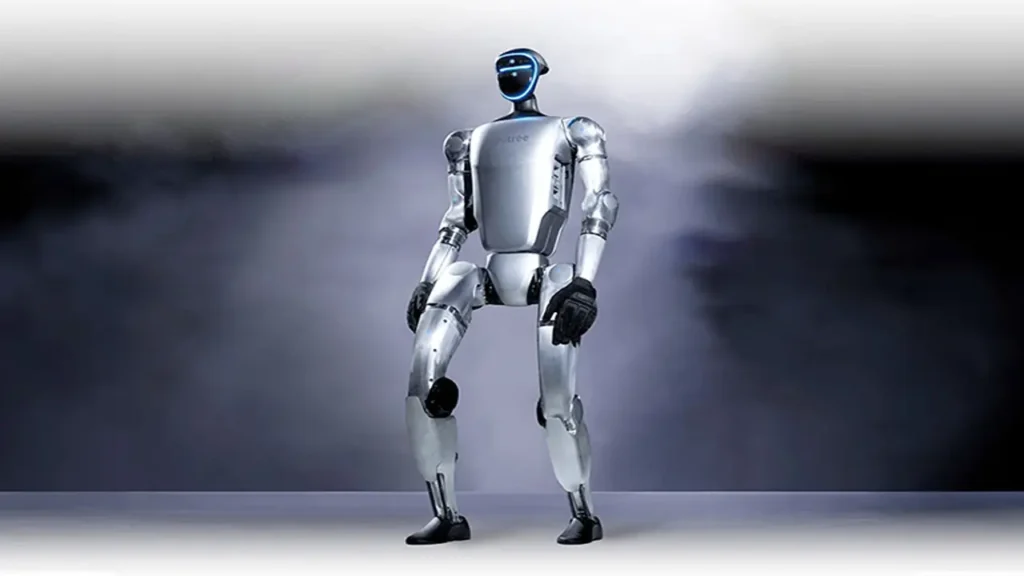
Unitree G1 Humanoid Robot — What Is It and Why Is Everyone Talking About It?
The Unitree G1 humanoid robot comes from Unitree Robotics, a Chinese company best known for their quadruped robots (the dog-like machines you’ve probably seen doing backflips on social media). When they announced the G1, they brought their experience in dynamic movement and cost-efficient manufacturing to the humanoid form factor.
Standing roughly 127 cm (about 4’2″) tall, the Unitree G1 humanoid robot is designed for research, development, and educational purposes. It’s not trying to be your butler or personal assistant—at least not yet. Instead, it’s aimed at:
- University research labs exploring bipedal locomotion and manipulation
- Robotics developers who want a platform for testing algorithms and AI
- Tech enthusiasts with deep pockets and a passion for cutting-edge hardware
- Companies investigating automation possibilities in controlled environments
The Unitree G1 humanoid robot sits in a sweet spot: sophisticated enough to be genuinely useful for development work, but (relatively) affordable enough that institutions and serious hobbyists can consider purchasing one.
Unitree G1 Humanoid Robot and Unitree G1 Price — How Much Does the “Entry Ticket” Cost?
Let’s talk numbers. The Unitree G1 price starts at approximately $16,000 USD for the base “EDU” version. That’s the stripped-down model without hands—basically a walking torso with arms that end in simple grippers.
If you want the full experience with dexterous hands (and trust me, you do—we’ll get to why later), the Unitree G1 price jumps to around $90,000-$100,000 USD. That’s a significant leap, but it reflects the complexity of those articulated hands.
Unitree G1 Product Tier Analysis
A technical comparison of the Humanoid G1 EDU vs. the Full dexterous assembly.
| Version | Price (USD) | Configuration Details |
|---|---|---|
| G1 EDU | ~$16,000 | Academic Base Entry-level humanoid base. Utilizes simple grippers instead of dexterous hands. Designed for core locomotion research and basic AI training. |
| G1 Full | ~$90k – $100k | Advanced Manipulation Complete high-performance system. Features multi-articulated dexterous hands and the full integrated sensor suite for complex object interaction. |
Why such a big price difference? Those dexterous hands aren’t just cosmetic—they’re incredibly complex pieces of engineering with multiple motors, sensors, and control systems. For many applications, they’re the difference between a walking mannequin and a useful manipulation platform.
The Unitree G1 price positions it as the “affordable” option compared to competitors like Boston Dynamics’ Atlas (not commercially available) or Agility Robotics’ Digit (which runs into six figures). It’s “affordable” in the same way a Tesla is “affordable” compared to a Bugatti—technically true, but still out of reach for most people.
Unitree G1 Humanoid Robot — Unitree G1 Specs in Plain English
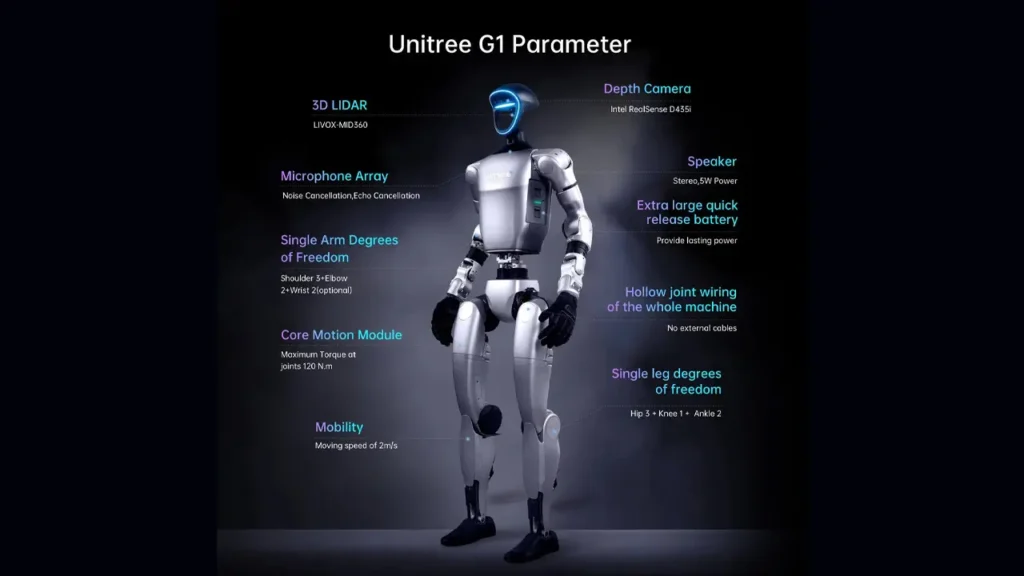
Let’s cut through the technical jargon and talk about what the Unitree G1 specs actually mean in practice.
Physical specs:
- Height: ~127 cm (4’2″)
- Weight: ~35 kg (77 lbs)
- Walking speed: Up to 2 m/s (about 4.5 mph)
The Unitree G1 humanoid robot is relatively compact and lightweight compared to industrial robots. This makes it easier to work with in lab settings and less dangerous if something goes wrong (a 35 kg robot falling is much better than a 100 kg one).
Sensors and perception:
- 3D LiDAR for spatial mapping
- Depth cameras for object recognition
- IMU (Inertial Measurement Unit) for balance
- Force sensors in joints for tactile feedback
These sensors let the Unitree G1 humanoid robot understand its environment. The LiDAR creates a 3D map of the space, the depth cameras help it recognize and track objects, and the force sensors give it a sense of “touch” so it doesn’t crush everything it picks up.
Battery and runtime:
- Approximately 2 hours of operation per charge (varies by activity)
- Swappable battery design for extended sessions
Two hours might not sound like much, but for research and development work, it’s usually enough for meaningful testing sessions. The swappable design means you can keep spare batteries charging and swap them out quickly.
Computing:
- Onboard computer for real-time control
- Support for external computing via high-speed connections
- Compatible with ROS (Robot Operating System) and other development frameworks
This is crucial for developers: the Unitree G1 humanoid robot works with industry-standard tools, so you’re not locked into proprietary software.
Unitree G1 Humanoid Robot — Unitree G1 Release Date and Why It Matters
The Unitree G1 release date was officially announced in May 2024, with units beginning to ship to customers by late summer 2024. But why does timing matter so much?
2024 was a watershed year for humanoid robotics. Tesla was showing off improvements to Optimus, Figure AI was demonstrating their Figure 01 in real work environments, and Boston Dynamics was teasing commercial applications for Atlas. The market was heating up, and Unitree jumped in with aggressive pricing and actual availability.
The Unitree G1 release date hit at the perfect moment when:
- AI capabilities (particularly vision and language models) were becoming robust enough to make humanoid control more practical
- Manufacturing costs were dropping thanks to better motors and sensors
- There was genuine industry interest in humanoid platforms for warehouses, manufacturing, and eventually service roles
Media coverage exploded because the Unitree G1 humanoid robot represented something tangible—not a concept or a controlled demo, but a product you could actually order. That shifted the conversation from “humanoids are coming someday” to “humanoids are here, and here’s what they cost.”
Unitree G1 Humanoid Robot — Caviar Aladdin Robot: The Luxury Version as Marketing Booster
Here’s where things get delightfully absurd. Caviar, a Russian luxury customization company known for gold-plating iPhones and making diamond-encrusted gadgets, decided to create the Caviar Aladdin robot—a luxury version of the Unitree G1 humanoid robot.
The Caviar Aladdin robot features:
- 18-karat gold plating on body panels
- Hand-applied gemstone decorations
- Custom engraving and artistic detailing
- A price tag rumored to be in the $200,000+ range
Does the gold plating make it work better? Absolutely not. Does it make the robot heavier and potentially mess with its center of gravity? Probably. Is it completely ridiculous? Totally.
But here’s the genius: the Caviar Aladdin robot went viral. Tech blogs, social media, mainstream news outlets—everyone covered it. Suddenly, people who had never heard of Unitree or the G1 were talking about humanoid robots. The luxury treatment made the technology feel simultaneously more real (if it’s expensive enough to gold-plate, it must be legitimate) and more accessible (if this is the fancy version, there must be a regular version I could learn about).
Caviar essentially gave Unitree millions of dollars in free marketing by making the Unitree G1 humanoid robot into a meme and a status symbol simultaneously.

Unitree G1 Humanoid Robot — Luxury Humanoid Robot: Who Actually Needs This?
Let’s be honest about the luxury humanoid robot market—it’s not about need, it’s about want. But there are actually some legitimate audiences:
Collectors and tech enthusiasts: Some people collect vintage computers, rare game consoles, or prototype hardware. A gold-plated robot fits perfectly in that world—it’s a conversation piece, an investment (maybe), and a statement about being on the cutting edge.
Luxury showrooms and brand experiences: High-end car dealers, jewelry stores, and fashion boutiques are increasingly using technology to create memorable customer experiences. A luxury humanoid robot like the Caviar Aladdin makes for incredible theater—imagine it greeting customers or showcasing products.
Corporate PR and marketing: Tech companies and innovation-focused brands might purchase a luxury humanoid robot for trade shows, conferences, or corporate lobbies. It’s a physical manifestation of “we’re investing in the future.”
Wealthy early adopters: There’s always a segment of the population that wants the newest, flashiest technology. These are the same people who bought $10,000 Google Glass or reserved Cybertruck Founders Series. For them, a luxury humanoid robot is the ultimate tech flex.
When a robot costs more than a luxury car, it’s no longer a tool—it’s a statement. And statements, as it turns out, can be very profitable.
Unitree G1 Humanoid Robot — Affordable Humanoid Robot: Where’s the Real “Affordability”?
Let’s get real about the affordable humanoid robot claim. The Unitree G1 humanoid robot is affordable relative to competitors, but it’s still expensive in absolute terms.
At $16,000 for the base model, it’s cheaper than:
- A used car in many markets
- A semester of college tuition in the US
- High-end industrial robot arms
- Other commercially available humanoid platforms
But it’s still more expensive than:
- Most people’s annual discretionary spending
- The entire computing budget for small research teams
- What most hobbyists can justify for a passion project
So who is the affordable humanoid robot actually affordable for?
Universities and research institutions: With grant funding and department budgets, $16,000-$90,000 is achievable for serious robotics programs. It’s a platform multiple researchers can use, and it justifies the investment.
Corporate R&D departments: Companies exploring automation or human-robot interaction can budget for units as part of feasibility studies.
Well-funded maker spaces and technical schools: Some community resources and vocational programs can pool resources for shared equipment.
Serious hobbyists with disposable income: Think software engineers, entrepreneurs, or tech professionals who make six figures and want a legitimate development platform.
The Unitree G1 humanoid robot opened the door from “only Google and MIT can afford this” to “if you’re serious and save up, you might manage it.” That’s meaningful progress, even if it’s not “impulse purchase at Best Buy” affordable yet.
Unitree G1 Humanoid Robot — Unitree G1 Dexterous Hand: The Hands Make All the Difference
Here’s a truth about robotics: locomotion is impressive, but manipulation is what makes robots useful. The Unitree G1 dexterous hand is why the full version costs so much more than the base model—and why it’s worth it.
The Unitree G1 dexterous hand features:
- Five fingers with multiple joints each
- Force sensing for gentle object handling
- Enough dexterity to manipulate tools, open doors, and handle fragile items
- Individual finger control for complex grasping strategies
Why does this matter so much? Consider what you can do with simple grippers versus articulated hands:
Simple grippers:
- Pick up regularly shaped objects
- Press buttons
- Hold tools (but not manipulate them skillfully)
Dexterous hands:
- Turn doorknobs and handles
- Manipulate objects while holding them
- Use human tools without modification
- Perform delicate tasks like plugging in cables
- Gesture and communicate non-verbally
The Unitree G1 dexterous hand transforms the robot from a mobile platform that can barely interact with the world to something that can potentially perform useful tasks in human environments. Those demonstrations you see of humanoid robots folding laundry, assembling products, or organizing shelves? They all depend on capable hands.
For researchers, the Unitree G1 dexterous hand is the difference between “I can study walking” and “I can study human-environment interaction.” That’s why it commands such a premium.
Unitree G1 Humanoid Robot — Unitree G1 23 DoF: Movement, Balance, and “Lifelikeness”
When roboticists talk about the Unitree G1 23 DoF, they’re referring to degrees of freedom—essentially, how many different ways the robot can move.
The Unitree G1 23 DoF breaks down roughly like this:
- 6 DoF per leg (hip, knee, ankle movements)
- 5+ DoF per arm (shoulder, elbow, wrist)
- Additional DoF in the torso and head
Humanoid Kinematics Analysis
A technical breakdown of Degrees of Freedom (DoF) and their associated operational capabilities.
| Body Segment | Degrees of Freedom | Functional Capability |
|---|---|---|
| Each Leg | ~6 DoF | Locomotion Enables bipedal walking, dynamic stair climbing, and autonomous balance recovery during external perturbations. |
| Each Arm | ~5-7 DoF | Manipulation Facilitates precise reaching, object manipulation within a wide workspace, and natural humanoid gesturing. |
| Torso / Waist | ~2-3 DoF | Articulation Supports bending, axial twisting, and dynamic weight shifting to stabilize the center of gravity during movement. |
| Head / Neck | ~2 DoF | Perception Allows for multi-directional situational awareness, object tracking, and sensor-to-target alignment. |
Why does the Unitree G1 23 DoF matter?
More degrees of freedom mean:
- More natural movement: The robot can shift its weight, bend, and move in ways that look and function more like human movement
- Better balance: More joints mean more ways to recover from disturbances and maintain stability
- Versatile manipulation: The robot can reach objects from different angles and adapt to complex tasks
- Efficient motion: Instead of the whole body moving rigidly, the Unitree G1 humanoid robot can make subtle adjustments
Compare this to earlier humanoid robots with 12-15 DoF, which often moved in stiff, mechanical ways. The Unitree G1 23 DoF allows for fluid, adaptive movement that’s more robust and capable.
For developers, more DoF means more control options and richer possibilities for AI and machine learning applications. You can teach the robot more complex behaviors because it has more ways to express those behaviors physically.
Unitree G1 Humanoid Robot — Humanoid Robot for Home: Should You Expect a “Home Helper” Anytime Soon?
Here’s the big question everyone really wants answered: is the humanoid robot for home use actually happening, or is it still science fiction?
The honest answer for 2025: it’s still early.
What the Unitree G1 humanoid robot can do today:
- Navigate structured environments with clear pathways
- Manipulate objects it’s been trained on
- Follow programmed routines reliably
- Serve as a development platform for researchers creating better home robot behaviors
What it can’t reliably do yet:
- Handle the chaos of a real home (kids, pets, unexpected messes)
- Adapt to completely novel situations without human intervention
- Operate safely around vulnerable people (elderly, children) without supervision
- Perform complex multi-step tasks like “clean the kitchen” autonomously
The humanoid robot for home vision is getting closer, but we’re still in the “early adopter” phase. Think of it like personal computers in the late 1970s—the technology exists, enthusiasts are excited, but it’s not ready for everyone’s grandmother.
Companies like Unitree are building the hardware foundation. The missing pieces are:
- Better AI for general-purpose tasks: Current systems excel at specific tasks but struggle with versatility
- Safety guarantees: Homes are unpredictable; robots need to be safe around people in all situations
- Cost reduction: Even at $16,000, the Unitree G1 humanoid robot is too expensive for most consumers
- User-friendly interfaces: Not everyone can program or train a robot; it needs to be as easy as using a smartphone
That said, we’re making real progress. Every year, these robots get smarter, cheaper, and more capable. Specialized applications—like eldercare in controlled facilities or warehouse assistance—are already happening. The fully autonomous home helper is probably 5-10 years away, but the foundation is being built right now.
So, where does the Unitree G1 humanoid robot actually stand?
It’s a legitimate, commercially available platform that’s pushing humanoid robotics forward by making the technology accessible to developers, researchers, and institutions. The pricing is “affordable” in the context of cutting-edge robotics, even if it’s still out of reach for casual consumers.
The Caviar Aladdin robot stunt might seem silly, but it served a purpose: it got people talking about humanoid robots who otherwise wouldn’t care. Sometimes, a little spectacle is what it takes to make real technology break through the noise.
Is the Unitree G1 humanoid robot ready to be your personal assistant? No. Is it a meaningful step toward that future? Absolutely. And for researchers and developers who want to be part of building that future, it’s one of the most accessible entry points available in 2025.
For updates, honest breakdowns of robotics tech, and a clear-eyed look at what’s real versus what’s hype, keep following the conversation at aiinovationhub.com—because the future of humanoid robots is being written right now, and it’s worth understanding what’s actually happening.
If you’re into humanoid robots, cybernetic upgrades, and the not-so-distant future where “human + machine” is a real category, don’t stop here. Explore our Cybernetic Humans section for more sharp, beginner-friendly breakdowns and fresh news: https://aiinovationhub.com/category/cybernetic-humans-aiinnovationhub/
Curious where home humanoid robots and embodied AI are heading next — beyond the hype and into real-life use? This guide breaks down the most promising “at-home” humanoids, what they can actually do today, and what’s still science fiction. Read it here: https://bestchinagadget.com/home-humanoid-robots-embodied-ai/