
Sarvam AI India is an emerging AI company building LLM and voice solutions for low resource languages and unstable internet markets.
1. Introduction: Why Sarvam AI India Is Trending in 2026
In a world dominated by Silicon Valley AI giants, Sarvam AI India has emerged as a refreshing alternative—a homegrown contender that’s rewriting the rules of artificial intelligence for the world’s most linguistically diverse nation. While ChatGPT and Gemini dominate headlines globally, Sarvam AI India is making waves in 2026 for a different reason: it’s building AI that actually understands India
Founded in August 2023 by Dr. Vivek Raghavan and Dr. Pratyush Kumar, this Bengaluru-based startup has quickly become one of the most talked-about emerging AI companies 2026. What sets Sarvam apart isn’t just ambitious promises—it’s real, measurable results. In February 2026, the company’s models reportedly outperformed Google’s Gemini and OpenAI’s ChatGPT on India-specific benchmarks, particularly in optical character recognition (OCR) for Indic scripts and multilingual voice interactions.
But Sarvam AI India isn’t just about beating global models at specific tasks. It represents a fundamental shift in how we think about AI development. Instead of adapting Western-centric models for Indian use, Sarvam is building from the ground up—creating solutions designed for India’s unique linguistic landscape, connectivity challenges, and cultural nuances. This approach has caught the attention of investors, government officials, and enterprises alike, positioning Sarvam AI India as a critical player in the nation’s sovereign AI ambitions.
As India’s digital infrastructure continues to expand and AI becomes increasingly central to economic growth, Sarvam AI India stands at the intersection of technology, policy, and social impact. This article explores what makes this emerging AI companies 2026 standout so compelling, from its technical architecture to its real-world applications and investment momentum.
2. What Is Sarvam AI India?
Sarvam AI India is more than just another Indian AI startup 2026—it’s a comprehensive “full-stack” AI platform purpose-built for India’s unique needs. The name “Sarvam” comes from Sanskrit, meaning “all,” reflecting the company’s mission to make AI accessible to everyone, regardless of language or location.
At its core, Sarvam focuses on three interconnected pillars: developing large language models optimized for Indian languages, creating voice-first AI interfaces that work in low-connectivity environments, and building enterprise-grade tools that businesses and governments can deploy at population scale. Unlike companies that simply translate or adapt global models, Sarvam trains its systems from scratch using India-specific datasets, ensuring they understand cultural references, code-switching between languages, regional idioms, and the practical realities of Indian communication.
The company’s founding team brings together complementary expertise. Dr. Pratyush Kumar, with a PhD from IIT Bombay, previously led AI4Bharat, a pioneering open-source initiative for Indian language AI. He spent years researching at IBM and Microsoft before deciding to build commercial solutions for India’s AI challenges. Dr. Vivek Raghavan, an IIT Delhi graduate with a PhD from Carnegie Mellon University, brings deep experience in building population-scale digital infrastructure. He volunteered with the Unique Identification Authority of India (UIDAI) for nearly 12 years, working on Aadhaar’s biometric systems—experience that proves invaluable when designing AI solutions for India’s 1.4 billion people.
This combination of academic research expertise and practical implementation experience at scale distinguishes Sarvam from other AI startups. The founders understand both the theoretical challenges of building robust AI systems and the real-world complexities of deploying them in diverse, resource-constrained environments. As an Indian AI startup 2026, Sarvam operates with a clear strategic advantage: intimate knowledge of the problems they’re solving and direct access to the markets they’re serving.
3. Sarvam AI LLM: Architecture and Capabilities
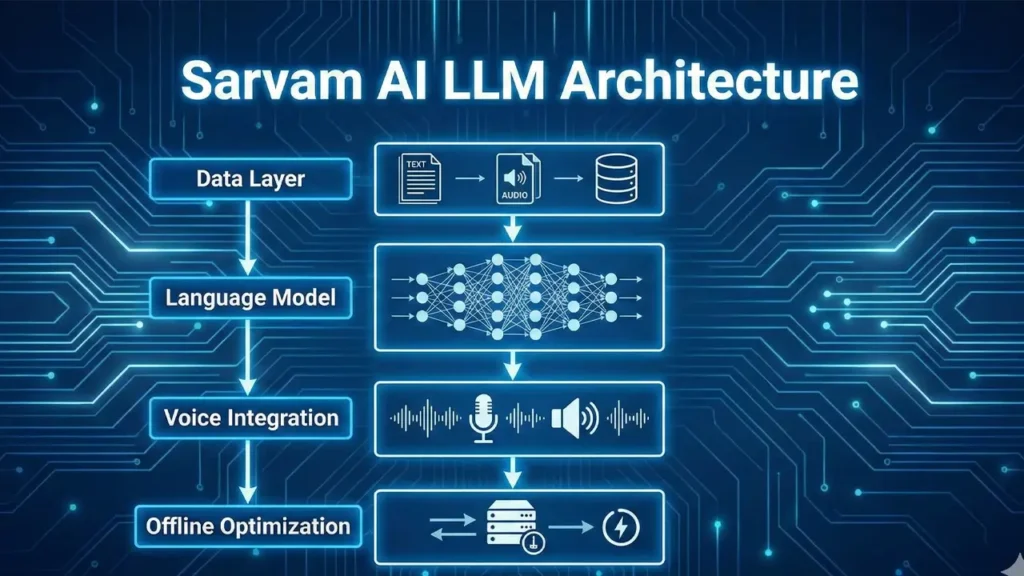
The Sarvam AI LLM represents a technical departure from typical large language model development. Instead of fine-tuning existing Western models for Indian languages—a common approach that often yields mediocre results—Sarvam builds models from the ground up with Indian linguistic realities baked into their architecture.
The company has released several model variants, each tailored for specific use cases. Sarvam-1, a 2 billion parameter model, demonstrated that smaller, focused models could outperform much larger general-purpose systems on Indian language tasks. Sarvam-M, a 24 billion parameter hybrid model built on top of Mistral Small, achieves new benchmarks across Indian languages, mathematics, and programming tasks for models of its size. This hybrid approach—starting with a strong foundation and expanding it with India-specific training—allows Sarvam to leverage global research while optimizing for local contexts.
What makes Sarvam AI LLM particularly interesting is its training methodology. The models undergo a two-phase training process: embedding alignment, which aligns randomly initialized Indic language embeddings, and bilingual language modeling, which teaches the model to attend cross-lingually across tokens. This approach enables the model to handle code-switching—when speakers seamlessly move between languages mid-sentence—which is extremely common in Indian communication but poorly handled by most global models.
The India large language model under development for the government’s IndiaAI Mission takes this further. Sarvam is building three variants: Sarvam-Large for advanced reasoning and generation tasks, Sarvam-Small for real-time interactive applications where latency matters, and Sarvam-Edge for compact on-device tasks that work even without internet connectivity. This multilingual AI model India architecture reflects a deep understanding that India’s AI needs aren’t monolithic—different use cases require different trade-offs between capability, speed, and resource consumption.
Beyond pure language understanding, Sarvam’s models excel at practical business tasks: parsing complex Indian documents with mixed scripts, understanding domain-specific terminology in finance, healthcare, and legal contexts, and maintaining consistent voice and personality across multiple languages. These capabilities make the multilingual AI model India particularly valuable for enterprises looking to serve diverse customer bases.
4. AI for Low Resource Languages: The Real Differentiator
The concept of AI for low resource languages sits at the heart of Sarvam’s competitive advantage. In AI research, “low resource” refers to languages with limited digital text data available for training models. While English has enormous datasets spanning decades of digitized content, many Indian languages have comparatively scarce digital resources—yet they’re spoken by hundreds of millions of people.
Sarvam approaches this challenge through multiple strategies. First, the company actively creates and curates datasets specifically for Indian contexts. In partnership with academic institutions like IIT Madras’s AI4Bharat initiative, Sarvam has developed samvaad—a series of richly curated Indian datasets featuring over 100,000 high-quality, multi-turn conversations (more than 700,000 turns) in English, Hindi, and Hinglish. These datasets capture authentic Indian communication patterns, including the colloquialisms, references, and conversational structures that global datasets miss.
Second, Sarvam’s AI for low resource languages strategy includes innovative training techniques that maximize learning from limited data. By leveraging transfer learning from high-resource languages while maintaining the unique characteristics of Indian languages, their models achieve strong performance without requiring the massive datasets that typically power Western AI systems.
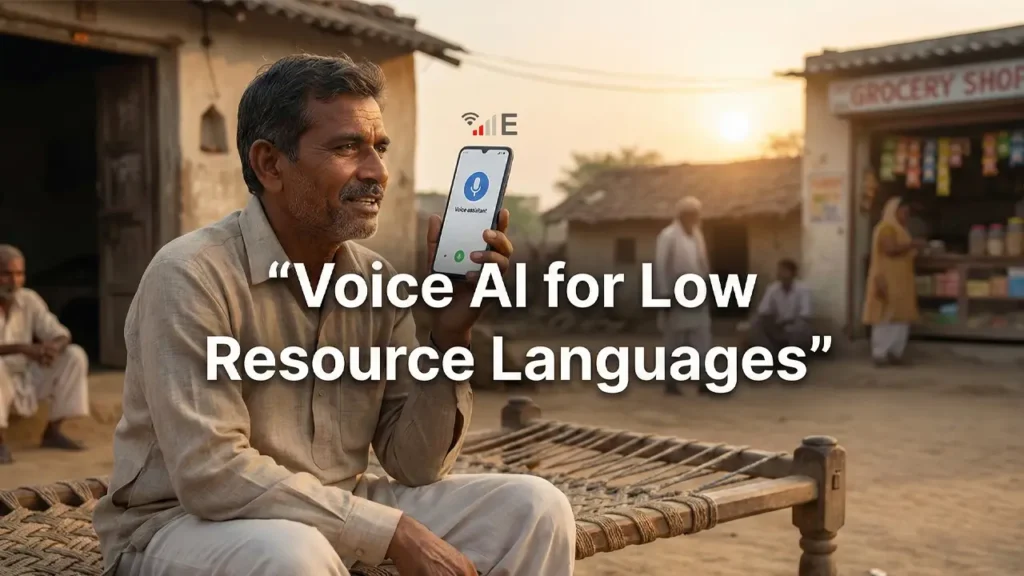
Third, the company focuses on voice as a primary modality. In a country where literacy rates vary significantly and English proficiency is limited, voice interfaces democratize access to technology. Sarvam’s voice models can understand diverse accents, handle background noise common in Indian environments, and process speech even when internet connectivity is poor—all critical factors for AI for low resource languages success in real-world deployments.
The implications extend beyond just supporting more languages. When AI systems truly understand low-resource languages, they enable entirely new categories of applications: government services that citizens can access in their native language, educational content that adapts to regional dialects, healthcare systems that don’t require English fluency, and financial services that reach underbanked populations who prefer voice interactions. This is where the AI for low resource languages work becomes transformative—it’s not just about technical capability, but about expanding opportunity and access.
Sarvam currently supports 11 languages across its platform: Hindi, Bengali, Tamil, Telugu, Gujarati, Kannada, Malayalam, Marathi, Punjabi, Odia, and English with Indian accents. Plans to expand to all 22 official Indian languages demonstrate the company’s commitment to comprehensive linguistic coverage.
5. Voice AI India: Solving Connectivity Problems
Voice AI India represents perhaps Sarvam’s most immediately impactful innovation. In a country where voice is the preferred mode of technology interaction for millions, particularly in rural and semi-urban areas, Sarvam’s voice AI India solutions address real-world constraints that global AI companies often overlook.
The flagship voice product, Bulbul V3, released in early 2026, showcases what’s possible when voice AI is built specifically for Indian contexts. Unlike typical text-to-speech systems that sound robotic or struggle with Indian names and terms, Bulbul V3 delivers natural, expressive voices across 11 languages. The system handles code-switching effortlessly—a conversation can start in Hindi, switch to English for technical terms, and include regional greetings, all within the same utterance while maintaining natural prosody and emotional tone.
What makes this voice AI India technology particularly clever is its architectural approach. Built on a language model foundation, Bulbul V3 analyzes text to infer prosodic elements—emphasis, pauses, tone, and pacing—based on context and intent rather than processing words as a simple sequence. This contextual understanding enables it to adjust delivery for different situations: professional and clear for business communications, warm and reassuring for customer service, energetic for marketing content, or calm and measured for educational materials.
The offline AI voice assistant capabilities represent Sarvam’s solution to India’s connectivity challenges. While urban India enjoys increasingly reliable internet access, rural and semi-urban areas—where hundreds of millions of people live—face intermittent connectivity, low bandwidth, and high latency. Global voice AI systems that require constant cloud connectivity simply don’t work in these environments. Sarvam’s offline AI voice assistant approaches this through edge computing strategies, allowing voice processing to happen locally on devices with minimal or no internet connection.
For enterprises, this offline AI voice assistant capability unlocks entirely new markets. A telecom company can deploy voice agents that help customers manage their accounts even in areas with poor network coverage. A financial services provider can offer voice-based account inquiries to gig workers who may not have consistent data plans. Educational technology companies can create offline-capable learning assistants for schools in remote areas. In each case, the voice AI India technology makes services accessible that would otherwise be impossible to deliver.
The Saaras v3 model handles the speech-to-text side, supporting both transcription (same-language output) and translation (English output) via mode parameters. This flexibility means a customer speaking Hindi can be understood by an English-based business system, or vice versa, enabling seamless multilingual interactions. Combined with Bulbul for the speech synthesis side, Sarvam offers a complete voice AI India stack that enterprises can integrate into existing systems.
Real-world deployments demonstrate the impact. Tata Capital uses Sarvam’s technology to scale personalized, multilingual conversations across consumer loan products, reaching customers in their preferred language while reducing costs. Call centers report significant improvements in customer satisfaction when deploying the voice AI India system because customers can interact naturally in their native language. Gig economy platforms use voice agents to onboard workers without requiring them to fill forms or download apps—just conversation.
Linguistic Precision Matrix
A technical assessment of Sarvam AI Bulbul V3 specializing in Indic-first voice synthesis vs global generalist TTS systems.
| Capability Area | Bulbul V3 (Indic-First) | Global TTS Architectures |
|---|---|---|
| Linguistic Breadth | Deep Coverage Native support for 11 Indian languages + English, optimized for regional syntax. |
Limited Indian language sets; primarily focused on major international dialects. |
| Code-Switching | Hinglish Native Seamless transitions between mixed-language speech (e.g., Hindi-English) without prosody breaks. |
Fragmented performance; significant errors in intonation during mid-sentence language shifts. |
| Accent Fidelity | Hyper-Local Recognition and synthesis of hyper-local Indian accents and speech patterns. |
Generic phonetic modeling; often results in “standardized” non-native sounding outputs. |
| Operational Locality | Edge Optimized Designed for high-performance edge computing and offline Indic-voice deployment. |
High connectivity dependency; primarily cloud-resident architectures. |
| Name Accuracy | Contextual Precision Highly accurate pronunciation of unique Indian names and regional geographic entities. |
Frequent mispronunciations due to lack of local phonetic corpus training. |
6. Comparison With US and Chinese Models
Understanding where Sarvam AI India stands relative to US and Chinese AI models requires moving beyond simplistic “better or worse” comparisons to examine specific dimensions of capability and suitability.
Global models from OpenAI, Anthropic, Google, and others excel at breadth—they’re trained on enormous, diverse datasets covering countless topics and languages. They handle complex reasoning, generate creative content, and solve problems across domains. However, this breadth comes with trade-offs. These models often struggle with Indic scripts, particularly in optical character recognition tasks involving low-quality scans, mixed scripts, and handwritten annotations common in Indian documents. They may miss cultural references or generate content that feels foreign to Indian users. Code-switching confuses them. Regional idioms get mangled. And crucially, their computational requirements and connectivity demands make them challenging to deploy in resource-constrained environments.
Chinese models like DeepSeek have made headlines with remarkably low-cost training approaches, demonstrating that compute efficiency matters as much as raw capability. This resonates with India’s context, where “frugal innovation” isn’t just philosophy but necessity. Chinese AI development also operates under sovereign data principles—keeping data and computation within national borders for security and regulatory compliance. India’s approach through initiatives like IndiaAI Mission reflects similar priorities.
Sarvam’s India large language model strategy borrows from both traditions while charting its own course. Like Chinese models, Sarvam emphasizes efficiency and sovereignty. The company’s models deliver strong performance at smaller parameter counts than comparable Western models, reducing computational costs and enabling deployment on less powerful hardware. Like leading US research, Sarvam pursues technical excellence and innovation, publishing research and contributing to open-source projects.
Where Sarvam distinguishes itself is domain specialization for India. In head-to-head comparisons on India-specific benchmarks, Sarvam’s Sarvam Vision outperforms general models at OCR tasks involving Indic scripts. Bulbul V3 delivers more natural-sounding speech in Indian languages than global text-to-speech systems. The company’s document intelligence models better handle the messy realities of Indian paperwork—mixed scripts, low-resolution scans, stamps, and handwritten fields.
This doesn’t mean Sarvam matches GPT-4 or Gemini across all tasks. For broad general knowledge, complex English-language reasoning, or creative writing in Western contexts, global models maintain advantages. But for enterprises serving Indian customers, government agencies delivering citizen services, or applications requiring Indian language fluency, Sarvam’s specialized approach offers superior results.
The emerging pattern suggests a multi-polar AI future. Rather than one or two models dominating globally, we’re likely to see ecosystem diversity: global general-purpose models for broad applications, regional specialized models like Sarvam for local contexts, and domain-specific models for particular industries. This diversity benefits users by providing more suitable tools for different needs while promoting competition and innovation.
Geopolitical AI Strategy Matrix
Comparative analysis of architectural specialization, regional performance, and data governance frameworks.
| Dimension | Sarvam AI (India) | US (OpenAI / Google) | China (DeepSeek / Baidu) |
|---|---|---|---|
| Indic Performance | Excellent Native training on Indic-first linguistic corpus. | Good Broad but often translated/limited coverage. | Limited Minor secondary priority in training. |
| Compute Efficiency | High Surgically optimized for cost-effective inference. | Moderate Scaling-law focused; highly resource intensive. | Very High Innovative MoE architectures for frugality. |
| Data Sovereignty | Absolute Local infrastructure; strict India residency. | Limited Global SaaS clouds; jurisdictional complexity. | Full Sovereign China-based data ecosystems. |
| Knowledge Breadth | Focused Optimized for regional/India-specific domains. | Superior Vast global training sets and cross-domain logic. | Good Strong global coverage with cultural filters. |
| Edge Support | Excellent Optimized for low-connectivity/offline use. | Poor Architecturally dependent on cloud latency. | Moderate Strong on mobile; less focus on rural edge. |
7. Investment Momentum: AI Investment India 2026
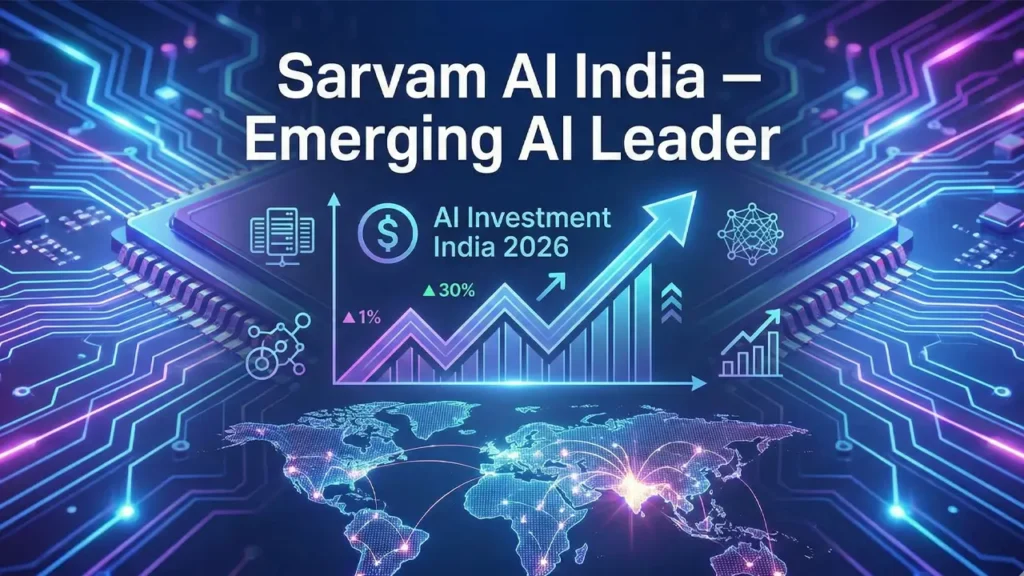
The story of AI investment India 2026 surrounding Sarvam illustrates both the company’s trajectory and the broader momentum in India’s AI ecosystem. In December 2023, just months after founding, Sarvam raised $41 million in Series A funding—one of the largest early-stage rounds for an Indian AI startup at that time. The round was led by Lightspeed Venture Partners, with participation from Peak XV Partners (formerly Sequoia Capital India) and Khosla Ventures.
This investor lineup is significant. Vinod Khosla, a pioneer in Silicon Valley AI investments who backed OpenAI early, saw in Sarvam the potential for India to develop “deep expertise for building AI in and for India.” Hemant Mohapatra from Lightspeed, having backed some of the most influential generative AI companies globally, recognized Sarvam’s unique approach combining model innovation with application development for population-scale solutions.
By August 2025, Sarvam had raised additional funding, bringing total capital to approximately $53.8 million across multiple rounds. More importantly, the company’s valuation reached ₹1,720 crore (approximately $206 million), according to public filings—remarkable growth for a company less than two years old.
However, the most significant “investment” came not from venture capital but from the Indian government. In April 2025, when Sarvam was selected as the first startup under the IndiaAI Mission to build India’s sovereign large language model, it gained access to ₹247 crore (approximately $30 million) worth of GPU computing resources—4,000 GPUs for six months. This represents not just financial support but strategic validation and access to compute infrastructure that would be prohibitively expensive for most startups to purchase outright.
The AI investment India 2026 momentum extends beyond Sarvam’s direct funding. In January 2026, the company signed a memorandum of understanding with Tamil Nadu to establish India’s first full-stack Sovereign AI Park—a project involving ₹10,000 crore (approximately $1.2 billion) in investment over five years. While Sarvam will bring the investment through various partners, the state will provide land and necessary support. Days later, in February 2026, Odisha signed a similar MoU with Sarvam involving $2.3 billion for a Sovereign AI Capacity Hub hosting around 25,000 GPUs.
These massive infrastructure projects represent a shift in how India approaches AI development. Rather than relying solely on cloud services from global providers, states are building sovereign compute capacity—data centers physically located in India, owned by Indian entities, and subject to Indian regulations. Sarvam’s role as the anchor tenant and technology partner for these facilities positions it at the center of India’s AI infrastructure buildout.
For investors, this creates compelling dynamics. Sarvam has government backing, access to compute infrastructure that gives it cost advantages over competitors, partnerships with leading enterprises, and positioning as the default Indian AI provider for sensitive government and corporate applications requiring data sovereignty. These factors contributed to the company’s rapid valuation growth and continue to attract AI investment India 2026 interest.
The broader context matters too. India’s venture capital ecosystem has increasingly focused on deep tech and AI infrastructure, recognizing that consumer internet opportunities are maturing while foundational technology investments offer long-term strategic value. Global investors see India as the next major AI market and are positioning early. Domestic investors view supporting homegrown AI capabilities as both commercially and strategically important.
8. Why Investors Call It One of the Top Emerging AI Companies 2026
When investors describe Sarvam as among the top emerging AI companies 2026, they’re evaluating several factors beyond just technology quality. Understanding these investment theses illuminates what makes Sarvam compelling from a business and strategic perspective.
First, market timing and positioning. Sarvam entered the market at an inflection point when India’s digital infrastructure was mature enough to support AI applications at scale, but before the market became crowded with well-funded competitors. The company’s early momentum and government selection gave it advantages in mindshare and access to resources that later entrants will struggle to match. As one of the first serious Indian AI startups focused on indigenous models rather than just deploying global ones, Sarvam established thought leadership and attracted top talent.
Second, the founders’ credibility and execution track record. Dr. Kumar’s leadership of AI4Bharat demonstrated his ability to build influential open-source projects and mobilize academic communities. Dr. Raghavan’s work on Aadhaar proved he could navigate complex government partnerships and build systems serving hundreds of millions of users. Together, they’ve assembled a team that investors describe as “among the highest caliber AI teams” emerging from India. In AI startups, where talent is the primary constraint, this matters enormously.
Third, the business model diversity. Unlike pure research companies or single-product startups, Sarvam operates across multiple revenue streams: enterprise API subscriptions, custom model development for specific clients, government contracts, and increasingly, infrastructure services through the Sovereign AI Parks. This diversification reduces risk while creating multiple paths to scale. Investors appreciate that if one revenue stream underperforms, others can compensate.
Fourth, the strategic alignment with national priorities. India’s government has made sovereign AI capabilities a priority under the IndiaAI Mission, committing ₹10,370 crore ($1.3 billion) to building indigenous AI infrastructure and capabilities. Sarvam’s selection as the first startup to receive support isn’t just validation—it’s a strategic position that virtually guarantees continued government backing and preferential access to resources. For investors, this reduces policy risk and creates near-term revenue visibility through government contracts.
Fifth, the practical go-to-market traction. Sarvam isn’t just building impressive technology demos—it’s deploying production systems serving real users. The UIDAI partnership processes Aadhaar transactions for over a billion residents. Tata Capital uses Sarvam’s multilingual AI for customer interactions across its loan portfolio. These deployments prove that the technology works in real-world conditions, at scale, with stringent reliability and compliance requirements. Investors view this operational maturity as exceptional for such a young company.
Sixth, the competitive moat. Sarvam’s focus on Indian languages and contexts creates natural defensibility. Global AI companies can build products for India, but doing so requires significant investment in data collection, model training, and market understanding—investments that may not justify returns compared to their primary markets. Meanwhile, Sarvam’s deep expertise in Indian languages, cultural contexts, and regulatory requirements would be difficult for competitors to replicate quickly. This “local knowledge” moat protects the business even against well-funded rivals.
Finally, the strategic optionality. While Sarvam initially focused on enterprise and government customers, the underlying technology platform enables expansion into consumer applications, developer tools, and even becoming an infrastructure provider as the Sovereign AI Parks come online. Investors appreciate businesses with multiple strategic options, as they can pivot toward the highest-value opportunities as markets evolve.
Industry analysts have noted Sarvam’s approach represents a significant shift toward AI inclusivity and accessibility in non-English speaking markets. The company fills an important gap by prioritizing linguistic diversity and creating AI tools that work for people regardless of language. This mission-driven aspect, combined with strong commercial traction, makes Sarvam particularly attractive to investors who value both impact and returns. It’s this combination—strong technology, experienced team, market traction, government support, and clear strategic positioning—that elevates Sarvam to the top tier of emerging AI companies 2026.
9. Use Cases: Government, Telecom, Rural Markets
The true test of any AI company lies not in laboratory benchmarks but in real-world deployments serving actual users. Sarvam AI India has accumulated an impressive portfolio of use cases spanning government services, telecommunications, financial services, and rural markets—deployments that demonstrate both the technology’s capabilities and its practical value.
Government and Public Sector Applications
The partnership with UIDAI (Unique Identification Authority of India) represents Sarvam’s most prominent government deployment. Beginning in March 2025, Sarvam deployed an AI-powered voice interaction system within UIDAI’s air-gapped infrastructure to enhance Aadhaar services. The system performs voice-based interactions with residents in 10 Indian languages for enrollment and update processes, providing near real-time feedback including alerts about potential overcharging or irregular practices.
Crucially, the system also delivers real-time fraud alerts. If suspicious authentication activity is detected—for example, someone attempting to use another person’s Aadhaar credentials—the legitimate Aadhaar holder receives an immediate voice notification in their preferred language. This proactive fraud prevention represents a significant improvement over traditional alert systems that often go unnoticed.
The technical implementation showcases Sarvam’s understanding of government requirements. The entire AI stack runs on-premise within UIDAI’s secure environment—no data leaves the facility at any stage. This air-gapped deployment ensures complete data sovereignty and compliance with India’s stringent privacy regulations. For a system handling biometric and personal data of over a billion citizens, such security measures are non-negotiable.
Beyond UIDAI, state governments are deploying Sarvam’s technology for citizen services. Voice-based systems help residents check the status of government schemes, understand eligibility requirements, and file complaints—all without needing to navigate complex websites or wait in long queues at government offices. In rural and tribal areas where literacy rates are lower and smartphone adoption varies, voice interfaces make government services accessible to citizens who might otherwise struggle to interact with digital systems.
Telecommunications Sector
Telecom companies face unique challenges in India: serving customers across multiple languages, managing high call volumes with cost constraints, and providing support in areas with varying connectivity quality. Sarvam’s multilingual AI model India solutions address these challenges directly.
A major telecom provider deployed Sarvam’s voice AI for customer support, enabling customers to check their balance, understand plan details, resolve billing questions, and troubleshoot basic technical issues through natural language conversations in their preferred language. The system handles code-switching seamlessly—a customer might say, “Mera balance kitna hai aur next recharge kab due hai?” (What’s my balance and when is my next recharge due?), mixing Hindi and English naturally.
The economics prove compelling. Voice AI agents handle routine inquiries at a fraction of the cost of human agents while maintaining consistent quality and 24/7 availability. This allows human agents to focus on complex issues requiring empathy and judgment. Customer satisfaction metrics showed improvement because interactions felt more natural than navigating through menu trees or struggling with chatbots that couldn’t understand regional accents.
For gig economy platforms that telecom companies increasingly partner with, Sarvam’s offline AI voice assistant capabilities enable onboarding workers even in areas with poor connectivity. A delivery partner can register, complete verification, and start working through voice interactions—no forms, no app downloads, no waiting for customer service. This voice-first approach dramatically reduces onboarding friction and expands the addressable workforce.
Financial Services and Banking
Tata Capital’s deployment illustrates how financial services companies leverage Sarvam’s technology for customer acquisition and retention. The company embedded multilingual interactions across its consumer loan products, enabling personalized conversations about loan eligibility, application status, payment reminders, and financial guidance in customers’ native languages.
The impact extends beyond language support. By making financial services accessible in regional languages, Tata Capital reaches customers who might feel intimidated by English-language banking systems or struggle to understand complex financial terms. A Tamil-speaking customer in Chennai can discuss loan options in Tamil, while a Marathi-speaking customer in Pune gets the same quality of service in Marathi. This linguistic inclusivity breaks down barriers to financial access.
For rural banking, where physical branch presence is limited and internet connectivity can be unreliable, Sarvam’s offline AI voice assistant technology enables basic banking services through voice-based mobile applications. Customers can check account balances, transfer money to contacts, or receive payment reminders through voice interactions that work even with minimal data connectivity. This addresses the “last-mile” problem in financial inclusion—reaching customers who have mobile phones but limited digital literacy or reliable internet access.
Rural Markets and Agricultural Applications
Rural markets represent both enormous opportunity and unique challenges. Sarvam’s AI for low resource languages capabilities particularly shine in these contexts. Agricultural information systems built on Sarvam’s technology deliver crop advice, weather updates, and market prices to farmers in local languages and dialects. A farmer in Punjab can ask questions about wheat cultivation in Punjabi and receive responses based on local conditions, while a cotton farmer in Maharashtra gets information in Marathi tailored to the region’s growing season.
Educational applications leverage voice AI to support students in regional medium schools. An AI tutoring system can explain concepts in Telugu or Kannada, answer questions, and adapt to individual learning paces—all crucial capabilities in areas where qualified teachers may be scarce and students’ primary language isn’t English. The offline capability means schools without reliable internet can still benefit from AI-enhanced learning.
Healthcare applications enable preliminary consultations and health information access in rural areas through voice interfaces. A person can describe symptoms in their local language and receive information about potential conditions, when to seek medical attention, and nearby healthcare facilities—all without needing to speak English or navigate complex medical terminology.
Industrial Implementation Matrix
A multi-sector technical overview of Sarvam AI deployments across governmental, commercial, and social sectors.
| Market Sector | Enterprise Use Case | Systemic Benefit | Core Technology Stack |
|---|---|---|---|
| Government | UIDAI: Real-time Aadhaar fraud alerts and enrollment verification feedback. | Localized fraud prevention architecture serving 10+ languages simultaneously. | Voice AI On-Premise Infrastructure |
| Finance | Tata Capital: Multilingual customer lifecycle management and loan processing. | Dramatically increased customer reach and engagement through regional linguistic optimization. | LLM Orchestration Conversational AI |
| Telecom | 24/7 Voice-based customer resolution and automated support systems. | Significant OpEx reduction through 24/7 autonomous support with native code-switching. | Bulbul V3 Voice AI Code-Switching Logic |
| Agriculture | Disseminating crop diagnostics and real-time market data to rural farmers. | Democratic access to critical information in vernacular languages via low-bandwidth channels. | Voice Assistant Offline-First Compute |
| Education | Regional language AI tutoring and personalized learning support modules. | Personalized pedagogy delivered in the student’s native tongue for better retention. | Multilingual LLM TTS Synthesis |
These deployments share common threads: they prioritize accessibility over sophistication, focus on solving real problems rather than showcasing technical capabilities, and recognize that effective AI for Indian markets must work within India’s infrastructure realities—including intermittent connectivity, device constraints, and linguistic diversity. This practical, problem-solving orientation distinguishes Sarvam’s approach and explains its traction across diverse sectors.
10. Conclusion: Can Sarvam AI India Become a Global AI Brand?
As we look at Sarvam AI India’s trajectory from its 2023 founding to its position in early 2026, a compelling question emerges: can this Indian AI startup 2026 become a truly global AI brand, or will it remain primarily a domestic player?
The case for global expansion rests on several foundations. First, Sarvam’s core expertise—building AI for linguistically diverse, resource-constrained environments—transfers to other markets. Countries across Southeast Asia, Africa, and Latin America face similar challenges: multiple languages, limited digital resources, connectivity constraints, and needs for local cultural understanding. The techniques Sarvam developed for Indian languages could apply to Bahasa Indonesia, Swahili, or Spanish regional dialects. The offline capabilities matter as much in rural Philippines or Kenya as in rural India.
Second, as global enterprises seek to serve non-English markets more effectively, Sarvam’s approach offers a template. Rather than force-fitting Western AI models, companies could leverage Sarvam’s methods to build truly localized solutions. This consulting and technology licensing opportunity could enable global expansion without requiring Sarvam to directly serve every market.
Third, the “sovereign AI” concept resonates globally. As countries increasingly recognize AI as strategic infrastructure requiring domestic control, demand for non-US, non-Chinese AI capabilities will grow. Sarvam, positioned as India’s leading indigenous AI provider, could partner with governments and enterprises in other nations seeking to develop their own AI capabilities while avoiding dependence on major power technology stacks.
However, significant challenges constrain global ambitions. Sarvam’s competitive advantages—deep knowledge of Indian languages, government relationships, local infrastructure partnerships—don’t automatically transfer to other markets. Building similar depth in other countries requires time, investment, and local partnerships. The company’s focus on Indian contexts, while a domestic advantage, could limit global appeal if systems can’t adapt effectively to other cultural and linguistic contexts.
Moreover, the capital requirements for global expansion would be substantial. Competing internationally means facing OpenAI, Google, and Anthropic on broader turf where their advantages in resources, brand recognition, and existing customer relationships matter more. Sarvam’s efficiency and specialization work well in focused markets but may not provide sufficient differentiation in global general-purpose AI competitions.
The more likely scenario—and perhaps the more strategically sound one—involves Sarvam becoming an exemplar of regional AI excellence rather than attempting to replicate global players’ strategies. Success might look like: dominating the Indian and broader South Asian market, establishing technology partnerships with AI companies in other emerging markets, contributing foundational research that global AI development builds upon, and demonstrating that specialized regional models can coexist with and complement global general-purpose systems.
This path forward aligns with Sarvam’s fundamental mission: making AI accessible and valuable to all. For India’s 1.4 billion people and the hundreds of millions in neighboring countries, accessible means working in their languages, understanding their contexts, and functioning within their infrastructure realities. If Sarvam achieves this goal—building AI that truly works for India rather than adapting foreign systems—it will have created enormous value, regardless of whether the Sarvam brand becomes household worldwide.
The company’s trajectory through early 2026 suggests it’s executing well on this vision. Government selection as the sovereign LLM provider, enterprise traction across key sectors, infrastructure partnerships through AI Parks, and continued technical innovation all indicate strong momentum. The question isn’t whether Sarvam AI India will succeed—the evidence suggests it already is succeeding at its core mission. The question is how that success scales and whether the company maintains its focus on depth in its primary market or attempts broader but potentially shallower global expansion.
For investors, customers, and partners, the bet on Sarvam AI India represents more than just financial returns or technology access. It’s a bet on a different model of AI development—one that puts local needs first, builds capabilities from the ground up rather than adapting foreign systems, and recognizes that effective AI isn’t one-size-fits-all. As India continues its digital transformation and AI becomes increasingly central to economic development, Sarvam AI India stands positioned to play a defining role in ensuring that transformation serves all Indians, regardless of language, location, or connectivity.
The emerging AI companies 2026 landscape includes players with various strategies: some chase the frontier of capability, others focus on cost efficiency, still others pursue specific vertical applications. Sarvam’s distinction lies in its commitment to inclusion—ensuring AI benefits reach beyond English-speaking urban elites to encompass the linguistic and economic diversity that defines India. If the company maintains this focus while continuing to innovate technically and execute operationally, it won’t just be one of the emerging AI companies 2026 to watch—it will be a model for how AI development can serve populations that global technology often overlooks.
Whether Sarvam AI India becomes a global brand may matter less than whether it achieves its stated mission: making AI accessible to all. For the hundreds of millions of Indians who prefer Hindi to English, Tamil to Hindi, or any of the nation’s other languages; for the rural residents with intermittent connectivity; for the government services seeking to reach every citizen—Sarvam’s success in building genuinely inclusive AI technology represents progress that matters far beyond quarterly metrics or valuation multiples. That’s the real measure of whether this Indian AI startup 2026 succeeds: not market share or brand recognition, but whether India’s AI future works for everyone. On that dimension, Sarvam AI India’s trajectory suggests an answer: it’s working.
If you’re tracking global tech innovation, it’s worth watching not only AI breakthroughs but also next-gen devices coming from China. From smart gadgets to cutting-edge electronics, trends move fast. Explore the latest releases, reviews, and tech insights here: https://bestchinagadget.com/ — innovation never sleeps.