
1. Introduction: What Is Mistral Codestral Mamba 7B?
If you’ve been keeping an eye on the world of AI coding tools, you’ve probably noticed that the space has been evolving at breakneck speed. Every few months, a new model emerges claiming to be the best, fastest, or smartest at helping developers write code. But every once in a while, something genuinely different shows up — something that doesn’t just improve on what came before, but actually changes the rules of the game.
That’s exactly what Mistral AI pulled off when it introduced Mistral Codestral Mamba 7B. Released on July 16, 2024, this model isn’t just another fine-tuned code generator. It’s built on a fundamentally different architecture — one that challenges the dominance of the Transformer, the model type that has powered nearly every major AI breakthrough over the last several years.
So what exactly is Mistral Codestral Mamba 7B? In simple terms, it is an ai coding model from Mistral AI built specifically for code generation and code productivity tasks, powered by the Mamba2 architecture rather than the traditional Transformer approach. It is a Mamba2 language model specialised in code generation, available under an Apache 2.0 license, and was designed with help from two of the leading researchers in the field, Albert Gu and Tri Dao.
What makes this exciting isn’t just the technical novelty — it’s what that novelty means for developers in the real world. Faster responses. Smarter handling of long files. A model that can realistically run on local hardware. And all of it open source, free to use, modify, and distribute. If you’re a developer, a researcher, or just someone curious about where AI coding tools are heading, Codestral Mamba 7B deserves your full attention.

2. Overview of the Mistral AI Codestral Model
To understand where Codestral Mamba fits, it helps to know a little about Mistral AI itself. Founded in 2023 and headquartered in Paris, Mistral AI quickly established itself as one of the most technically ambitious companies in the open-source AI landscape. Their early models — particularly Mistral 7B and the Mixtral family — demonstrated that you don’t need a massive parameter count to get top-tier performance. Efficient, well-trained models can punch well above their weight.
The mistral ai codestral model family was born from this philosophy. The original Codestral 22B was Mistral’s first model dedicated specifically to code generation, supporting over 80 programming languages. It quickly earned a reputation as one of the most capable code-generation models available in its class.
But Mistral didn’t stop there. Following the publishing of the Mixtral family, Codestral Mamba is another step in Mistral’s ongoing effort to study and provide entirely new AI architectures. The Mamba variant is positioned differently from Codestral 22B — it’s smaller, faster, and designed with a strong focus on local deployment and real-time code assistance. Think of it as a highly optimized tool for the day-to-day work of writing and debugging code, rather than a heavyweight model reserved for the most demanding reasoning tasks.
Codestral Mamba 7B was made available simultaneously through Mistral’s la Plateforme API under the identifier codestral-mamba-2407, so developers could test it immediately without any infrastructure setup. It was also released with raw weights downloadable from HuggingFace, and support for deployment via the mistral-inference SDK and TensorRT-LLM. This dual availability — cloud API plus local weights — reflects Mistral’s commitment to making powerful models accessible to everyone, from individual developers to larger research teams.
BestChina3DPrinters
Expert Reviews & Rankings
Independent 3D Printer Reviews
Your trusted source for Chinese 3D printer reviews, rankings, and comparisons. We buy, test, and review every printer so you can make informed decisions.
3. Architecture: Mamba Architecture AI Explained
Here’s where things get genuinely interesting. To understand why Codestral Mamba 7B is different, you need to understand its underlying architecture. The mamba architecture ai is not a variation of the Transformer — it’s an alternative to it, rooted in a branch of mathematics and control theory called State Space Models, or SSMs.
A State Space Model is a mathematical framework that describes how a system transitions between states over time. In the context of language modeling, the “state” represents a compressed summary of all the context the model has processed so far. Rather than looking at every previous token the way a Transformer does, an SSM maintains a compact hidden state that gets updated as new tokens come in.
The Mamba architecture, first introduced by Tri Dao and Albert Gu in their 2023 paper “Mamba: Linear-Time Sequence Modeling with Selective State Spaces,” made SSMs practical for language modeling by introducing a key innovation: selective state spaces. The model can selectively decide what information to retain in its hidden state and what to discard, based on the content of the input. This makes it far more intelligent than earlier recurrent models that simply processed tokens one by one without any content-based filtering.
Mamba2, the version used in Codestral Mamba 7B, refines the original Mamba architecture further. According to the research paper “Transformers are SSMs: Generalized Models and Efficient Algorithms Through Structured State Space Duality,” authored by Tri Dao and Albert Gu, the Mamba-2 core layer is a refinement of Mamba’s selective SSM that is 2 to 8 times faster, while continuing to be competitive with Transformers on language modeling.
What makes Codestral Mamba’s architecture particularly powerful is the combination of Mamba2 layers with selective attention layers — a hybrid design. Pure Mamba handles long-range sequence modeling with great efficiency, while the attention components ensure that precise, fine-grained token-level relationships are captured when needed. This combination gives Codestral Mamba 7B the best of both worlds: the speed and memory efficiency of SSMs, paired with the expressive power of attention for complex reasoning tasks in code.
4. Mamba vs Transformer AI: Key Differences
To truly appreciate what Codestral Mamba 7B offers, it’s worth doing a side-by-side comparison of mamba vs transformer ai. This isn’t just an academic exercise — the differences have very real consequences for how the model feels to use in practice.
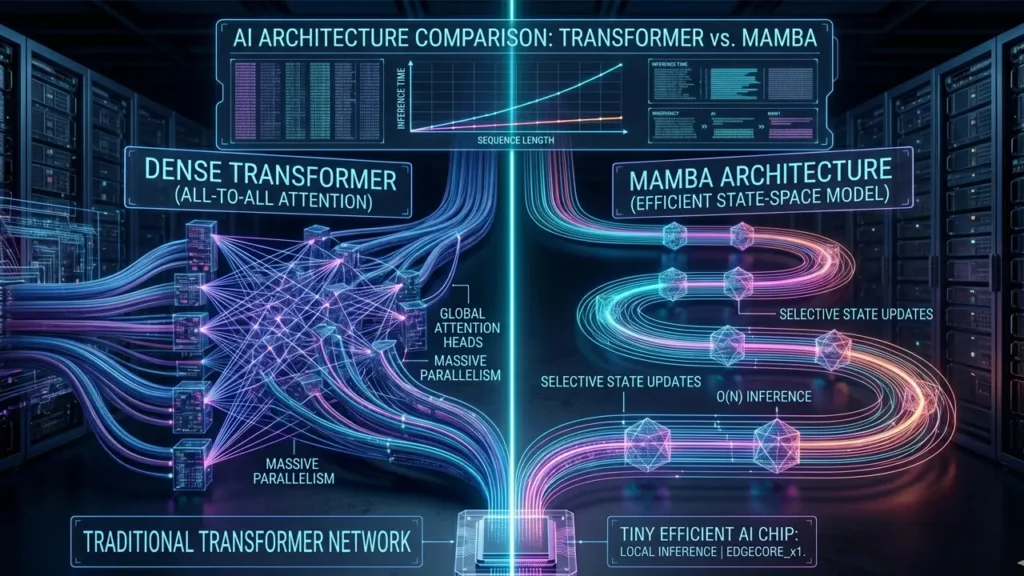
Transformers work by computing attention across all tokens in the input at every step. Every token can look back at every previous token to build its representation. This is extraordinarily powerful, but it comes with a significant computational cost: the complexity scales quadratically with sequence length. Double the input length, and the computation required quadruples. This is known as the “quadratic bottleneck,” and it’s one of the primary reasons why Transformer-based models struggle with very long contexts without expensive hardware.
Mamba, by contrast, processes sequences through a hidden state that is updated linearly — one step at a time, with O(n) complexity. It doesn’t need to recompute relationships between all previous tokens every time a new one arrives. It simply updates its compact state and moves on. This makes inference dramatically faster, especially as sequences get longer.
Here is a clear comparison of the two architectures:
Architectural Efficiency Matrix
Analyzing the strategic shift from quadratic Transformer bottlenecks to Linear State-Space Models (SSM). Evaluating memory persistence, sequence fidelity, and operational ROI for frontier AI systems.
| Technical Pillar | Standard Transformer | Mamba (SSM / Linear) |
|---|---|---|
| Computational Complexity | ||
|
Inference Scaling
|
$O(n^2)$
Quadratic Bottleneck
|
$O(n)$
Linear Efficiency
|
| Memory Architecture | ||
| Memory Footprint |
Context-Dependent Large KV Cache Overhead
|
Fixed-Size State Constant Hidden State
|
| Long Sequence IQ | Memory Limited | Theoretically Unlimited |
| Inference & Throughput | ||
| Throughput ROI |
Baseline Velocity
|
5x Faster
Sub-quadratic Advantage
|
| Training Logic |
Fully Parallelizable
|
Parallelizable (Mamba-2)
|
| Cognitive Profile | ||
| Reasoning Type |
Excellent
Full Attention Matrix
|
Competitive
Selective State Spaces
|
Mamba (SSM)
Linear complexity allows for theoretically infinite sequences with fixed-size hidden states, perfectly optimized for edge deployment.
Standard Transformer
Industry standard for high-fidelity reasoning, but constrained by quadratic memory growth as context windows expand.
The bottom line is that Transformers are excellent at precise, global attention across a fixed window, while Mamba excels at efficiently processing very long sequences with consistent speed regardless of how long the input gets. For coding tasks — where files can be long, context accumulates quickly, and response latency matters — this is a meaningful difference.
5. Linear Inference AI Model — What Does It Actually Mean for You?
The phrase “linear inference” might sound like a technical footnote, but understanding it reveals why Codestral Mamba 7B is such a practical tool for real-world coding. As a linear inference ai model, Codestral Mamba processes tokens at a speed that remains consistent regardless of how much context has accumulated.
Think about what this means in practice. Imagine you’re working on a large codebase — a project with thousands of lines spread across multiple files. With a Transformer-based model, as your conversation or context grows longer, each response takes progressively more memory and computation to generate. At some point, the model either slows to a crawl, starts hallucinating because it’s running out of effective context window, or simply refuses to process the full input.
With Mamba’s linear inference, none of that happens in the same way. The model maintains a compact, fixed-size hidden state that summarizes all the context it has processed. It doesn’t need to re-examine every previous token every time it generates a new one. The result is that response time stays stable and fast, whether you’re sending 1,000 tokens or 100,000 tokens.
Mistral has tested Codestral Mamba on in-context retrieval tasks up to 256,000 tokens — a context window that is double that of OpenAI’s GPT-4o at the time of Codestral Mamba’s release. This means it can technically hold an enormous amount of code, documentation, and conversation history in context while still responding quickly.
For code productivity specifically, this is transformative. Auto-completion becomes snappier. Code review of large files becomes feasible locally. Long refactoring sessions don’t bog down. The model stays responsive even when you’re deep in a complex, multi-file project. That’s the practical promise of linear inference, and Codestral Mamba delivers on it.
6. Codestral Mamba Performance and Benchmarks
Let’s talk numbers. codestral mamba performance across standard industry benchmarks is genuinely impressive, especially considering the model’s 7B parameter size. In the AI world, larger models typically win benchmark competitions — so when a 7B model starts competing with or outperforming models that are 3 to 5 times its size, that’s worth paying attention to.
The primary benchmark used to evaluate code generation models is HumanEval, which tests a model’s ability to write functionally correct Python code given a natural language problem description. Here is how Codestral Mamba 7B performs according to official Mistral AI data:
Coding Intelligence Audit
Analyzing the performance delta of Codestral Mamba across core programming benchmarks. Evaluating Python reasoning (HumanEval), general logic (MBPP), and SQL synthesis (Spider).
| Model Identity | HumanEval (Python) | MBPP (Logic) | Spider (SQL) |
|---|---|---|---|
|
Codestral Mamba
7B Leader
|
75.0%
|
68.5%
|
58.8%
|
|
DeepSeek v1.5 7B
|
65.9%
|
70.8%
|
— |
|
CodeGemma 1.1 7B
|
61.0%
|
67.7%
|
— |
| CodeLlama 34B |
31.1%
|
— | — |
| Codestral 22B |
81.1%
Sovereign Performance Ceiling (HumanEval)
|
||
Codestral Mamba
Dominating the 7B class with 75% Python fidelity, nearly matching models 3x its size in reasoning complexity.
DeepSeek v1.5 7B
CodeGemma 7B
The codestral mamba benchmark results tell a clear story. At 75.0% on HumanEval, Codestral Mamba 7B outperforms models like CodeGemma 1.1 7B, CodeLlama 7B, and even the much larger CodeLlama 34B. It also beats DeepSeek v1.5 7B on the key HumanEval Python test. The only model in this comparison that scores higher is Codestral 22B — a model that is over three times larger in parameter count.
Beyond Python, the model also shows strong performance in HumanEval C++ and HumanEval Bash, demonstrating that its coding capabilities generalize well across languages and paradigms. The Spider SQL benchmark score of 58.8% further shows competence in database-related tasks, making it useful not just for application development but also for data engineering and analytics workflows.
In real-world use cases, the model excels at a broad range of tasks: generating HTML, CSS, and JavaScript snippets for web development; writing efficient Python code for data manipulation and machine learning; providing design pattern boilerplate in Java and C++; and assisting with debugging across multiple languages.
7. Open Source Coding AI Model: Accessibility and Impact
One of the most significant aspects of Codestral Mamba 7B is that it is a fully open source coding ai model released under the Apache 2.0 license. This isn’t a marketing headline — it has real, practical implications for the developer community.
Apache 2.0 is one of the most permissive open-source licenses available. It means anyone can download the model weights, use them for any purpose (including commercial applications), modify them, and redistribute them — all without paying licensing fees. There are no usage restrictions based on revenue, team size, or industry. This stands in contrast to many other high-performing code models that are either closed-source, API-only, or restricted by non-commercial licenses.
For individual developers, this means you can run Codestral Mamba 7B entirely on your own machine. For companies, it means you can deploy it internally without worrying about data leaving your infrastructure. For researchers, it means you can study the model’s behavior, fine-tune it on specialized codebases, and publish findings freely.
The model supports multiple deployment paths to accommodate different technical setups. It can be deployed using the mistral-inference SDK, which is optimized to work with Mamba models and leverages the reference implementation from the official Mamba GitHub repository. It is also compatible with TensorRT-LLM for high-performance inference on NVIDIA hardware. Additionally, support for llama.cpp — the popular library for running LLMs on consumer hardware — was planned and subsequently rolled out, making local inference accessible to developers without high-end server GPUs.
For hardware requirements, Mistral and the broader community suggest NVIDIA RTX A6000 as a starting point, with NVIDIA L40 or A100 recommended for smooth inference, and NVIDIA H100 for fine-tuning. While these are professional-grade GPUs, they are far more attainable than what would be required to run a 70B or 100B+ parameter model with equivalent performance.
The open-source availability of Codestral Mamba 7B has already begun influencing the broader AI landscape. It demonstrated to the community that Mamba-based models can be competitive with Transformer models for specialized tasks, accelerating research into SSM architectures. According to IBM, models like Codestral Mamba are part of a growing wave of Mamba-based and hybrid models — including AI2’s Jamba series and IBM Granite 4.0 — that are democratizing AI access by running on comparatively inexpensive hardware.
8. AI Code Generation Model 2025: Trends and Context
Zooming out a little, where does Codestral Mamba 7B fit in the broader landscape of ai code generation model 2025 developments? The short answer is that it represents one of the clearest examples of a trend that is reshaping the field: the shift toward specialized, efficient models optimized for specific tasks rather than general-purpose giants.
For years, the prevailing assumption in AI was that bigger always meant better. Models with 70B, 100B, or even larger parameter counts commanded the leaderboards, while smaller models were seen as compromise solutions for users with limited resources. Codestral Mamba 7B challenges this assumption directly. A 7B model with the right architecture and training focus can outperform 34B models on the tasks that matter most.
This trend toward specialization is accelerating across the industry. We’re seeing dedicated models for mathematics, biology, law, finance, and of course software development. The logic is straightforward: a model that is trained intensively on code-related data, with an architecture optimized for the patterns present in code — long-range dependencies, precise syntax, structured logic — will serve developers better than a general-purpose model that knows a little about everything.
The architectural innovation embodied by Codestral Mamba 7B — the Mamba2 foundation — is also gaining momentum as a research direction. The theoretical possibility of modeling sequences of infinite length, combined with linear inference that stays fast regardless of context size, is increasingly important as developers work with larger codebases, longer conversations with AI assistants, and more complex multi-file projects.
Looking ahead, the AI code generation market is expected to continue growing rapidly. GitHub Copilot, Amazon CodeWhisperer, and other tools powered by Transformer models have already shown massive adoption. The next wave of tools — built on more efficient architectures like Mamba, or hybrid combinations of Mamba and Attention — will likely bring those capabilities to a broader range of hardware and use cases, lowering the barrier to AI-assisted development even further.
Codestral Mamba 7B is, in this sense, not just a product — it’s a signal of where the field is heading.

9. Advantages and Disadvantages of Mistral AI New Model Codestral
No technology is perfect, and the mistral ai new model codestral mamba is no exception. Let’s take an honest look at both the strengths and limitations.
Advantages:
The most compelling advantage is speed. Linear inference means the model stays fast even when handling long inputs, which is a genuine daily quality-of-life improvement for developers using it as a coding assistant. You don’t notice performance degradation as your context window fills up.
The 256K context window is extraordinary for a 7B model. The ability to feed in an entire large file, a long conversation history, or multiple related code snippets simultaneously gives it a meaningful edge over competitors with more restricted context windows.
Open-source availability under Apache 2.0 is a major practical benefit. Full freedom to use, modify, deploy, and build commercial products on top of Codestral Mamba 7B is something that many competing models simply do not offer.
Benchmark performance is excellent for its size class. Beating models 3 to 5 times its parameter count on HumanEval is a significant achievement, and it means that in many real-world coding workflows, Codestral Mamba 7B is genuinely competitive with much larger — and more expensive — alternatives.
The model is well-suited for local deployment, which is important for privacy-conscious developers and organizations that cannot send code to external APIs.
Disadvantages:
Codestral Mamba 7B is not without limitations. The most significant is that it still falls behind Codestral 22B on several benchmarks. For the most demanding code generation tasks — complex architectural reasoning, highly nuanced code review, or advanced algorithmic challenges — the larger model simply has more capacity.
Hardware requirements, while lower than very large models, are still meaningful. Running this model well on truly consumer-level hardware (like a laptop GPU) remains a challenge, even though local deployment on workstation-class GPUs is quite feasible.
Because it is based on a newer architecture that is less widely used than Transformers, the ecosystem of tools, integrations, and community support — while growing rapidly — is still less mature. Developers who want to fine-tune or extensively customize the model may encounter more friction than with Transformer-based alternatives.
It is also worth noting that Mistral has announced a retirement date for this specific model version (open-codestral-mamba v0.1) of June 6, 2025, with Codestral listed as the recommended replacement going forward. This doesn’t diminish its current usefulness, but it’s worth keeping in mind for long-term deployment planning.
10. Conclusion: Should You Use Mistral Codestral Mamba 7B?
So, after all that, is mistral codestral mamba 7b worth using? The honest answer is: it depends on your specific situation — but for a surprisingly wide range of developers, the answer is a clear yes.
If you are a developer who wants a fast, capable, open-source code assistant that you can run locally or access through an API, Codestral Mamba 7B is one of the strongest options available at its size class. Its benchmark performance is genuinely impressive, its linear inference makes it feel responsive even with long contexts, and its Apache 2.0 license means there are essentially no restrictions on how you use it.
If you are a researcher interested in exploring non-Transformer architectures for language and code modeling, Codestral Mamba 7B is an invaluable reference point. It demonstrates that Mamba2-based models can compete seriously with Transformer models on real-world coding tasks, and having open weights available for study and fine-tuning is enormously valuable.
If you are an organization that needs to keep code private and cannot route queries through external APIs, Codestral Mamba 7B’s local deployment capability — and its relatively modest hardware requirements compared to larger models — make it an attractive option.
The one scenario where you might want to consider alternatives is if you need the absolute highest possible performance on the most complex coding and reasoning tasks, without any concern for speed or cost. In that case, the larger Codestral 22B or other frontier-scale models will serve you better.
But for the vast majority of everyday coding workflows — writing functions, generating boilerplate, debugging snippets, exploring APIs, working with SQL, drafting tests — Codestral Mamba 7B is more than capable. It is fast, smart, open, and genuinely innovative. It represents Mistral AI at their best: pushing the boundaries of what’s possible with efficient, purpose-built models, and then giving the results to the world for free.
The future of AI code generation is not just about building bigger models. It’s about building smarter, faster, and more accessible ones. Mistral Codestral Mamba 7B is a compelling proof of concept for exactly that vision.
🇬🇧 English
This article on Mistral Codestral Mamba 7B is incredibly insightful. The explanations are clear, even for beginners, and the breakdown of the hybrid architecture is easy to follow. I especially liked how the site keeps things simple but still professional. Definitely bookmarking aiinovationhub.com for future AI updates.
🇪🇸 Español
El artículo sobre Mistral Codestral Mamba 7B es muy interesante y fácil de entender. Me gustó cómo explican conceptos complejos de forma sencilla. El sitio aiinovationhub.com tiene contenido de calidad y actualizado. Sin duda volveré para leer más sobre inteligencia artificial.
🇸🇦 العربية
مقال رائع حول نموذج Mistral Codestral Mamba 7B. الشرح بسيط وواضح حتى لغير المتخصصين، وهذا ما أعجبني كثيرًا. موقع aiinovationhub.com يقدم محتوى احترافي ومفيد عن الذكاء الاصطناعي. أنصح بمتابعته باستمرار.
🇨🇳 中文
关于 Mistral Codestral Mamba 7B 的文章非常专业,同时也很容易理解。作者很好地解释了复杂的 AI 架构。aiinovationhub.com 是一个值得关注的网站,内容新颖且实用,我会继续阅读更多内容。
🇫🇷 Français
Un excellent article sur Mistral Codestral Mamba 7B. Les explications sont claires et bien structurées, même pour les débutants. Le site aiinovationhub.com propose du contenu de qualité sur l’intelligence artificielle. Je recommande vivement.
🇩🇪 Deutsch
Ein sehr informativer Artikel über Mistral Codestral Mamba 7B. Die Inhalte sind verständlich und gut erklärt. Besonders gefällt mir der moderne Stil von aiinovationhub.com. Ich werde die Seite definitiv weiter verfolgen.