
What Is MiniMax M2.5 AI Model?
The MiniMax M2.5 AI model is the latest flagship large language model from MiniMax, a Shanghai-based AI company founded in 2021. Released on February 12, 2026, it was built under one clear mandate: real-world productivity. MiniMax currently serves over 212 million individual users and more than 100,000 enterprise clients worldwide, and counts Alibaba, Tencent, Sequoia China, and Hillhouse Capital among its investors.
M2.5 is not simply a chatbot upgrade. MiniMax describes it as a “digital employee” — a model designed for sustained, autonomous work. According to the official MiniMax release, the company already runs 30% of all internal tasks autonomously using M2.5, and 80% of newly committed code is generated by the model. The MiniMax M2.5 AI model is open-weight and available on Hugging Face under a modified MIT License, making it one of the most accessible frontier-tier models ever released.
2. MiniMax M2.5 AI Model Architecture Explained
The MiniMax AI architecture is based on a Mixture-of-Experts (MoE) design. Total parameter count is 230 billion, but only 10 billion parameters are activated per forward pass — roughly 4% of the total. This means the MiniMax M2.5 AI model reasons like a large model while inferring at the speed and cost of a much smaller one.
Training relied on a purpose-built reinforcement learning framework called Forge. Unlike traditional supervised learning on static datasets, Forge deploys the model into live environments — real code repositories, browsers, office applications, and API endpoints — and trains it by measuring real outcomes. Over training, MiniMax exposed M2.5 to more than 200,000 real-world environments.
A key algorithmic innovation inside Forge is CISPO (Clipping Importance Sampling Policy Optimization), which MiniMax developed to keep the model stable during intense reinforcement learning — achieving a 2x speedup over the previous DAPO algorithm. Forge also introduces a decoupling layer between the training-inference engine and agent scaffolding, allowing MiniMax to swap different agent frameworks without retraining from scratch.
One fascinating behavioral outcome is what MiniMax calls the Architect Mindset: the MiniMax M2.5 AI model naturally learned to plan before it codes — decomposing features, designing structure, and drafting a UI plan before writing a single line, mirroring the behavior of a senior software architect. The context window is 200,000 tokens, enabling very large codebases, lengthy legal documents, and complex multi-step research within a single session.
3. MiniMax M2.5 Capabilities and Core Features
The MiniMax M2.5 capabilities are organized around four pillars MiniMax identifies as the most economically valuable AI tasks of 2026.
Coding. Trained across 13+ languages — Python, TypeScript, Go, Rust, Java, C, C++, Kotlin, JavaScript, PHP, Lua, Dart, Ruby — in 200,000+ real environments, the MiniMax M2.5 AI model handles the full development lifecycle: 0-to-1 system design, environment setup, database architecture, feature iteration, API development, code review, and testing. Supported platforms include Web, Android, iOS, and Windows.
Search and Tool Calling. On BrowseComp — OpenAI’s complex web research benchmark — M2.5 scores 76.3% (with context management). On the BFCL multi-turn subset, MiniMax reports 76.8%. Compared to its predecessor M2.1, the MiniMax M2.5 AI model solves agentic tasks using approximately 20% fewer search rounds, indicating more efficient reasoning paths.
Office Work. Developed in collaboration with senior professionals in finance, law, and social sciences, M2.5 can generate professional Word documents, PowerPoint presentations, and Excel financial models. In internal GDPval-MM evaluations, it achieved an average win rate of 59.0% against mainstream competing models.
Speed. The Lightning variant generates output at a native 100 tokens per second — roughly twice the speed of other frontier models. When running SWE-Bench Verified evaluations, the MiniMax M2.5 AI model completes tasks in an average of 22.8 minutes, a 37% improvement over M2.1, matching Claude Opus 4.6 at only 10% of its cost per task.
4. MiniMax M2.5 Performance Benchmark Results
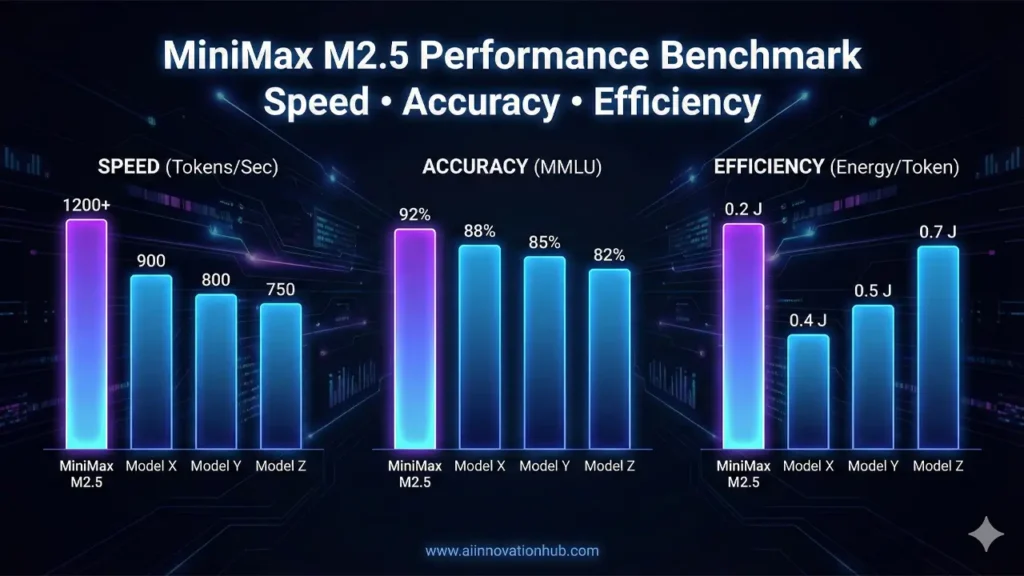
The MiniMax M2.5 performance benchmark data gives a clear picture of where it stands in early 2026. On the Artificial Analysis Intelligence Index — a composite of nine evaluations spanning reasoning, knowledge, math, and coding — M2.5 scores 42/100, well above the open-weight model median of 26.
Gemini 2.5 Intelligence Matrix
A technical audit of frontier capabilities across software engineering, reasoning, and multimodal efficiency benchmarks.
| Benchmark Cluster | Measured Result | Competitive Context & Notes |
|---|---|---|
| SWE-Bench Verified |
80.2% SOTA Leadership |
State-of-the-art performance in autonomous software engineering; establishes parity with Claude 3.7 / 4.x frontier. |
| Multi-SWE-Bench |
51.3% Global Rank #1 |
Ranked first globally at release for cross-file software troubleshooting and logic. |
| BrowseComp | 76.3% | Web-navigation and task completion efficiency utilizing native context management. |
| BFCL Multi-turn | 76.8% | Berkeley Function Calling Leaderboard; indicates superior accuracy in tool-use and API orchestration. |
| Office Win Rate | 59.0% | GDPval-MM; comparative win rate against mainstream models in enterprise office productivity tasks. |
| AA Intelligence Index | 42 / 100 | Artificial Analysis Index. Significant lead over open-weight median score of 26. |
| Output Throughput |
Standard: 54 t/s Lightning: 100 t/s |
Measured via independent audit. High-efficiency inference for real-time agentic workflows. |
| Context Window | 200k Tokens | Official specification for Gemini 2.5 Flash; optimized for long-form data retrieval. |
On the OpenHands Index — covering issue resolution, greenfield development, frontend work, testing, and information gathering — the MiniMax M2.5 AI model ranked 4th overall globally, with OpenHands describing it as “the first open model to exceed Claude Sonnet on their recent tests.”
5. MiniMax M2.5 vs GPT: Real Comparison
The MiniMax M2.5 vs GPT comparison reveals striking differences in both capability and economics. On coding benchmarks, M2.5 competes directly with GPT-5.2 Codex while being dramatically less expensive.
Strategic Intelligence Matrix
A comparative assessment of open-weight frontier architectures vs. proprietary hyperscale systems.
| Dimension | MiniMax M2.5 | GPT-5 (Frontier Tier) |
|---|---|---|
| Architecture |
230B MoE 10B active parameters per token. Optimization Lead |
Undisclosed. Speculated Dense Transformer scaling. |
| Weight Access |
Open Weights Modified MIT License. |
Proprietary / Closed SaaS. |
| Context Window | 200,000 Tokens | 128,000 Tokens (Baseline) |
| Efficiency / Cost |
$1.20 / M tokens (Standard) Competitive pricing for scale. |
Significantly higher at frontier tier. Premium enterprise margins. |
| SWE-Bench |
80.2% Verified State-of-the-art coding logic. |
Competitive at frontier level. (Proprietary benchmarks) |
| Deployment |
Self-hosting available. Full infrastructure sovereignty. |
Cloud API / Managed Only. |
| Training Logic |
Forge RL Iterative real-world environments. |
RLHF + Massive Supervised Scaling. |
| Agentic ROI |
~$1.00 / hour (Lightning) High-frequency (100 t/s) throughput. |
Substantially higher cost per unit of agentic throughput. |
Where the MiniMax M2.5 AI model clearly wins is cost-efficiency and openness. Self-hosting via vLLM or SGLang eliminates API fees entirely. GPT models remain proprietary, requiring API access at significantly higher per-token costs. For organizations running 24/7 autonomous agents, this cost difference is transformative. Where GPT-class models still lead is the broader ecosystem of plugins, enterprise support, and general multimodal maturity.
6. MiniMax Multimodal Model: Text, Image & Beyond
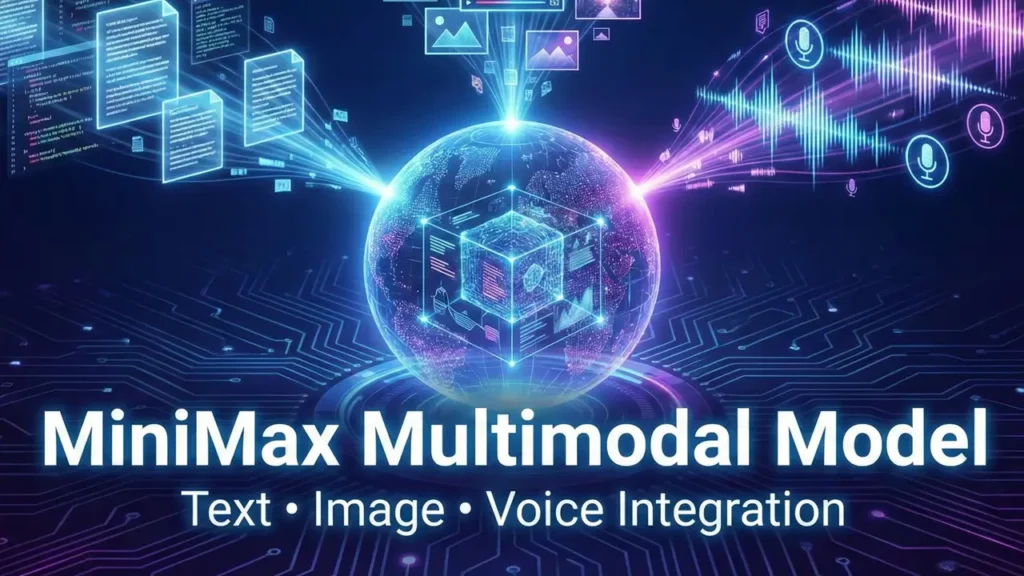
When discussing the MiniMax multimodal model ecosystem, it is important to distinguish between M2.5 as a language model and MiniMax’s broader Hailuo AI platform. MiniMax has achieved what it calls “full-modality capabilities” — ranking first globally in audio generation, second in video generation, and in the first echelon for text as of 2025.
The Hailuo AI platform integrates the M-series text models with dedicated audio and video generation systems. Users can generate full-length music tracks with vocals, create high-resolution AI video from text prompts, engage in near-zero-latency voice conversation, and work through an all-in-one assistant powered by the MiniMax M2.5 AI model.
Within the MiniMax Agent interface, M2.5 acts as the orchestration layer — deciding autonomously when to call the video tool, when to invoke the audio generator, and how to synthesize results into a final deliverable. For developers building standalone multimodal apps, MiniMax’s API platform provides separate access to text and multimedia models, giving full compositional flexibility.
7. MiniMax M2.5 Use Cases in 2026
The practical MiniMax M2.5 use cases span a wide range of industries. Because the MiniMax M2.5 AI model was trained in real-world environments, its strengths are especially pronounced in tasks requiring sustained, multi-step autonomous execution.
Software Development. M2.5 handles full-stack project development from initial architecture through deployment, across 13+ languages and environments. Via OpenHands Cloud, developers can run M2.5 free of charge during the introductory period — an ideal entry point for AI-assisted software teams.
Legal and Financial Document Work. Collaboration with senior legal and financial professionals during training gives M2.5 the ability to generate deliverable-quality legal briefs, Excel financial models, investment memos, and compliance reports — not just text drafts.
Enterprise Research and Intelligence. A BrowseComp score of 76.3% means the MiniMax M2.5 AI model can autonomously navigate complex, multi-site research requiring information synthesis across dozens of web pages — valuable for competitive intelligence, due diligence, and market research.
Autonomous AI Agents. At $1 per hour of continuous operation, running M2.5 agents 24/7 becomes economically feasible at scale. Four instances running continuously for a full year cost approximately $10,000 — a figure that redefines what persistent business automation looks like.
HR and Operations Automation. MiniMax itself uses M2.5 to screen resumes, analyze online data, and process user feedback at scale — practical, high-volume operational tasks where M2.5’s speed and cost efficiency shine most.
8. MiniMax AI for Business Applications
The business case for MiniMax AI for business rests on three pillars: frontier-competitive performance, open-weight flexibility for custom deployment, and a cost structure that enables true scale.
MiniMax’s own internal deployment is the most compelling case study. With 30% of company tasks completed autonomously and 80% of code generated by M2.5, the company is demonstrating real workload reduction at the highest level of technical complexity. MiniMax frames this as the beginning of an “AI-native organization” model for enterprise.
Two deployment paths are available for businesses. The first is the managed API at platform.minimax.io, with no infrastructure overhead. The second is self-hosting: the model weights on Hugging Face allow organizations to run the MiniMax M2.5 AI model on their own GPU infrastructure via SGLang or vLLM, keeping proprietary data entirely in-house.
A Coding Plan subscription is also available for teams wanting predictable monthly expenditure. The MiniMax Agent platform (agent.minimax.io) provides a no-code-friendly interface with two modes: Lightning Mode for fast conversational tasks, and Pro Mode for deep, long-running projects like full-stack development or comprehensive research reports.
9. MiniMax M2.5 API Access and Integration
Getting started with MiniMax M2.5 API access is straightforward. The official platform is at platform.minimax.io, where developers find documentation, API keys, and a reference implementation. A particularly developer-friendly detail: MiniMax’s API follows the Anthropic Messages API format, meaning teams already using Claude via the Anthropic SDK can often switch to MiniMax M2.5 with minimal code changes.
Inference Modality Matrix
A technical guide to accessing MiniMax M2.5 through managed endpoints, specialized agent clouds, or sovereign self-hosting.
| Deployment Method | Technical Access Point | Strategic Fit & Utility |
|---|---|---|
|
Managed SaaS Managed API |
platform.minimax.io
|
Zero-friction implementation. Ideal for rapid prototyping and production scale without GPU overhead. |
|
Agent Cloud OpenHands Cloud |
OpenHands Platform
|
Purpose-built for autonomous software engineering agents and iterative code troubleshooting. |
|
Sovereign Infra vLLM Self-Hosted |
Hugging Face Weights
|
Maximum data privacy and architectural control. Optimized for specialized internal infrastructure. |
|
Sovereign Infra SGLang Self-Hosted |
Hugging Face Weights
|
Optimized for massive parallel throughput and high-concurrency enterprise inference requirements. |
|
No-Code Interface MiniMax Agent UI |
agent.minimax.io
|
Optimized for business productivity and no-code prompt engineering workflows. |
The MiniMax M2.5 API supports prompt caching on both Standard and Lightning variants, reducing costs for applications that reuse system prompts across many calls — a common pattern in agent pipelines. The model identifier is minimax-m2.5.
10. MiniMax AI Pricing and Final Verdict
The MiniMax AI pricing model is one of the most aggressive in the frontier tier. MiniMax offers two API variants, identical in capability but different in speed:
Inference Economics Matrix
A comparative analysis of unit costs, throughput benchmarks, and estimated hourly operating expenses for M2.5 variants.
| Model Variant | Max Throughput | Input / 1M Tokens | Output / 1M Tokens | Est. Hourly ROI |
|---|---|---|---|---|
|
M2.5-Lightning High Performance |
100 t/s | $0.30 | $2.40 |
~$1.00 / hr Full Saturation |
|
M2.5 Standard Balance / Logic |
50 t/s | $0.15 | $1.20 |
~$0.30 / hr Full Saturation |
Based on output pricing, M2.5 costs one-tenth to one-twentieth of Claude Opus 4.6, Google Gemini 3 Pro, and GPT-5 frontier variants. Four M2.5-Lightning instances running continuously for an entire year cost roughly $10,000 — a figure that would buy only hours of equivalent proprietary frontier compute.
Final verdict. The MiniMax M2.5 AI model is one of the most significant open-weight releases in AI history. It delivers benchmark-competitive performance on coding, search, and agentic tasks — matching or approaching the top proprietary models from Anthropic, Google, and OpenAI — while available at a cost that makes continuous, large-scale autonomous deployment economically feasible for the first time. Its MoE architecture is elegant: 230 billion total parameters for broad knowledge, 10 billion activated per inference for speed and cost control. The Forge RL training framework, built on real-world environments, gives the MiniMax M2.5 AI model a practical robustness that benchmark numbers alone don’t fully capture. For developers and enterprises in 2026, it is an immediate, strong contender.
If you’re exploring advanced AI models and next-generation technologies, it’s only logical to look at the hardware shaping innovation too. From smart automation to rapid prototyping, 3D printing plays a massive role. Discover powerful, affordable machines and expert insights at https://bestchina3dprinters.com/ and see how ideas become real products faster than ever.
Fancy a punt? I checked out 88phatbet and reckon it’s worth a look. Decent odds, and the interface isn’t completely rubbish. Nice one!