
1. Introduction: FLUX.1 Krea Image Generation Model
If you’ve been following the AI image generation space lately, you’ve probably noticed one name popping up again and again: FLUX.1 Krea. This model arrived in mid-2025 and immediately made waves — not just because of its technical specifications, but because of a bold and opinionated vision: to create AI images that simply don’t look like AI images.
FLUX.1 Krea [dev] is a state-of-the-art open-weights model for text-to-image generation that was specifically designed to overcome the oversaturated “AI look” and achieve new levels of photorealism with a distinctive aesthetic approach. That’s a big claim — but as we’ll explore throughout this article, it largely delivers on that promise.
So why is everyone talking about the FLUX.1 Krea AI model? There are three main reasons. First, because it is genuinely different from most models currently on the market. Second, because it is open-source, meaning developers, artists, and researchers can run it locally, fine-tune it, and integrate it into their own creative pipelines. And third, because it represents a meaningful collaboration between two well-respected players in the AI world: Black Forest Labs and Krea AI.
Whether you are a digital artist looking to upgrade your workflow, a developer building creative tools, or simply someone curious about what the best AI image generator 2026 has to offer — this guide is for you. Let’s dive in.

2. What Is FLUX.1 Krea AI Model?
The Developers Behind the Model
FLUX.1 Krea [dev] — also referred to as flux-krea — is the open-weights version of Krea 1, the first proprietary image model developed in a close research collaboration between Krea AI and Black Forest Labs. It represents the publicly available distillation of Krea’s flagship internal model, made accessible to the global developer and creative community.
Black Forest Labs (BFL) is the foundation model developer behind the entire FLUX model family. The company was founded in 2024 by Robin Rombach, Andreas Blattmann, and Patrick Esser — former key employees of Stability AI who previously contributed to the creation of Stable Diffusion at LMU Munich. BFL received an initial investment of $31 million and later secured a landmark $300 million Series B round co-led by Salesforce Ventures and AMP, with participation from Andreessen Horowitz, NVIDIA, and General Catalyst.
Krea AI, on the other hand, is an applied AI lab focused on building creative tools for artists, designers, and content creators. Their platform at krea.ai offers a range of generation, editing, and enhancement capabilities. This joint project between BFL and Krea demonstrates the real-world value of collaborative model development between a foundation model lab and an application-focused team.
Open Source Image Generation AI
One of the most important aspects of FLUX.1 Krea is its commitment to openness. The model weights are publicly available on Hugging Face under the flux-1-dev-non-commercial-license, making it one of the most accessible open source image generation AI options available today. For non-commercial use — personal projects, research, artistic exploration — it is completely free. Commercial licenses are available separately through the BFL Licensing Portal.
This open approach has driven rapid community adoption. Within days of its release on July 31, 2025, FLUX.1 Krea was integrated into ComfyUI, Diffusers, Replicate, Fal, Runware, TogetherAI, and DataCrunch — making it one of the fastest-adopted open models in recent AI history.
Need a professional website or SEO optimization?
Visit our web development studio for custom websites, SEO services, and digital solutions.
Go to Andreev Web Studio →3. How Does Text to Image AI Model FLUX Work?
The Architecture Under the Hood
To understand what makes FLUX.1 Krea special, it helps to understand how the FLUX model family works at a technical level. FLUX.1 Krea [dev] is a 12-billion parameter rectified-flow transformer — a hybrid architecture that combines elements of diffusion modeling and flow-based generative modeling.
Traditional diffusion models work by gradually adding noise to an image and then learning to reverse that process. Rectified flow transformers, by contrast, learn to move directly from a noise distribution to the target image distribution along straighter, more efficient paths. The result is a model that can generate high-quality images in fewer steps, with greater stability and consistency across diverse prompts.
Guidance Distillation: Speed Without Sacrifice
A key technical feature of the text to image AI model FLUX is guidance distillation. This technique trains the model to internalize the behavior of classifier-free guidance — a common quality-boosting trick in diffusion models — directly into the model weights. The practical effect is significant: FLUX.1 Krea generates excellent images in far fewer inference steps than comparable models, making it both faster and more computationally efficient.
The model supports resolutions between 1024 and 1280 pixels and is fully compatible with the FLUX.1 [dev] ecosystem, meaning it works seamlessly with existing LoRAs, ComfyUI nodes, and Diffusers-based pipelines. Developers can use it as a drop-in replacement for FLUX.1 [dev] in any system that already supports it.
How Is It Different from Standard Diffusion Models?
Most text-to-image diffusion models are trained to maximize general image quality and prompt adherence across a very wide range of styles and subjects. This broad training often introduces characteristic artifacts: oversaturated colors, plastic-like skin textures, unnatural highlights, and an overall “painted” look that immediately signals “AI-generated.”
FLUX.1 Krea takes a different approach. Rather than optimizing for general coverage, it was fine-tuned with a carefully curated aesthetic philosophy — prioritizing naturalism, cinematic tone, restrained color grading, and realistic detail representation. The developers describe it as “opinionated” precisely because it makes deliberate aesthetic choices rather than trying to be everything to everyone.
4. Why FLUX Is a Leader in T2I CoReBench
What Is T2I CoReBench?
T2I CoReBench (Text-to-Image Compositionality and Reasoning Benchmark) is one of the most rigorous and comprehensive evaluation frameworks for text-to-image models available today. It was accepted to ICLR 2026, giving it significant academic credibility. Unlike older benchmarks that focused primarily on simple prompt accuracy, T2I CoReBench evaluates models across two fundamental dimensions: composition and reasoning.
The benchmark is structured around a 12-dimensional evaluation taxonomy:
Composition Dimensions:
- Multi-Instance (MI): Does the model render all specified objects?
- Multi-Attribute (MA): Does each object have all assigned attributes — color, size, material?
- Multi-Relation (MR): Are spatial and semantic relationships between objects accurately depicted?
- Text Rendering (TR): Is legible, correctly formatted text rendered within the image?
Reasoning Dimensions:
- Logical Reasoning (LR): Multi-hop premise-to-conclusion mapping
- Behavioral Reasoning (BR): Inferring observable effects from described situations
- Hypothetical Reasoning (HR): Generating images based on counterfactual scenarios
- Procedural Reasoning (PR): Depicting step-by-step processes
- Generalization Reasoning (GR): Applying concepts to novel contexts
- Analogical Reasoning (AR): Visual analogy generation
- Commonsense Reasoning (CR): Applying everyday world knowledge
- Reconstructive Reasoning (RR): Reconstructing implied visual states
T2I CoReBench Leader Model Performance
The FLUX family — and FLUX.1 Krea in particular — demonstrates strong compositional performance in T2I CoReBench evaluations. The benchmark reveals a consistent pattern across models: strong performance on compositional tasks (rendering multiple objects with correct attributes and spatial relationships) but a notable reasoning gap — meaning that even top models struggle when prompts require multi-step inference rather than direct visual description.
This finding is actually informative for users: FLUX.1 Krea excels when your prompts are rich, specific, and compositionally detailed. For complex visual scenes with many interacting elements, it consistently outperforms older open-source models. Prompts requiring implicit logical inference — such as depicting the aftermath of an event rather than the event itself — remain more challenging across the board.
5. AI Image Composition Understanding — The Key Feature
What Makes Composition Understanding Special?
If there is one area where FLUX.1 Krea truly sets itself apart from the competition, it is AI image composition understanding. This refers to the model’s ability to correctly place multiple objects within a scene, respect their size relationships, maintain accurate spatial positioning, and apply attributes (color, texture, material) to the right subject — even in complex, multi-element prompts.
Many AI image generators struggle with what researchers call “attribute binding” — the tendency to mix up which adjective belongs to which noun. Ask a weaker model for “a red ball next to a blue cube” and it might produce a blue ball or randomly colored shapes. FLUX.1 Krea handles these compositional instructions with notably higher fidelity.
Complex Scenes, Realistic Results
Where this capability truly shines is in complex, multi-subject scenes. Consider a prompt like: “A middle-aged woman in a yellow raincoat walking her brown dog through a cobblestone street at night, neon signs reflecting in puddles, steam rising from a grate in the foreground.” Each element — the subject, the color, the dog, the environment, the lighting condition, the foreground detail — must be correctly understood, placed, and rendered.
FLUX.1 Krea’s training philosophy, combined with its rectified-flow architecture and curated post-training dataset, gives it a meaningful edge in these scenarios. The model demonstrates high compositional density handling — accurately generating scenes with more than five distinct visual elements simultaneously.
Additionally, the model’s “desaturation” philosophy — its deliberate choice to use restrained, naturalistic color palettes rather than over-rendered, hyper-saturated tones — actually reinforces compositional clarity. When every element isn’t competing for visual dominance through artificial brightness, the scene reads more coherently as a unified composition.
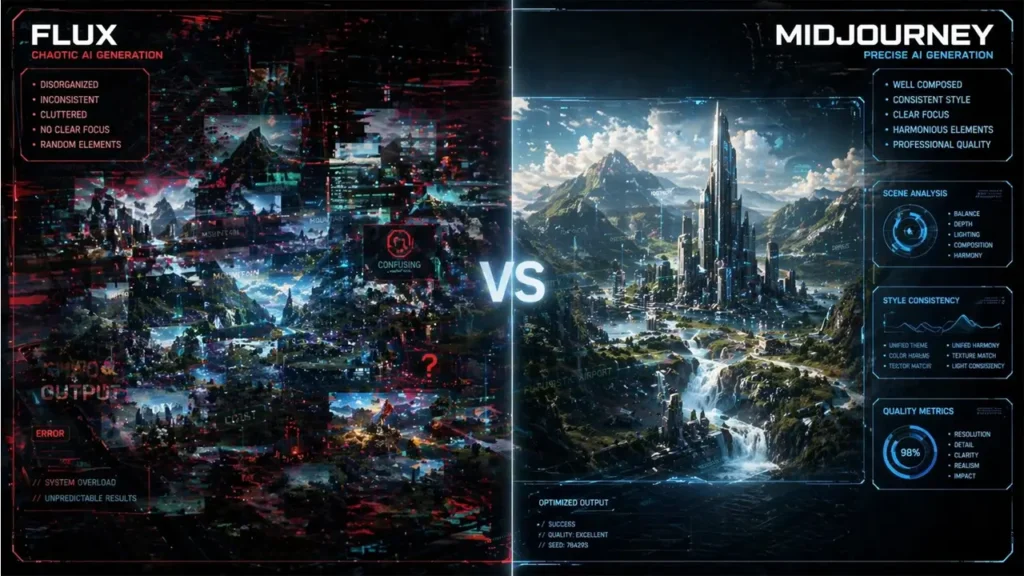
6. FLUX.1 Krea vs Midjourney
This is the comparison most people want to see. Both models are capable of producing stunning images, but they represent fundamentally different philosophies about what AI image generation should be.
Creative Intelligence Matrix
Analyzing the strategic delta between FLUX.1 and Midjourney V7. Evaluating architectural transparency against proprietary artistic refinement and ecosystem utility.
| Strategic Pillar | FLUX.1 Krea (Open Sovereign) | Midjourney V7 (Proprietary) |
|---|---|---|
| Model Governance & Infrastructure | ||
|
Architecture
|
Open-Weights
12B Parameters
|
Closed-Source
Proprietary Logic
|
| Deployment |
Native Local / ComfyUI |
Cloud Restricted |
| Creative Output Profile | ||
| Photorealism |
Cinematic / Naturalistic
Avoids “AI Gloss”
|
Stylized / Vibrant
“Painted” Aesthetic
|
| Abstract Utility | Realism Bias | Excellent Concept Art |
| Technical Fidelity & Latency | ||
| Inference Speed |
1–2 sec
Hosted API Baseline
|
~15 sec
Queue Dependent
|
| Prompt Fidelity |
Literal & Precise
|
Interpretive / Artistic
|
| Text Rendering | Weak Implementation | Moderate Reliability |
FLUX.1 Krea
Excels in Naturalism and prompt adherence. Eliminates cloud dependency with full LoRA/Fine-tuning support.
Midjourney V7
20M UsersIndustry titan for concept art and stylized aesthetics. Subscription-locked with proprietary interpretive logic.
Who Wins the FLUX.1 Krea vs Midjourney Battle?
Honestly, the answer depends entirely on what you need. FLUX.1 Krea wins on photorealism, prompt precision, compositional accuracy, anatomical correctness, and flexibility for developers. It produces images that look less “AI-generated” — a crucial advantage for product mockups, editorial content, and professional photography-style work.
Midjourney wins on artistic interpretation, abstract concept art, stylized illustration, and ease of use for non-technical users. Its aesthetic is more dramatic and emotionally evocative. It remains the tool of choice for concept artists and designers working in a more expressive, artistic register.
For real-world commercial photography replication, documentary aesthetics, and technical applications: choose FLUX.1 Krea. For surreal, fantastical, or painterly outputs with minimal technical setup: Midjourney remains excellent.
7. FLUX.1 Krea Prompt Examples
Getting great results from FLUX.1 Krea requires understanding its “opinionated” nature. Because the model has a strong photorealistic bias, it responds best to prompts that speak its language — descriptive, technical, and grounded in real-world visual vocabulary.
Prompt Structure That Works
The recommended prompt format for FLUX.1 Krea follows this pattern:
[Art style / shot type] + [Subject] + [Scene / environment] + [Lighting] + [Color / mood] + [Technical camera details]
Here are practical FLUX.1 Krea prompt examples across different use cases:
Portrait Photography: “Close-up portrait of a 35-year-old Southeast Asian woman, wet hair clinging to forehead, standing in a rainy Tokyo street at dusk, visible skin pores and freckles, damp wool coat, neon reflections on wet asphalt, shot on Canon EOS R5, 85mm f/1.8, shallow depth of field bokeh”
Landscape / Nature: “Photorealistic misty forest at dawn, sunlight filtering through ancient cedar trees, detailed moss-covered rocks, gentle stream in the foreground, golden hour warm tones, mist rising from the ground, naturalistic color grading”
Architecture / Urban: “Wide-angle street photography, cobblestone alley in a European old town at night, warm lantern light, long exposure motion blur on passing cyclists, wet pavement reflections, analog film aesthetic, slight grain texture”
Concept Art (pushing the model toward stylization): “Cinematic concept art digital painting of a futuristic city at sunset, towering brutalist architecture with overgrown vegetation, dramatic storm clouds, orange and teal color palette, highly detailed, wide establishing shot”
Macro / Detail Work: “Extreme close-up macro photograph of a monarch butterfly wing, intricate scale patterns, morning dew droplets, soft green foliage background, natural diffused light, hyper-realistic texture detail”
What to Avoid
Based on how the model’s training philosophy works, avoid these common mistakes:
- Vague subjective language: Words like “beautiful,” “amazing,” or “epic” are too abstract — be specific instead
- Conflicting style signals: Mixing “hyper-realistic” with “cartoon style” confuses the model
- Overly long prompts: A prompt with 15+ competing ideas can lead to inconsistent results — layer detail methodically
- Expecting heavy stylization: FLUX.1 Krea will always push toward naturalism — work with it, not against it
A useful tip from the official Krea documentation: structure prompts in layers from foreground to background. “In the foreground, a large oak tree with golden autumn leaves. Behind it, a flowing river, and in the background, a mist-covered mountain range.” This layered approach gives the model clear spatial instructions and leads to more coherent compositional outputs.
BestChina3DPrinters
Expert Reviews & Rankings
Independent 3D Printer Reviews
Your trusted source for Chinese 3D printer reviews, rankings, and comparisons. We buy, test, and review every printer so you can make informed decisions.
8. Krea AI Image Generator Review
The Platform Experience
Krea.ai serves as the primary hosted interface for experiencing FLUX.1 Krea in action. As a Krea AI image generator review, the platform offers several distinct modes of interaction that go beyond simple prompt-and-generate workflows.
User Interface and Experience: The Krea interface is clean, modern, and designed around iterative creative workflows. A real-time canvas feature updates previews as you type or adjust parameters — this immediate feedback loop fundamentally changes how you explore ideas. Rather than waiting for a final render to see if your prompt is working, you get continuous visual feedback throughout the process.
Available Models on Krea: The platform brings together multiple models in one place, with FLUX.1 Krea as its flagship open-weights offering, alongside Krea 1 (the proprietary version), FLUX 1.1 Pro, FLUX 1.1 Pro Ultra, FLUX Kontext Pro, and external providers including Imagen 4 and Ideogram. This versatility means you’re not locked into one aesthetic.
Generation Speed: On the Krea hosted service, FLUX.1 Krea generates images in approximately 1–2 seconds — near-instantaneous for practical creative use. This speed advantage over local deployments makes it particularly attractive for professional workflows where iteration speed matters.
Image Quality: The output quality is genuinely impressive. FLUX.1 Krea on Krea.ai consistently delivers natural skin tones, balanced non-blown-out highlights, accurate anatomical detail, and an analog-film-like texture that reads as believable rather than artificially perfected. The model’s signature “desaturation” treatment — its preference for restrained, naturalistic color — creates a cohesive aesthetic that feels more like professional photography than AI art.
What It Does Well:
- Photorealistic portraits with natural skin and light
- Complex environmental scenes with multiple elements
- Cinematic landscape and architectural photography
- Product visualization with realistic material rendering
- Iterative exploration via the real-time canvas
Current Limitations:
- Text rendering within images remains weak — a common limitation across the FLUX family
- Niche or highly stylized prompts may require more iteration to pull away from the model’s naturalistic bias
- Local deployment requires significant VRAM (24GB recommended for full quality; FP8 versions available for lower-spec hardware)
- Commercial use requires a separate license from Black Forest Labs
Pricing on Krea.ai: Flux (the default version) costs 5 credits per image, making it one of the most economical options on the platform. This low cost per generation makes FLUX.1 Krea ideal for conceptual iteration and draft exploration before committing to higher-cost premium models for final outputs.
9. AI Image Generation Tools Comparison
The AI image generation landscape in 2026 is more competitive than ever. FLUX.1 Krea occupies a specific and valuable niche within this ecosystem. Here’s how it stacks up against the wider field:
Generative Media Strategic Audit
Evaluating the 2025-2026 image generation landscape. Analyzing the trade-offs between Open Sovereignty (local control) and Frontier API performance.
| Model Identity | Strategic Advantage | Operational Constraint | Access |
|---|---|---|---|
| Open Sovereignty (Local Control) | |||
|
FLUX.1 Krea [dev]
Open-Weights
|
SOTA Photorealism & Naturalism.
Exceptional composition; avoids “AI Gloss.”
|
Complex text rendering & stylized abstractions.
|
Free Tier*
|
|
Stable Diffusion 3.5
Open-Source
|
Deep Ecosystem & LoRA Support.
|
Baseline quality trails FLUX-series.
|
Free
|
| Frontier Performance (Cloud APIs) | |||
|
FLUX 1.1 Pro
High-Speed API
|
6x Throughput Delta.
Enterprise-grade resolution & reliability.
|
No free-access tier.
|
Paid API
|
|
Midjourney V7/8
Proprietary
|
Artistic Coherence & Community.
Leading Concept Art aesthetic.
|
Zero local deployment capability.
|
Subscription
|
|
Google Imagen 4
Google Cloud
|
Exceptional Realism & Safety.
|
Heavily restricted ecosystem.
|
GCP API
|
| Specialized Utility (Text & Context) | |||
| Ideogram v2 | Market-Leading Typography rendering. | Limited Photorealism range. | Freemium |
| FLUX Kontext Pro | Advanced Editing & Style Transfer. | High marginal cost per-edit. | Paid API |
FLUX.1 Krea
LocalCinematic Naturalism. No “AI look.”
Text rendering is currently a minor blocker.
Midjourney V7
CloudThe gold standard for Artistic Style & Concept Art.
Where Does FLUX.1 Krea Sit in the Market?
In the broader AI image generation tools comparison for 2026, FLUX.1 Krea occupies a unique and highly valuable position: it is the best-performing open-weights model for naturalistic, photorealistic image generation currently available. It closes the gap with closed-source alternatives in ways that no previous open model has managed.
The competitive landscape has evolved into a two-tier market. Closed, proprietary platforms like Midjourney and Imagen 4 offer polished, curated experiences with higher per-image cost. Open models like FLUX.1 Krea offer flexibility, local deployment, fine-tuning capability, and much lower cost — at the expense of requiring somewhat more technical sophistication to set up and operate.
For studios, agencies, and individual professionals who need consistent, high-volume photorealistic output with full control over their pipeline, FLUX.1 Krea is the clear leader in the open-source space in 2026.
10. Conclusion: Is It the Best AI Image Generator 2026?
After exploring everything FLUX.1 Krea has to offer — its architecture, its benchmark performance, its compositional capabilities, its platform experience, and how it compares to the competition — the answer is nuanced but largely positive.
FLUX.1 Krea is almost certainly the best AI image generator 2026 for the following users and use cases:
Developers and researchers who need an open-weights model they can deploy locally, fine-tune, and integrate into custom pipelines. No other model in 2026 offers this combination of output quality and genuine openness.
Professional creators and studios who need photorealistic imagery that doesn’t look AI-generated. Whether for product photography, editorial content, architectural visualization, or cinematic concept work, FLUX.1 Krea’s naturalistic aesthetic is a genuine differentiator.
Cost-conscious creators who need high-volume generation without large subscription costs. At 5 credits per image on Krea.ai — and completely free for non-commercial local use — it dramatically undercuts proprietary alternatives.
It may not be the best choice for artists who prioritize abstract, surreal, or highly stylized creative output. Midjourney still holds an edge in that space. It is also not ideal if you need reliable text rendering within images — Ideogram v2 remains the leader there.
Final Verdict
FLUX.1 Krea represents a genuinely important moment in the evolution of AI image generation. It demonstrates that open-source models can reach — and in some respects exceed — the quality of closed commercial alternatives. It was built with a clear aesthetic vision, released responsibly with safety evaluations and content mitigations in place, and supported by a rapidly growing ecosystem of integrations.
Is it perfect? No. The text-rendering limitation is real, and its strong photorealistic bias means you need to understand its personality to get the best from it. But for what it does best — generating believable, cinematic, naturalistic images that make people ask “is that a real photo?” — FLUX.1 Krea is in a class of its own among open models in 2026.
If you haven’t tried it yet, the barrier to entry has never been lower. Head to krea.ai, download the weights from Hugging Face, or spin it up in ComfyUI — and see for yourself what an opinionated AI image model can do.
Wish you happiness