
The AI landscape is witnessing a paradigm shift. While tech giants guard their most powerful models behind paywalls and API limits, a new contender has emerged that’s turning heads across the machine learning community. The DeepSeek R1 reasoning model isn’t just another large language model—it’s a sophisticated reasoning engine that rivals OpenAI’s o1 while remaining completely open-source and MIT-licensed. This isn’t hype; it’s a genuine breakthrough that democratizes advanced AI capabilities for developers, researchers, and businesses worldwide.
1. What is DeepSeek R1 Reasoning Model?
DeepSeek R1 represents a fundamental departure from traditional large language models. While conventional LLMs like GPT-4 or Claude excel at generating fluent text, they often struggle with multi-step reasoning, mathematical proofs, and complex logical deduction. DeepSeek R1 was specifically engineered to tackle these challenges head-on.
Released by DeepSeek AI in early 2025, R1 is an open-source AI reasoning model that employs chain-of-thought processing to break down complex problems into manageable steps. Think of it as the difference between a student who memorizes answers versus one who shows their work—R1 explicitly demonstrates its reasoning process, making its conclusions transparent and verifiable.
What sets R1 apart is its performance on benchmarks that measure genuine reasoning capability rather than pattern matching. On the AIME 2024 mathematics competition (designed for high school students but notoriously challenging for AI), R1 achieves scores comparable to OpenAI’s o1-preview. On coding benchmarks like Codeforces and programming competitions, it consistently delivers production-ready solutions that handle edge cases and complex algorithms.
The model family includes several variants:
- DeepSeek-R1 (the full 671B parameter model)
- DeepSeek-R1-Zero (trained purely through reinforcement learning without supervised fine-tuning)
- R1-Distill series (smaller, distilled versions ranging from 1.5B to 70B parameters)
This isn’t just incremental improvement—it’s a philosophical shift toward AI systems that truly “think” through problems rather than simply predict the next token.
2. DeepSeek R1 – Open-Source AI Reasoning Model with MIT License
The decision to release DeepSeek R1 under the MIT license is arguably as significant as the technical achievements themselves. In an industry dominated by closed-source models with restrictive terms of service, MIT-licensed AI models offer unprecedented freedom.
What does MIT licensing mean in practice? Unlike many “open” models that restrict commercial use or require attribution chains, the MIT license permits:
- Unlimited commercial deployment without licensing fees
- Model modification and fine-tuning for specialized applications
- Integration into proprietary products without disclosure requirements
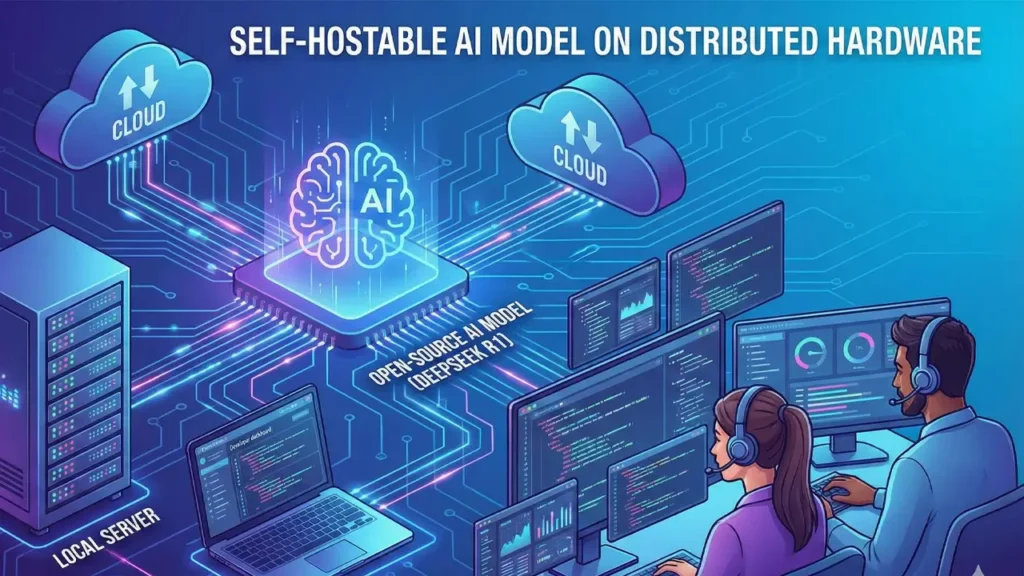
- Self-hosting on your own infrastructure with complete data privacy
This matters enormously for businesses concerned about data sovereignty. When you send a query to a proprietary API like GPT-4 or Claude, your data passes through external servers. With R1, you can run the entire model on-premises, ensuring sensitive information never leaves your network—critical for healthcare, finance, and legal applications.
The open-source nature also enables unprecedented transparency. Researchers can examine exactly how R1 arrives at its conclusions, audit its reasoning for biases or errors, and understand failure modes that black-box systems obscure. This transparency builds trust in a way that proprietary systems simply cannot match.
DeepSeek has released not just the model weights but also comprehensive training details, including their reinforcement learning approach, reward modeling strategies, and distillation techniques. This level of openness accelerates the entire field—researchers can build upon DeepSeek’s work rather than starting from scratch.
3. How Chain-of-Thought Reinforcement Learning Works in R1
The secret sauce behind R1’s reasoning prowess lies in its innovative training methodology: chain-of-thought reinforcement learning. This approach represents a significant evolution beyond traditional supervised learning.
Traditional language models learn by predicting the next word in a sequence, trained on massive text corpora. While this produces fluent language, it doesn’t inherently teach step-by-step reasoning. DeepSeek R1 takes a different path.
The training process begins with reinforcement learning from scratch (demonstrated in the R1-Zero variant). Rather than being shown examples of correct reasoning, the model learns through trial and error:
- Problem Presentation: The model receives a challenging problem (mathematical proof, coding challenge, logical puzzle)
- Exploration: It generates multiple solution attempts, explicitly showing its reasoning steps
- Reward Signal: A verifier checks whether the final answer is correct
- Policy Refinement: The model adjusts its approach based on what worked and what didn’t
This process mirrors how humans develop problem-solving skills—not by memorizing solutions, but by learning which reasoning strategies lead to correct answers. The “chain-of-thought” component means the model externalizes its reasoning process, generating text like:
“Let me approach this step by step:
- First, I’ll identify the key constraints…
- Next, I’ll consider what happens when…
- This leads to the conclusion that…”
DeepSeek further refined R1 by incorporating supervised fine-tuning on high-quality reasoning examples and using advanced techniques like Group Relative Policy Optimization (GRPO). The result is a model that combines the reasoning robustness of pure RL with the language fluency of supervised learning.
This methodology explains why R1 excels specifically on reasoning-heavy tasks where traditional LLMs struggle. It hasn’t just memorized solutions—it’s learned how to reason.

4. R1 vs OpenAI o1 Comparison: Deeper Than Surface Metrics
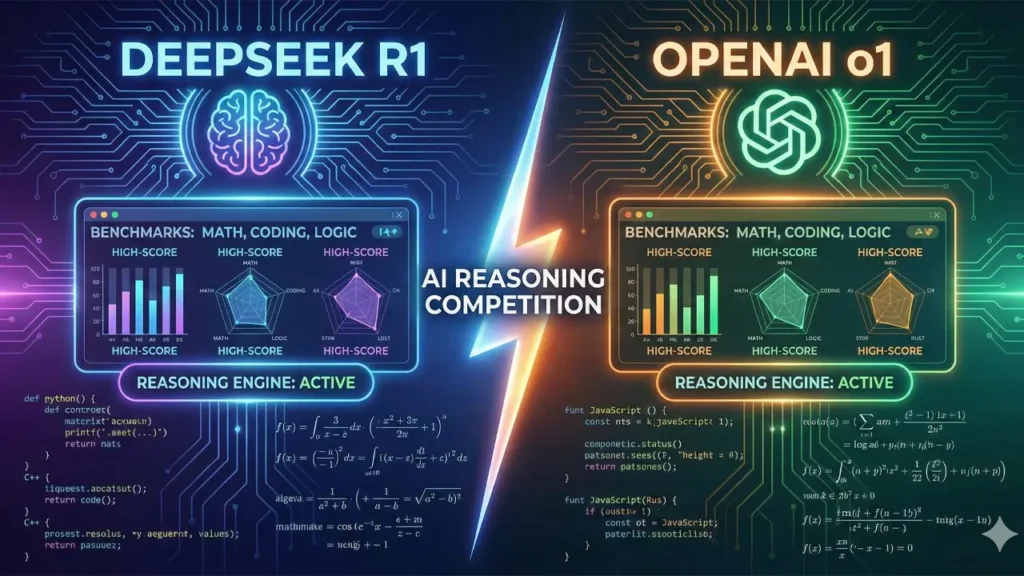
The elephant in the room: how does DeepSeek R1 actually stack up against OpenAI’s proprietary o1 model? The R1 vs OpenAI o1 comparison reveals a nuanced picture that goes beyond simple benchmark scores.
Reasoning Intelligence Matrix
A comparative assessment of expert-level reasoning, mathematics, and code synthesis across leading frontier architectures.
| Benchmark Cluster | DeepSeek R1 | OpenAI o1-preview | OpenAI o1-mini |
|---|---|---|---|
| AIME 2024 (Math) | 79.8% SOTA Performance | ~79.0% | ~70.0% |
| MATH-500 | 97.3% High Accuracy | ~96.0% | ~90.0% |
| Codeforces (Rating) | 2029 Competitive Level | ~1900 | ~1650 |
| LiveCodeBench | 65.9% Logic Lead | ~60.0% | ~55.0% |
| GPQA Diamond (Science) | 71.5% | ~73.0% Lead Position | ~60.0% |
The data reveals that R1 trades blows with o1-preview across different domains. On mathematical reasoning, R1 slightly edges ahead. For coding competitions, it demonstrates superior performance. On graduate-level science questions (GPQA), o1-preview maintains a marginal lead.
But raw numbers don’t tell the whole story. Consider these critical differences:
Transparency: R1’s reasoning process is completely visible and auditable. You can see exactly why it chose a particular approach. OpenAI’s o1 shows some reasoning but operates largely as a black box.
Cost: Running R1 locally costs only the electricity and hardware—no per-token API fees. OpenAI o1-preview costs approximately $15 per million input tokens, making extensive use prohibitively expensive for many applications.
Latency Control: With self-hosted R1, you control inference speed and can optimize for your specific use case. API-based models impose rate limits and variable latency.
Customization: R1 can be fine-tuned on domain-specific data (medical literature, legal precedents, specialized code). Proprietary models offer limited customization options.
The comparison ultimately depends on your priorities. If you need the absolute bleeding edge on specific benchmarks and can afford API costs, o1-preview remains compelling. If you value transparency, cost control, and customization, R1 offers superior value.
5. R1-Distill Benchmark Performance and Practical Use
One of DeepSeek’s most impressive achievements isn’t the flagship 671B parameter model—it’s the R1-Distill benchmark performance across smaller, more practical model sizes. Knowledge distillation involves training smaller models to replicate the reasoning patterns of larger ones, and DeepSeek has executed this brilliantly.
Deployment & Infrastructure Matrix
A technical tiering of DeepSeek-R1 variants, parameter scaling, and associated hardware requirements for production and local inference.
| Variant Architecture | Parameters | AIME ’24 | Codeforces | Infrastructure Baseline |
|---|---|---|---|---|
| DeepSeek-R1 Frontier | 671B (MoE) | 79.8% | 2029 | 8x NVIDIA A100/H100 (80GB) Full precision or high-quantization cluster |
| R1-Distill-Qwen-70B | 70B (Dense) | 72.5% | 1866 | 2x A100 / 4x RTX 4090 Enterprise workstation or cloud instance |
| R1-Distill-Qwen-32B | 32B (Dense) | 63.2% | 1595 | 1x A100 / 2x RTX 4090 Prosumer multi-GPU setup |
| R1-Distill-Qwen-14B | 14B (Dense) | 55.0% | 1420 | 1x RTX 4090 / A6000 Single high-end consumer GPU |
| R1-Distill-Qwen-7B | 7B (Dense) | 46.6% | 1207 | 1x RTX 3090 / 4070 Ti Standard desktop GPU / Apple M-Series |
| R1-Distill-Qwen-1.5B Edge | 1.5B (Dense) | 23.5% | 892 | Consumer Laptop (16GB RAM) Mobile device or localized CPU inference |
The distilled models retain remarkable reasoning capabilities despite their reduced size. The 70B variant achieves over 90% of the full model’s performance while running on hardware accessible to well-funded startups and research labs. The 7B model, which runs comfortably on consumer gaming GPUs, still outperforms many larger traditional LLMs on reasoning tasks.
This gradient of capabilities enables strategic deployment:
- Edge devices: The 1.5B model can run on laptops or mobile devices for offline reasoning assistance
- Production servers: The 14B-32B range offers excellent price-performance for customer-facing applications
- Research clusters: The 70B model provides near-flagship performance for academic institutions
- Enterprise datacenters: The full 671B model delivers state-of-the-art capabilities with complete data control
The distillation process preserves not just accuracy but reasoning style. Even the smallest models demonstrate chain-of-thought behavior, explicitly showing their work rather than jumping to conclusions. This makes them particularly valuable for educational applications where understanding the reasoning process matters as much as the final answer.
6. Focus on Reasoning Benchmarks: Math, Code, Logic
DeepSeek R1’s design explicitly targets reasoning benchmarks math code logic, and its performance on these specific challenges reveals why it’s genuinely different from general-purpose language models.
Mathematical Reasoning: The AIME (American Invitational Mathematics Examination) serves as a particularly challenging benchmark because it’s designed for gifted high school students and requires genuine problem-solving, not pattern recognition. Problems involve multiple steps, creative insights, and the ability to combine different mathematical concepts.
R1’s 79.8% accuracy on AIME 2024 places it in the top percentile of human test-takers. More impressively, analysis of its solutions shows it employs diverse problem-solving strategies—sometimes using algebraic manipulation, other times geometric reasoning or number theory insights. This flexibility suggests genuine reasoning rather than memorized solution templates.
On the MATH benchmark (which includes problems from algebra, geometry, precalculus, and number theory), R1 achieves 97.3% accuracy. While impressive, what matters more is how it solves these problems. Error analysis reveals that mistakes typically occur on ambiguously worded problems rather than computational errors—a very human failure mode.
Coding Proficiency: Codeforces ratings provide a standardized measure of programming skill. R1’s rating of 2029 places it at the “Candidate Master” level—higher than approximately 92% of human competitive programmers. This isn’t about generating boilerplate code; it’s about solving algorithmic challenges that require:
- Understanding complex problem constraints
- Devising efficient algorithms (often requiring dynamic programming, graph theory, or advanced data structures)
- Implementing solutions with correct edge case handling
- Optimizing for time and space complexity
On LiveCodeBench (which tests models on recent programming problems to avoid training data contamination), R1 achieves 65.9% pass rate. These are problems the model has never seen before, requiring genuine problem-solving rather than recall.
Logical Reasoning: Benchmarks like GPQA (Graduate-Level Google-Proof Q&A) test the ability to reason about scientific concepts at an advanced level. These questions require:
- Understanding technical terminology across biology, physics, and chemistry
- Applying scientific principles to novel scenarios
- Distinguishing between superficially similar but fundamentally different concepts
R1’s 71.5% accuracy demonstrates strong performance, though interestingly this is one area where o1-preview maintains a slight edge. This likely reflects differences in training data distribution rather than fundamental reasoning limitations.
The common thread across these domains is multi-step reasoning under constraints. R1 excels precisely because it was trained to decompose complex problems, consider multiple approaches, and verify its solutions—the hallmark of genuine reasoning capability.
7. Benefits of a Self-Hostable Large Language Model for Developers
The ability to deploy a self-hostable large language model transforms R1 from an impressive research achievement into a practical development tool. For engineers and organizations, this brings tangible advantages that API-based solutions simply cannot match.
Data Privacy and Compliance: When processing sensitive information—medical records, legal documents, proprietary code, financial data—sending it to external APIs creates compliance nightmares. GDPR, HIPAA, SOC 2, and similar regulations often prohibit or restrict cloud processing of sensitive data. Self-hosting R1 means:
- All data remains within your infrastructure
- Complete audit trails of data access
- No third-party data sharing agreements required
- Ability to meet air-gapped deployment requirements for defense and intelligence applications
Cost Predictability: API pricing creates budgeting uncertainty. A viral product launch or unexpected usage spike can result in five-figure bills. With self-hosted R1:
- Capital expenditure on hardware (one-time cost)
- Predictable operational costs (electricity, cooling, maintenance)
- No per-token charges, enabling unlimited internal experimentation
- Ability to allocate computational resources based on priority rather than budget
Latency Optimization: Network round-trips to API endpoints introduce unavoidable latency—typically 200-500ms just for the initial connection, before any processing begins. For interactive applications, this delay is noticeable. Self-hosting enables:
- Sub-50ms response initiation for on-premises deployment
- Ability to batch process thousands of requests in parallel
- Optimized inference engines tailored to your hardware
- No rate limiting or request queuing behind other API users
Customization and Fine-Tuning: Proprietary models offer limited customization. With R1:
- Fine-tune on proprietary datasets to improve domain-specific performance
- Adjust reasoning verbosity (more detailed explanations vs. faster responses)
- Implement custom stopping criteria or output formatting
- Integrate with proprietary tools and databases without API restrictions
Reliability and Availability: API outages happen. OpenAI, Anthropic, and other providers have experienced downtime that leaves dependent applications broken. Self-hosted models provide:
- Independence from external service status
- Ability to maintain older model versions if updates introduce regressions
- Disaster recovery on your timeline, not a vendor’s
- No risk of sudden pricing changes or service discontinuation
For development teams, the practical implications are profound. You can experiment freely during development without watching API meters. You can guarantee performance SLAs to customers. You can iterate on prompts and approaches without budget constraints. The model becomes infrastructure you control rather than a service you rent.
8. Advantages of a Small Footprint Reasoning Model for Startups
While the full DeepSeek R1 model requires substantial hardware, the distilled variants offer small footprint reasoning model capabilities that are game-changing for startups, independent developers, and resource-constrained organizations.
Accessible Infrastructure: The R1-Distill-7B model runs comfortably on a single RTX 4090 GPU (approximately $1,600 retail) or can even run on consumer laptops with quantization. This accessibility means:
- Bootstrapped startups can deploy advanced reasoning without investor capital
- Indie developers can integrate AI reasoning into products without cloud costs
- Educational institutions can provide students with local AI resources
- Researchers in developing regions can access frontier capabilities
Rapid Prototyping: Small models enable dramatically faster iteration cycles. With local deployment:
- Test prompt variations instantly without API latency
- Run thousands of evaluation samples in minutes, not hours
- Experiment with fine-tuning without worrying about training costs
- Prototype features knowing inference costs won’t scale prohibitively
Edge Deployment: Smaller models enable entirely new deployment paradigms:
- Mobile applications with on-device reasoning (privacy-preserving AI assistants)
- IoT devices that can reason about sensor data locally
- Embedded systems in vehicles, medical devices, or industrial equipment
- Offline operation in environments without reliable internet connectivity
Sustainable Scaling: The efficiency curve of distilled models creates better unit economics:
- Serve more users per GPU compared to larger models
- Lower energy consumption translates to reduced operational carbon footprint
- Ability to scale horizontally with commodity hardware rather than specialized infrastructure
- Better alignment between computational resources and actual task requirements
Consider a startup building an AI tutoring platform. With API-based models, each student interaction incurs costs, creating pressure to limit usage or charge premium prices. With R1-Distill-7B:
- Deploy on a $3,000 server that handles 50-100 concurrent students
- Offer unlimited practice problems without worrying about API costs
- Guarantee response times under 2 seconds
- Maintain complete privacy of student data
- Fine-tune on curriculum-specific materials to improve accuracy
The “small footprint” aspect doesn’t mean compromised capabilities. The 7B model still demonstrates chain-of-thought reasoning, handles multi-step math problems, and generates working code. It’s not as capable as the full model, but it’s far more capable than traditional 7B models that weren’t specifically trained for reasoning.
This democratization of AI reasoning capability is perhaps DeepSeek’s most significant contribution. Advanced reasoning is no longer gated behind expensive API subscriptions or enterprise budgets—it’s accessible to anyone with a decent GPU or even a modern laptop.
9. Using DeepSeek R1 in Products and Projects
The real test of any AI model is practical deployment. How are developers and organizations actually using DeepSeek R1 in products and projects? Early adoption patterns reveal compelling use cases across diverse domains.
Educational Technology: Several tutoring platforms have integrated R1-Distill models to provide step-by-step problem solving:
- Math homework helpers that show complete solutions with explanations
- Coding bootcamps using R1 to generate practice problems and provide detailed debugging assistance
- SAT/ACT prep applications that explain reasoning behind correct answers
- Language learning apps that break down grammar rules through logical reasoning
The transparency of chain-of-thought reasoning is particularly valuable here. Students don’t just see answers—they see the reasoning process they should emulate.
Developer Tools: The coding capabilities make R1 excellent for developer-facing products:
- Code review tools that explain logical flaws in proposed changes
- Documentation generators that infer intent from code structure
- Bug analysis systems that reason about potential edge cases
- API design assistants that evaluate interface consistency
One development team reported using R1-70B as an internal “senior developer” that reviews pull requests, catching logical errors that pass unit tests but would fail in production edge cases.
Enterprise Decision Support: Organizations are deploying R1 for analytical workflows:
- Financial modeling assistants that explain the reasoning behind projections
- Legal research tools that analyze case precedents and identify logical arguments
- Medical diagnosis support systems that outline differential diagnosis reasoning
- Strategic planning facilitators that evaluate business decisions through formal logic
The audit trail provided by explicit reasoning is critical in regulated industries where “black box” AI decisions are unacceptable.
Agentic Workflows: R1 excels in multi-step agent applications:
- Research assistants that break down complex questions, search for information, and synthesize findings
- Automation systems that reason about conditional logic (“if X then Y, unless Z”)
- Planning agents that decompose high-level goals into executable steps
- Validation agents that verify outputs from other AI systems
One particularly creative implementation uses R1 as a “reasoning oracle” in a multi-agent system—other specialized models generate proposals, and R1 evaluates their logical soundness before execution.
Creative Applications: Even creative fields benefit from reasoning capabilities:
- Game AI that reasons about strategy rather than following scripted behaviors
- Puzzle generators that ensure solvability through logical deduction
- Story plot assistants that check narrative consistency
- Music theory tools that explain compositional choices
The key insight across all these applications is that R1’s reasoning transparency creates trust. Users can evaluate whether the AI’s logic is sound rather than blindly accepting outputs. When R1 makes a mistake, developers can often identify where the reasoning went wrong, enabling targeted improvements through fine-tuning.
10. Conclusion: Why DeepSeek R1 is the Top Reasoning Model Right Now
The AI industry stands at an inflection point. For years, the narrative has been that cutting-edge capabilities require massive capital investment and proprietary development. DeepSeek R1 shatters this assumption comprehensively.
Performance Parity with Proprietary Models: R1 doesn’t just approach OpenAI o1’s capabilities—in several domains, it exceeds them. The 79.8% AIME accuracy, 2029 Codeforces rating, and 97.3% MATH benchmark performance place it firmly in the top tier of reasoning models globally. This isn’t a “good enough” open-source alternative; it’s a genuinely competitive option that stands on its merits.
Open Source as Competitive Advantage: The MIT license transforms what would be impressive research into a foundation for ecosystem development. Thousands of developers can now build upon R1, creating specialized variants, optimized inference engines, and novel applications. This community effect will likely accelerate R1-based innovation beyond what any single company could achieve with a closed model.
Economic Accessibility: The combination of zero licensing costs, self-hosting capabilities, and efficient distilled models fundamentally changes AI economics. A capability that would cost tens of thousands monthly in API fees becomes accessible for the price of consumer hardware. This democratization expands the universe of viable AI applications by orders of magnitude.
Transparency and Trust: In an era of increasing AI regulation and concerns about algorithmic accountability, R1’s explicit reasoning provides a path toward trustworthy AI systems. You can audit its logic, understand its failures, and verify its conclusions—essential properties for deployment in critical applications.
Practical Deployment: R1 isn’t vaporware or a benchmark-optimized model that fails in production. Real applications are being built, deployed, and scaled using R1 variants. The gradient of model sizes from 1.5B to 671B parameters ensures there’s an appropriate option for virtually any use case and budget.
Limitations to Acknowledge: R1 isn’t perfect. It can still hallucinate, particularly on topics outside its training distribution. The reasoning process, while explicit, can sometimes follow incorrect logical paths. Inference is slower than traditional LLMs due to the extended chain-of-thought generation. For simple tasks that don’t require reasoning, smaller traditional models may be more efficient.
But these limitations don’t diminish R1’s significance. This is a model that brings advanced reasoning capabilities—previously available only through expensive APIs or not at all—into the open-source ecosystem. It proves that the frontier of AI capability isn’t permanently locked behind corporate walls.
For developers choosing between R1 and proprietary alternatives, the decision matrix is clear:
- Choose R1 if: You need data privacy, want cost predictability, require customization, value transparency, or need to deploy in regulated environments
- Choose proprietary models if: You need absolute cutting-edge performance on specific benchmarks, can’t manage infrastructure, or require comprehensive commercial support
For many applications—arguably the majority—R1 provides superior total value. The combination of competitive performance, zero marginal cost, complete control, and transparency creates a compelling package that proprietary alternatives struggle to match.
The release of DeepSeek R1 will likely be remembered as a pivotal moment in AI development. It demonstrates that open collaboration can achieve results matching well-funded corporate research. It proves that advanced reasoning capabilities can be distilled into accessible model sizes. Most importantly, it shows that the future of AI need not be concentrated in the hands of a few large companies.
The DeepSeek R1 reasoning model isn’t just another open-source project—it’s a demonstration that the next generation of AI will be built on open foundations, accessible to anyone with the skills to use it. For researchers, developers, and organizations looking to integrate advanced reasoning into their products, R1 represents both a practical solution and a glimpse of an increasingly open AI future.
The tools are now available. The benchmarks prove the capability. The license grants the freedom. What remains is for the community to build the next generation of reasoning-powered applications—and with DeepSeek R1, that future is open source.
If you’re exploring breakthrough AI models like DeepSeek R1, you’ll probably love discovering the latest smart tech innovations too. From cutting-edge gadgets to next-gen devices redefining everyday life, check out what’s trending now at https://bestchinagadget.com/ — where innovation meets real-world usability.