
Introduction: Why Synthetic Data Generation Matters in 2025
If you have been working in machine learning for any amount of time, you already know the pain. You have a brilliant model architecture, a clear use case, and a team ready to build — but you are stuck waiting for data. Real data. Properly labeled, privacy-compliant, legally cleared, and large enough to actually train something useful. In 2025, that bottleneck is not getting smaller. It is getting bigger.
The AI industry has reached a point where the demand for training data is outpacing the ability to safely collect it. Privacy regulations like GDPR, CCPA, and the EU AI Act put real constraints on how personal information can be used. Labeling real-world examples by hand is slow and expensive. And for specialized domains — medical records, financial transactions, rare edge cases in autonomous systems — collecting enough high-quality real data can take months or years.
This is exactly where synthetic data generation steps in, and it is why tools like SynthData-Gen v2 are generating so much excitement in the ML community right now.
Synthetic training data is artificially created data that mimics the statistical properties and patterns of real-world information, without containing any actual personal or sensitive details. Think of it as building a perfect training partner for your model: one that behaves exactly like the real thing, but comes without the legal complexity, the privacy risks, or the collection delays. In 2025, this approach is shifting from a niche workaround to a core strategy for scaling AI responsibly.
Throughout this guide, we will walk you through everything you need to know about SynthData-Gen v2 — what it is, how it works, what it supports, and why the broader ML community is embracing it as one of the most practical open-source tools available today.
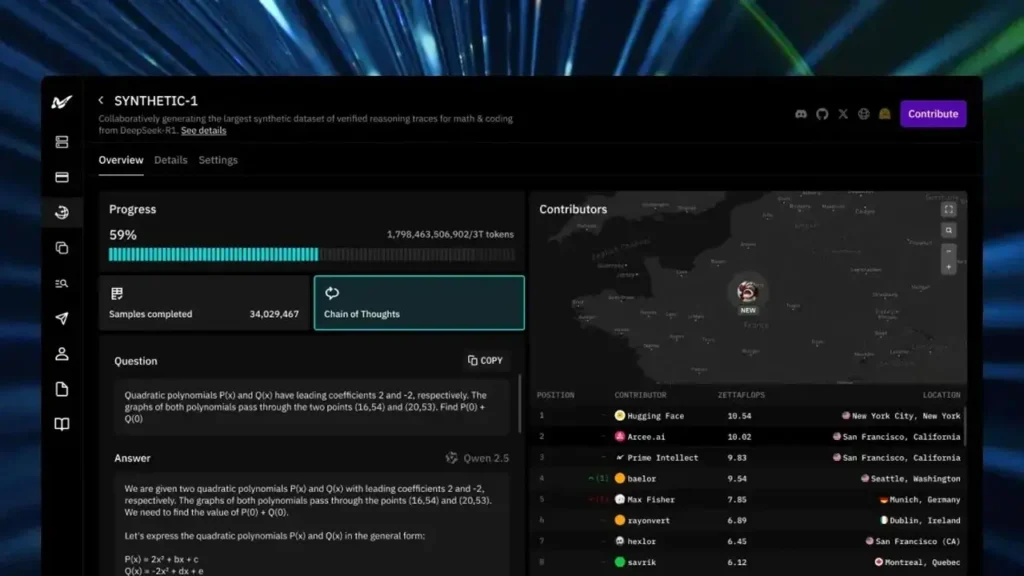
What Is SynthData-Gen v2 and Why the AI Community Uses It
SynthData-Gen v2 is a synthetic dataset generator built on top of the distilabel framework, developed by Argilla and deeply integrated with the Hugging Face ecosystem. It is an open-source tool designed to let ML engineers create high-quality datasets for training and fine-tuning language models — without requiring real user data, manual annotation pipelines, or complex data engineering infrastructure.
The project lives in the Hugging Face Spaces environment, which means you can start using it through a browser-based interface without installing anything locally. It also ships as a Python package on GitHub, so teams that want to run it locally, customize pipelines, or embed it into existing workflows have full access to the source code.
What makes this tool stand out in a crowded space is its combination of accessibility and power. The no-code interface guides you through a straightforward process: describe the dataset you want to create, choose your task type, configure your generation parameters, and let the tool do the heavy lifting. In the background, it leverages distilabel — described by its creators as a framework for synthetic data and AI feedback for engineers who need fast, reliable, and scalable pipelines based on verified research papers — alongside the free Hugging Face text-generation API.
The Argilla community has already used this approach to create landmark open datasets. The 1M OpenHermesPreference dataset, a collection of approximately one million AI preferences, was built using distilabel at scale and has been used to train several state-of-the-art models. This is not a proof-of-concept tool. It is battle-tested infrastructure that has already influenced some of the most widely used open models available today.
How Synthetic Data Generation Works
Understanding the mechanics behind synthetic data generation helps you use it more effectively and set realistic expectations for your projects.
At its core, the process involves using a large language model as a data factory. Rather than collecting examples from real users or scraping the web, you instruct a capable LLM to generate examples that match a specific distribution, format, and purpose. The key insight is that a well-prompted LLM already understands language, context, and structure — so it can produce diverse, coherent examples at scale without you having to source or label them manually.
In SynthData-Gen v2’s pipeline, powered by distilabel, generation typically follows a multi-step flow. First, diverse prompts or seed inputs are created to ensure variety across the dataset. Then an LLM generates responses or completions for each prompt. In preference and feedback datasets, a second LLM can evaluate and rate those outputs, producing the kind of comparison data needed for RLHF (Reinforcement Learning from Human Feedback) training. Finally, the generated data is filtered, formatted, and pushed directly to the Hugging Face Hub.
What makes this pipeline particularly valuable is its reproducibility. Each pipeline is defined in a shareable YAML configuration file, meaning your entire data generation process is documented, versioned, and repeatable — something that is nearly impossible to achieve with manual collection methods.
The quality of synthetic data depends heavily on the quality of the prompts and the capability of the underlying model. For text-heavy tasks like classification or instruction following, modern LLMs produce synthetic examples that are statistically indistinguishable from human-written ones. For more structured formats like tabular data or code, careful schema design ensures that outputs remain valid and useful. In either case, the key principle holds: synthetic data should capture the statistical properties and realistic patterns of the domain you care about, without encoding information about real individuals.
BestChina3DPrinters
Expert Reviews & Rankings
Independent 3D Printer Reviews
Your trusted source for Chinese 3D printer reviews, rankings, and comparisons. We buy, test, and review every printer so you can make informed decisions.
50+ Supported Formats: Building Any Type of Synthetic Dataset
One of the most practical strengths of modern synthetic data generation tools — and specifically the distilabel-powered ecosystem that SynthData-Gen v2 builds on — is the breadth of dataset formats they support. This is not a tool that only works for one narrow task type. The framework is designed to cover the full spectrum of ML training needs.
The table below gives you a clear picture of the major format categories available, along with typical use cases:
| Format Category | Data Examples | Typical Use Case |
|---|---|---|
| Standard & Structured NLP | ||
|
Text Classification
Classification
|
News, reviews, intent labels | Supervised classification models & sentiment analysis |
|
Tabular Data
Structured
|
CSV, structured rows with schema | Structured data models, analytics, feature engineering |
| Generative LLM & Alignment | ||
|
Chat / Dialogue
Conversational
|
Multi-turn conversation, single-turn QA | Chatbot and interactive assistant fine-tuning |
|
Instruction Following
SFT Engine
|
Task prompts with expected outputs | Supervised Fine-Tuning (SFT) pipelines |
|
Preference / Feedback
Alignment
|
Ranked response pairs, DPO datasets | RLHF optimization and policy alignment |
|
Question Answering
Knowledge
|
Context-answer pairs, open-domain QA | RAG architecture and dense reading comprehension |
|
Summarization
Generation
|
Document and summary pairs | Abstractive summarization and context condensation models |
| Specialized Domains | ||
|
Code Generation
Development
|
Function stubs, docstrings, unit tests | Code LLM architecture fine-tuning & Copilot workflows |
|
Translation
Multilingual
|
Bilingual sentence pairs | Neural Machine Translation (NMT) models |
|
Domain-Specific NLP
Verticals
|
Legal, medical, financial text corpora | Specialized vertical model training & expert pipelines |
LLM Alignment
SFT & TuningTask prompts & response pairs for SFT / DPO alignment.
Includes: Conversations, multi-turn chat, RAG contexts, and abstractive summaries.
Specialized Verticals
High-Value TechПрограммирование (тесты, докстринги), билингвальные пары для машинного перевода (NMT) и изолированные текстовые корпуса экспертных ниш (медицина, юриспруденция).
The tool generates text classification datasets at around 50 samples per minute and chat datasets at around 20 samples per minute using the free Hugging Face API. For teams that need higher throughput, it is straightforward to connect your own API credentials and custom models to scale well beyond these defaults. The pipeline architecture built on distilabel supports integrations with Hugging Face Inference Endpoints, LiteLLM, and local Transformers models — giving you flexibility at every level.
Creating Machine Learning Datasets Without Real User Information
One of the most compelling reasons teams adopt synthetic data generation in 2025 is the ability to build complete ML pipelines without ever touching personally identifiable information. This is not just a nice-to-have feature. It is rapidly becoming a legal and operational necessity.
Real-world datasets — particularly in healthcare, finance, insurance, and e-commerce — contain information that is tightly regulated under GDPR in Europe, CCPA in California, and a growing body of national AI legislation worldwide. Collecting, storing, labeling, and sharing this data requires legal agreements, security infrastructure, anonymization processes, and ongoing compliance audits. For a small research team or an early-stage startup, this overhead can be paralyzing.
Synthetic data removes this bottleneck entirely. Because the generated examples are artificially created and contain no one-to-one mapping to real individuals, they do not trigger the same regulatory requirements. A fraud detection model can be trained on thousands of synthetic transaction records that capture the statistical patterns of real fraud without representing any actual customer. A customer support bot can be trained on realistic conversations that were never actually had by any real user.
This approach also dramatically accelerates the development timeline. Instead of waiting weeks for data collection, annotation, and compliance review, an ML engineer can describe the dataset they need and have thousands of examples ready within hours. For rapid prototyping, ablation studies, and benchmarking experiments, this speed advantage is enormous.
There is an important nuance worth understanding here: when synthetic data is generated from a model that was trained on real data, traces of the original distribution are present in the outputs. This is what makes synthetic data useful — it inherits statistical realism. Best practice is to validate that your synthetic dataset does not inadvertently reconstruct identifiable examples from the training corpus, particularly for sensitive domains. Tools like the singling-out risk metric (targeting less than 5% singling-out risk) are used in enterprise contexts to confirm that generated data meets privacy guarantees.
Data Augmentation for AI: Improving Model Quality
Synthetic data generation is not only about replacing real data from scratch. One of its most practical applications in everyday ML engineering is augmentation — using synthetic examples to complement, extend, and improve existing datasets.
Consider a common challenge: class imbalance. You are training a sentiment classifier, and 90% of your examples are neutral, while only 5% are strongly negative. Your model learns to predict “neutral” for everything and still achieves high accuracy, which is useless in practice. With synthetic data augmentation, you can generate additional strongly negative examples that match the distribution of your real data, rebalancing the training set without any new manual collection.
The same principle applies to demographic representation. If your customer dataset skews heavily toward one age group or geographic region, synthetic data can fill in the gaps — creating examples that represent underserved segments and helping your model generalize more fairly. This is particularly valuable for compliance with AI fairness regulations that are becoming more common globally.
Data augmentation is also widely used for handling rare edge cases that are difficult or dangerous to collect in the real world. In robotics and autonomous vehicles, synthetic simulation data is now considered essential for training perception models on scenarios that cannot be safely staged in real environments. NVIDIA’s Cosmos and Isaac GR00T platforms, announced at GTC 2025, are prominent examples of how simulation-driven synthetic training has become foundational for physical AI systems.
For NLP models specifically, augmentation techniques include paraphrasing existing examples to add surface variation, back-translation to create linguistically diverse versions of the same content, and LLM-driven rewriting to shift formality, tone, or domain without changing the underlying label. All of these techniques can be implemented cleanly within the distilabel pipeline ecosystem that powers SynthData-Gen v2.

AndreevWebStudio.com
Professional web development and design services. Custom WordPress sites, landing pages, e-commerce solutions, and 3D printing content creation for businesses and creators.
- • WordPress Development
- • Custom Web Design
- • E-Commerce Solutions
- • 3D Printing Content
SynthData-Gen v2 for AI Model Training Data
Let us get practical and look at the specific training scenarios where SynthData-Gen v2 adds the most value for ML engineers today.
Fine-Tuning Large Language Models. The most direct use case is supervised fine-tuning (SFT). If you want to adapt a base model like Llama or Mistral for a specific domain or task — customer support, legal document drafting, code review — you need a dataset of instruction-response pairs that reflect the style and content you want the model to learn. SynthData-Gen v2 lets you define the task, provide examples of the desired behavior, and generate thousands of training pairs automatically. The result is a dataset you fully control, without relying on scraped web content of uncertain quality.
Alignment and RLHF Pipelines. Training models to follow instructions reliably and behave according to human preferences requires preference datasets — pairs of responses where one is rated better than the other. These are notoriously expensive and time-consuming to create through human annotation. Distilabel’s pipeline architecture includes support for using LLMs as evaluators, generating both the responses and the preference labels automatically. The OpenHermesPreference dataset, built this way at one million examples, demonstrated that this approach can produce high-quality alignment data at a scale that would be completely impractical with human annotators.
RAG System Development. Retrieval-Augmented Generation systems need question-answer pairs grounded in specific documents or knowledge bases. Synthetic data generation can produce diverse question sets from any source document, creating evaluation and training data for retrieval pipelines without requiring domain experts to write questions manually.
Chatbot and Conversational AI. Building a domain-specific assistant — for an internal HR system, a technical support tool, or a specialized knowledge base — requires conversational training data. SynthData-Gen v2’s chat dataset format lets you describe the persona, domain, and conversation scenarios you need, and generates realistic multi-turn dialogues that can be used directly for fine-tuning.
NLP Classification and Evaluation Benchmarks. Teams building evaluation frameworks for their models need diverse test sets that cover edge cases and failure modes. Synthetic generation can produce targeted adversarial examples, rare category instances, and controlled variation sets that would take significant human effort to curate manually.
Why Open Source AI Tools Are Winning
The AI development landscape in 2025 is defined, in large part, by the success of the open-source ecosystem. And SynthData-Gen v2 sits squarely at the intersection of the two most important open communities in the field: Hugging Face and GitHub.
The tool is available under an Apache 2.0 license, which means you can use it freely for commercial purposes, modify the source code, integrate it into proprietary systems, and distribute your own versions — all without paying licensing fees or navigating restrictive terms. For teams at startups, research institutions, and enterprise AI groups alike, this licensing model removes one of the most common friction points in adopting new tooling.
Beyond licensing, the open-source nature of the project means that the pipeline code is transparent, auditable, and reproducible. You are not trusting a black-box API to generate your training data — you can inspect exactly what prompts are being used, what models are being called, and what filtering logic is being applied. This transparency is increasingly important as AI governance frameworks require organizations to document and justify their training data choices.
The integration with Hugging Face’s ecosystem amplifies these benefits enormously. Generated datasets can be pushed directly to the Hugging Face Hub, making them instantly available for download, versioning, and sharing with collaborators. The Hub’s dataset viewer lets you inspect examples before downloading, and the metadata system allows you to document your generation methodology alongside the data itself.
The community around these tools is also genuinely active and collaborative. Argilla regularly publishes new example datasets and pipeline configurations, the distilabel library is updated with new research-backed techniques, and the Hugging Face Spaces platform makes it easy to share and fork customized versions of the generator for specific use cases. For ML engineers, this means practical help, real examples, and a community of practitioners working through the same challenges you are.
Synthetic Data for Machine Learning: Pros and Cons
No technology is without its trade-offs, and synthetic data generation is no exception. Here is an honest look at where it excels and where you need to be careful.
| Synthetic Data Advantages | Architectural Limitations |
|---|---|
| • No personal data required — inherently privacy-compliant. | Quality depends heavily on the underlying generative framework. |
| • Fast generation — thousands of examples in minutes or hours. | May fail to capture rare, stochastic real-world anomalies. |
| • Fully controllable — custom distribution, labels, and output schema. | Risk of model collapse if synthetic loops run without real anchors. |
| • Cost-effective — reduces manual annotation and collection overhead. | Algorithmic biases in the generator can propagate into data. |
| • Enables class balancing and precise demographic representation. | Empirical validation against real-world distributions remains necessary. |
| • Reproducible and auditable via code pipeline configuration files. | Domain-specific nuances demand intensive prompt engineering. |
| • Seamless native integration with the Hugging Face Hub ecosystem. | Regulatory acceptance of pure synthetic training data varies by vertical. |
- • Privacy: Zero personal data overhead (100% compliant).
- • Velocity: Thousands of high-fidelity tokens generated in hours.
- • Control: Absolute distribution, label, and schema configuration.
- • Balancing: Algorithmic elimination of edge-case class gaps.
- • Model Collapse: Hazard of feedback degradation without real data anchors.
- • Bias: High risk of propagating generator-level skewness.
- • Compliance: Fragmented cross-industry regulatory acceptance.
- • Realism: Missing critical, unexpected real-world distribution patterns.
The research community has developed useful frameworks for thinking about when synthetic data is sufficient on its own versus when it should be combined with real examples. For most NLP tasks, a hybrid approach — using synthetic data for the bulk of training while reserving a smaller real-world validation set — produces the best outcomes. The synthetic data provides scale and diversity; the real data provides a ground truth anchor for evaluation.
One of the most important cautions for practitioners is the risk of compounding biases. If the LLM you are using to generate synthetic data has learned biased associations from its own training corpus, those biases can appear in your synthetic dataset and eventually in your fine-tuned model. This is not a reason to avoid synthetic data — it is a reason to evaluate your datasets carefully, apply the same fairness auditing you would apply to real data, and be transparent about your data generation methodology in model documentation.
Conclusion: Should ML Engineers Use SynthData-Gen v2?
If you are building ML systems in 2025 and you are not already incorporating synthetic data generation into your workflow, you are almost certainly leaving efficiency and capability on the table.
SynthData-Gen v2 — built on distilabel, hosted on Hugging Face, and open-sourced under a permissive license — represents one of the most practical, accessible, and well-supported tools for synthetic data generation available today. It removes the most painful friction points in the ML data pipeline: privacy risk, collection delays, annotation cost, and the difficulty of creating balanced, diverse training sets.
For individual engineers, the no-code interface on Hugging Face Spaces means you can prototype a new dataset in an afternoon without writing a single line of code. For teams with more complex requirements, the full Python package and pipeline configuration system give you the control and reproducibility you need for production-grade workflows.
Synthetic data generation is not a replacement for real-world data in every scenario. There will always be tasks where grounding in genuine human behavior is essential, and where validation against real distribution is non-negotiable. But as a force multiplier — for prototyping, augmentation, fine-tuning, alignment training, and evaluation set creation — it is one of the most powerful capabilities available to ML practitioners right now.
The tools are mature, the community is active, the licensing is open, and the use cases are proven. Whether you are fine-tuning a domain-specific LLM, building a RAG system, training a classifier, or developing a conversational AI product, synthetic data generation belongs in your toolkit.
Explore more AI tools, model reviews, and practical ML engineering guides at AIInnovationHub.com — and keep building.
🇬🇧 1. Michael Carter — ⭐⭐⭐⭐⭐
“Excellent breakdown of SynthData-Gen v2 and synthetic data generation. The article explains complex ML concepts in a very simple way, making it useful even for developers who are just entering the AI field. AIInovationHub has become one of my favorite resources for AI news and practical guides.”
🔗 https://aiinovationhub.com/
🇪🇸 2. Sofía Ramírez — ⭐⭐⭐⭐⭐
“¡Un artículo fantástico! Explica claramente cómo crear conjuntos de datos sintéticos sin utilizar información real. Me gustó especialmente el enfoque práctico y las explicaciones sencillas. Sin duda volveré a visitar AIInovationHub para leer más contenido sobre inteligencia artificial.”
🔗 https://aiinovationhub.com/
🇸🇦 3. أحمد العتيبي — ⭐⭐⭐⭐⭐
“مقال رائع ومفيد للغاية لكل من يعمل في مجال الذكاء الاصطناعي وتعلم الآلة. شرح أداة SynthData-Gen v2 كان واضحًا وسهل الفهم، كما أن الموقع يقدم محتوى احترافيًا ومحدثًا باستمرار. أوصي بمتابعة AIInovationHub لكل المهتمين بالتقنيات الحديثة.”
🔗 https://aiinovationhub.com/
🇨🇳 4. 李伟 (Li Wei) — ⭐⭐⭐⭐⭐
“这篇文章非常专业,同时又容易理解。SynthData-Gen v2 的功能介绍得很详细,特别是关于生成合成训练数据和保护隐私方面的内容,对机器学习开发者很有帮助。我已经收藏了 AIInovationHub 网站,期待更多 AI 相关内容。”
🔗 https://aiinovationhub.com/
🇫🇷 5. Julien Moreau — ⭐⭐⭐⭐⭐
“Très bon article sur SynthData-Gen v2 ! Les explications sont claires, modernes et adaptées aussi bien aux débutants qu’aux ingénieurs ML expérimentés. J’apprécie particulièrement la qualité des analyses publiées sur AIInovationHub. C’est une excellente source d’information sur l’IA.”
🔗 https://aiinovationhub.com/
🇩🇪 6. Lukas Schneider — ⭐⭐⭐⭐⭐
“Ein wirklich informativer Beitrag über SynthData-Gen v2 und die Erstellung synthetischer Trainingsdaten. Der Artikel ist gut strukturiert und zeigt praxisnahe Einsatzmöglichkeiten für Machine Learning. AIInovationHub liefert regelmäßig hochwertige Inhalte – absolut empfehlenswert!”
🔗 https://aiinovationhub.com/