
A European Flagship Arrives
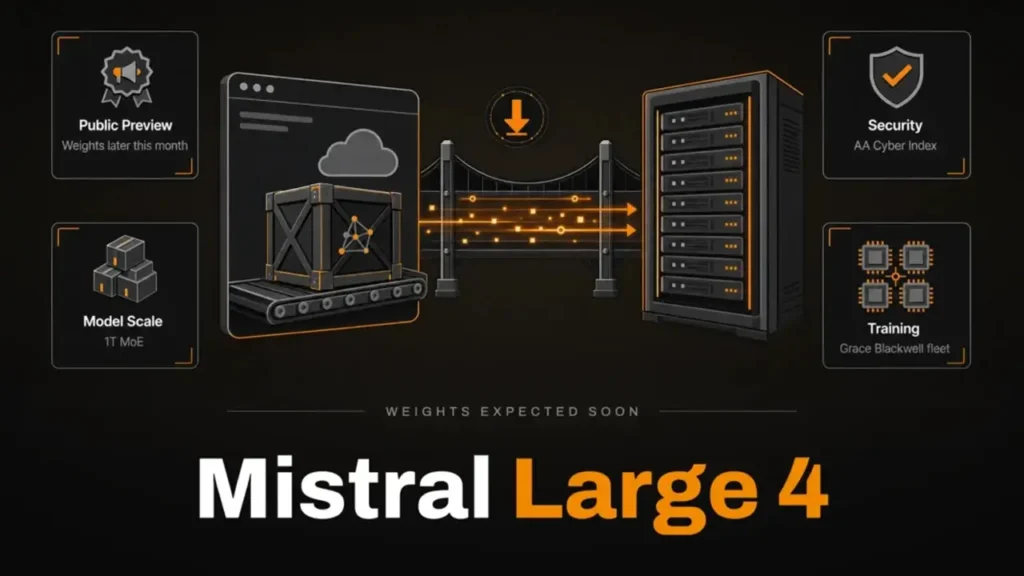
Mistral Large 4 is the largest and most capable model Mistral AI has ever shipped, and its debut gives developers, enterprises and policymakers plenty to talk about. The Mistral Large 4 release date was October 6, 2026, when the French company opened a public preview through its Mistral Studio web platform and its API. The launch matters for three reasons. First, the model is a trillion-parameter system built for reasoning, coding and agentic work. Second, it understands images as well as text. Third, Mistral says it will publish the weights for download by the end of October, which would make it one of the biggest open-weight releases to date.
The timing is worth noticing. Mistral’s previous flagship, Large 3, only arrived in December 2025. Less than a year later, the company has released a model that is far larger, noticeably more expensive to run, and clearly aimed at the same tier as the best systems from the United States and China. For a lab that built its reputation on lean, efficient models, this is a statement of ambition.
Before going further, one caveat. This is a preview, not a final release, and the weights are not yet public as of late October 2026. Many of the performance numbers circulating online come from Mistral itself, and independent testing is still thin. This review tries to keep those categories apart: what is confirmed, what is claimed by the company, and what remains unknown.
In the sections below you will find the architecture, benchmark results, a comparison with rival models, the multimodal abilities, enterprise and sovereignty angles, pricing, a quick usage guide, the context window and open-weight status, and a final verdict on who should actually use it.

Core Architecture and What Changed From Large 3
Under the hood, the model is a granular mixture-of-experts system. Instead of pushing every token through every parameter, a router sends each token to a small group of specialist sub-networks, so only a fraction of the model does work at any given moment. That is how a network with roughly 1.05 trillion total parameters can run with about 49 billion active parameters per token. It follows the same design philosophy as its predecessor, only scaled up considerably.
Bigger, But Not Proportionally Heavier
Large 3 launched with 675 billion total parameters, 41 billion active parameters and a 256K-token context window. The new model raises total parameters by about 55 percent, while active parameters grow by only about 20 percent. That gap is the whole point of the mixture-of-experts approach: a huge pool of stored knowledge with a comparatively modest compute bill for each token. Throughput figures gathered from third-party gateway traffic suggest speeds in the neighborhood of 50 tokens per second, which is respectable rather than spectacular for a model of this size.
Trained From Scratch in Europe
Mistral states that the model was trained from scratch on 3,800 Grace Blackwell GPUs in its own European data centers. “From scratch” matters because it means this is not an incremental fine-tune of an earlier checkpoint. It also supports the company’s sovereignty message, which we will return to in the enterprise section.
Mistral AI Model Features at a Glance
The most important Mistral AI model features can be summarized quickly:
- Granular mixture-of-experts design with about 1.05 trillion total and 49 billion active parameters
- A dedicated vision encoder of roughly 1.6 billion parameters for image understanding
- Text and image input, with text output
- Support for tool (function) calling and strict structured JSON output
- Prompt caching, which sharply reduces the cost of repeated context
- A very long context window, with exact figures varying by listing
- An API model ID of mistral-large-4, currently labeled as preview version 26.10
In short, the changes from Large 3 are about scale, vision and agentic reliability rather than a new architectural idea.

AndreevWebStudio.com
Professional web development and design services. Custom WordPress sites, landing pages, e-commerce solutions, and 3D printing content creation for businesses and creators.
- • WordPress Development
- • Custom Web Design
- • E-Commerce Solutions
- • 3D Printing Content
Mistral Large 4 Benchmarks: Vendor Claims Versus Independent Tests
Benchmarks are where excitement and skepticism collide. On Mistral’s own launch charts, the model looks like a frontier contender. On independent leaderboards, it looks more like a strong upper-middle performer. Both pictures contain truth, and the gap between them is the most useful thing to understand.
What Mistral Reports
For coding, Mistral reports a score of 61.7 percent on DeepSWE v1.1, a software-engineering benchmark built around realistic repository tasks. The company also ran a blind coding-quality evaluation using Surge AI annotators. In that test the preview scored 3.74 out of 5, placing second among five models, behind Claude Opus 5 at 4.22 and ahead of Kimi K3 at 3.59. Two details deserve emphasis. The study was run by Mistral rather than an independent party, and even in this favorable setting the model did not take first place.
What Independent Testers See
Artificial Analysis gives the model a score of 38 on its Intelligence Index, a blend of ten tests covering agentic tasks, coding, science and long-context reasoning. That places it in the upper-middle of open models rather than at the very top of the global field. Launch charts tend to name the rivals a model beats, while independent leaderboards compare against everything, which explains much of the difference.
The strongest independently confirmed result is in cyber defense. Artificial Analysis reproduced Mistral’s 81.7 percent score on a reproduce-and-patch task, and the model refused none of the tasks it was given. Legal work is another area where outside results have been comparatively strong.
A Note on MMLU and GSM8K
Classic tests such as MMLU and GSM8K still appear in many model cards, but at this scale they are close to saturated. Almost every frontier-class model scores very high on them, so they say little about real differences. Agentic coding, long-horizon tool use and domain-specific evaluations are far better guides, and those are exactly the areas where the evidence for this release is still accumulating.
How It Stacks Up Against the Competition
People searching for Mistral Large 4 vs GPT-4 are usually asking a broader question: is this a model that can replace the big proprietary systems? GPT-4 defined an entire generation of expectations, but the competitive field has moved far beyond it, and the fair comparison today is against the newest flagships from each lab.
Against Proprietary Frontier Models
The honest answer is that it does not beat the best closed models, even by Mistral’s own numbers. In the blind coding test, Claude Opus 5 finished clearly ahead. Independent index results also place the model below the very top tier. Anyone choosing purely on raw capability for the hardest reasoning and coding workloads will probably still pick a leading proprietary system.
Against Open and Open-Weight Rivals
Among open-weight competitors, the picture is more favorable. The model edged past Kimi K3 in Mistral’s coding evaluation and represents a substantial step up from Large 3. If the weights arrive as promised, it will compete directly with the largest openly available models, which is a much smaller and more interesting field.
Where It Wins
The model’s advantages are not purely about benchmark scores:
- European hosting and a clear data-residency story
- The prospect of self-hosting and fine-tuning once weights are released
- Strong results in cyber defense tasks
- Native image understanding in the same model that handles code and reasoning
- Pricing that undercuts many proprietary flagships, especially during the launch discount
The takeaway is that this model competes on a combination of capability, control and cost, not on being the single smartest system available.
Exploring Multimodal Capabilities
The multimodal capabilities Mistral built into this release are one of its headline upgrades. The model accepts text and images and produces text. A vision encoder of about 1.6 billion parameters handles the visual side, feeding what it sees into the main reasoning network.
Looking Closely at Images
Mistral’s demonstrations focus on tasks that require patience rather than simple captioning. In one, the model examines engineering drawings. In another, it works through very large satellite images by zooming into specific regions and checking what it finds before answering. That behavior, inspecting and verifying rather than glancing once, fits the agentic direction of the whole model.
Practical Uses
Several realistic use cases follow from this design:
- Reviewing technical diagrams, floor plans and schematics
- Extracting structured data from scanned documents, tables and forms
- Analyzing charts and dashboards inside a longer reasoning workflow
- Supporting geospatial and inspection work where large images must be examined in detail
What Is Not Confirmed
It is worth being precise about limits. Mistral describes the model as accepting text and images. Some third-party listings show broader tags, but the company’s own description does not promise audio or video understanding, and it does not generate images. Treat any claim beyond text-and-image input as unverified until Mistral documents it.
Enterprise Solutions, Security and Sovereignty
If there is one area where Mistral has differentiated itself consistently, it is the enterprise and public-sector market in Europe. The company’s pitch combines strong models with infrastructure located on European soil and a path toward deployments that organizations control themselves.
Sovereign AI Positioning
Independent coverage of the launch framed the model as part of Mistral’s European, sovereign-AI strategy. Training took place in the company’s own European data centers, and the main API endpoint is hosted in Europe. For banks, healthcare providers, government agencies and defense-adjacent firms, where the location of data and compute is a legal question rather than a preference, that matters.
Tooling for Real Business Workflows
The practical side of Mistral AI enterprise solutions comes down to features that make a model usable inside production systems. This release supports tool calling, strict structured JSON outputs, and prompt caching. Together they allow teams to build agents that call internal APIs, return machine-readable results, and keep costs under control when the same long context is reused again and again.
The Self-Hosting Option
The weight release could change the calculation for organizations with strict control requirements. Running a model on your own infrastructure removes third-party data exposure and allows fine-tuning on proprietary data. The trade-off is substantial: a model of this size demands serious GPU capacity, so self-hosting will suit large organizations and specialist providers far more than small teams.
As always, compliance claims should be verified directly with Mistral and checked against your own legal requirements. Sovereignty is a strong starting point, not a replacement for due diligence.
API Pricing and Access
The Mistral Large 4 API pricing at list rates is $1.36 per million input tokens, $0.14 per million cached input tokens, and $4.18 per million output tokens. By comparison, Large 3 cost $0.50 per million input tokens and $1.50 per million output tokens, so the new flagship is a little under three times more expensive.
The Launch Discount
Marketplace listings currently show an introductory discount of up to 50 percent, bringing the effective rates to about $0.68 per million input tokens, $0.07 per million cached input tokens and $2.09 per million output tokens. Launch promotions are temporary, so budget against the list price and treat the discount as a bonus.
A Quick Cost Example
Imagine a workload that processes 10 million input tokens and generates 2 million output tokens in a month. At list prices that costs about $13.60 for input plus $8.36 for output, a total of roughly $21.96. At the discounted rates, the same workload costs about half of that. Caching can lower the bill further when large prompts or documents repeat.
Where to Access It
During the preview, the model is available through Mistral Studio and the Mistral API under the model ID mistral-large-4. Several third-party gateways also route requests to it through OpenAI-compatible interfaces, which is convenient if you already use a multi-model setup. Always confirm current prices on the provider’s own pricing page before committing.
A Quick Usage Guide
If you are wondering how to use Mistral Large 4, the path is straightforward and will feel familiar to anyone who has called a chat-completion API before.
Getting Started in Five Steps
- Create an account on Mistral Studio and open the API section.
- Generate an API key and store it securely, for example in an environment variable rather than in your code.
- Install the official Mistral SDK for your language, or use any OpenAI-compatible client pointed at a supported gateway.
- Send a chat request using the model ID mistral-large-4 with a system message and a user message.
- Add images, tool definitions or a JSON schema to the request as your use case demands.
Tips for Better Results
- Be specific about the task. Large models reward clear instructions, explicit output formats and examples.
- Use structured outputs. If your application parses the response, request strict JSON rather than relying on free text.
- Cache repeated context. Put long, unchanging material at the start of the prompt so prompt caching can cut costs.
- Test with your own data. Vendor benchmarks are a starting point. A small evaluation set built from your real tasks is far more informative.
- Remember it is a preview. Behavior, limits and pricing may change before the final release, so avoid hard-wiring assumptions into production systems.
Context Window and Open-Weight Status
Two questions dominate discussion among builders: how much text the model can handle, and whether they will really be able to download it.
How Long Is the Context Window?
Reported figures differ. One model database lists 262,144 tokens, while gateway and marketplace listings show about 1 million or 1.05 million tokens. The most likely explanation is that limits vary by provider deployment and by preview configuration. For comparison, Large 3 offered 256K tokens. Check the official model card for the exact limit that applies to your endpoint, and test long-context performance yourself, because advertised window size and reliable recall across that window are not the same thing.
Open-Weight AI Models in 2026
The broader context is that open-weight AI models in 2026 have become genuinely competitive with proprietary systems on many tasks. Mistral describes the new flagship as open-weight, but the current release is a hosted preview, and the full weight release is planned for later in October, with one report pointing to October 27. Until the files are actually published, the model is available only as a service.
Open-Weight Is Not the Same as Open Source
It is important to read the license carefully when the weights arrive. “Open-weight” means the trained parameters can be downloaded, but terms on commercial use, redistribution and fine-tuning vary from one release to another. Do not assume the license matches that of any earlier Mistral model. Legal review should happen before you build a product on it.
If the weights do ship on schedule, the impact could be significant. Researchers would gain a trillion-parameter model to study, startups could fine-tune it, and enterprises could run it inside their own walls.
Final Verdict: Is It Worth Using?
This Mistral Large 4 performance review lands on a balanced conclusion. The model is not the best AI system in the world, and Mistral’s own data does not claim otherwise. What it offers instead is a rare mix of frontier-class scale, native image understanding, European hosting, a clear path to open weights, and pricing that is competitive even at list rates.
Who Should Use It
- European enterprises and public bodies that need data residency and a sovereign supplier
- Developers building agents that rely on tool calling, structured outputs and long context
- Security and legal teams, where independent results look strongest
- Open-weight enthusiasts and researchers who want to inspect, adapt and self-host a very large model
Who Might Wait
Teams that need the absolute strongest reasoning and coding performance may prefer a leading proprietary model for now. Anyone planning self-hosting should wait for the weights, the license terms and independent speed tests. And because this is a preview, production-critical systems should treat it with care until the final version is released.
Overall, Mistral Large 4 is a serious and meaningful release. It strengthens the open-weight ecosystem, gives European organizations a credible flagship, and keeps pressure on every other lab. The best way to judge it is simple: run it against your own tasks, compare cost and quality, and let your own results decide.