
Introduction: What is Mistral Large 3
Mistral Large 3 is one of the most powerful and exciting open-weight AI models ever released in Europe. Announced on December 2, 2025, by French AI startup Mistral AI, it represents the company’s most ambitious technical achievement to date and a proud milestone for the broader European AI ecosystem. If you have been following the world of large language models, this release is a name you need to know.
Founded by former researchers from DeepMind and Meta, Mistral AI has grown rapidly since its inception, raising approximately $2.7 billion and reaching a valuation of around $13.7 billion. The company has built its reputation on a simple but powerful idea: frontier-level AI should be open, transparent, and accessible to everyone. With Mistral Large 3, that philosophy reaches its boldest expression yet.
The Mistral Large 3 release date marks a turning point. This is not just another incremental update — it is a completely new model, trained from scratch on approximately 3,000 NVIDIA H200 GPUs, featuring a cutting-edge Mixture-of-Experts architecture, full multimodal support, and a massive 256,000-token context window. It was released alongside a full family of smaller models under the Mistral 3 umbrella, all licensed under Apache 2.0, which is one of the most permissive and developer-friendly licenses in the software world. Mistral Large 3 sits at the top of this lineup as its flagship model, designed to compete directly with the best closed-source AI systems from OpenAI, Google, and others — while remaining fully open and free to use, modify, and deploy.
Whether you are a developer building production applications, an enterprise seeking reliable AI infrastructure, or simply a curious reader who wants to understand where AI is heading, this guide will walk you through everything you need to know about Mistral Large 3: its features, architecture, real-world performance, benchmarks, comparisons, API access, and future potential.

Mistral Large 3 Features Overview
The Mistral Large 3 features set is impressively broad, combining frontier-level intelligence with genuine flexibility and openness. At its core, the model is designed to handle a wide spectrum of tasks: from writing and analysis to complex multi-step reasoning, code generation, document understanding, and multilingual conversations.
One of the most important Mistral Large 3 features is its multimodal capability. Unlike many earlier open-weight models that required separate components for vision tasks, Mistral Large 3 integrates text and image understanding natively in a single model. This means it can process diagrams, photographs, screenshots, and visual documents alongside text without any additional configuration.
Multilingual support is another cornerstone feature. Mistral Large 3 supports over 40 native languages, making it genuinely global in scope. This includes major European languages, Arabic, Chinese, Russian, and more — a significant advantage for businesses operating across multiple regions.
The model is also designed with agentic workflows in mind. It supports function calling, structured outputs, tool use, and prefix completion, making it an excellent foundation for building AI agents that interact with external systems, APIs, databases, and business logic. The 256,000-token context window enables it to process entire books, large codebases, extended conversation histories, or lengthy legal documents in a single pass.
Finally, because Mistral Large 3 is released under Apache 2.0, users and organizations can deploy it on their own infrastructure, fine-tune it for specific domains, and integrate it into commercial products without restrictive licensing concerns. This openness is itself a defining feature that sets it apart from proprietary alternatives.
Mistral Large 3 AI Model Architecture
To truly appreciate what Mistral Large 3 achieves, it helps to understand the architecture behind the Mistral Large 3 AI model. The model uses a Sparse Mixture-of-Experts (MoE) architecture — a design approach that allows it to achieve both scale and efficiency simultaneously.
In a traditional dense neural network, every parameter is activated for every input token. This becomes extremely expensive as models grow larger. A Sparse MoE model solves this by dividing the network into multiple specialized “expert” subnetworks and using a routing mechanism to activate only the most relevant experts for each token during inference. The result is that the model can hold a massive amount of knowledge in its total parameters while only using a fraction of them at any given moment.
Mistral Large 3 has 675 billion total parameters but only 41 billion active parameters during inference. This means it delivers intelligence and capabilities comparable to much larger dense models while consuming significantly less compute per token. It is this architecture that allows it to run on a single cluster of 8×A100 or 8×H100 GPUs using optimized frameworks like vLLM, rather than requiring vastly more expensive infrastructure.
The model was trained in close partnership with NVIDIA, leveraging NVIDIA Hopper GPU clusters and optimized with state-of-the-art attention and MoE kernels specifically developed for Large 3’s architecture. On NVIDIA’s GB200 NVL72 systems, Mistral Large 3 achieved a performance gain of approximately 10x compared to the previous H200 generation — a remarkable leap that translates to lower cost per token, faster inference, and better energy efficiency for production deployments.
Mistral Large 3 Performance in Real Tasks
Raw architecture numbers are one thing, but Mistral Large 3 performance in practical, real-world scenarios is what ultimately matters for developers and businesses. Across the core task categories — coding, analytical reasoning, document analysis, and creative text generation — the model demonstrates consistent and reliable results.
In coding tasks, Mistral Large 3 handles everything from writing clean Python functions to debugging complex multi-file projects, generating API integrations, and explaining legacy codebases. Its long context window is particularly valuable here, as it can hold entire repositories in memory during a single session.
For analytical reasoning, the model excels at multi-step problem solving, synthesizing information from long documents, constructing logical arguments, and producing structured reports from raw data. In document analysis workflows — processing invoices, contracts, research papers, or financial statements — its native multimodal capability allows it to work with scanned documents and image-heavy PDFs directly.
Mistral AI and its enterprise partners have noted that Mistral Large 3 shows fewer breakdowns and more consistent behavior than many comparable models, especially in multi-turn conversations and extended inputs. This reliability in sustained, complex interactions is a key differentiator for production use cases where inconsistency is costly.
Mistral Large 3 performance is particularly strong in multilingual contexts. The model maintains a high quality of instruction-following and reasoning across its supported languages, which is valuable for global enterprises that need consistent AI behavior across regional teams and customer bases.

Mistral Large 3 Benchmarks vs Competitors
When it comes to Mistral Large 3 benchmarks, the numbers tell a compelling story. On the LMArena leaderboard — one of the most widely respected human preference evaluation platforms — Mistral Large 3 debuted at number 2 in the open-source non-reasoning models category and number 6 among all open-source models overall. This places it firmly in the front rank of publicly available models globally.
On MMMLU, a comprehensive test of general knowledge and multilingual reasoning, Mistral Large 3 matches or outperforms several leading closed-source models. Official results from Mistral indicate that it surpasses both DeepSeek V3.1 and Kimi K2 on general prompts and multilingual prompts.
The following table summarizes Mistral Large 3 benchmark positioning across key evaluation areas:
Mistral Large 3 Performance Audit
Evaluating the strategic positioning of the “L’Archive” model across human preference arenas, multilingual knowledge benchmarks, and competitive open-weight audits.
| Evaluation Domain | Capability Context | Mistral Result |
|---|---|---|
|
LMArena Ranking
Human Preference
|
Positioning across Chatbot Arena (LMSYS) for non-reasoning and general open-weight categories. Measures qualitative user satisfaction. |
#2 OSS Non-Reasoning
#6 Global OSS
|
|
MMLU / Multilingual
General Knowledge
|
Evaluating academic breadth and professional knowledge across 50+ languages. Successfully matches or exceeds leading proprietary models. |
Frontier Tier
EXCEEDS CLOSED MODELS
|
|
Head-to-Head Audit
Competitive Parity
|
Direct performance comparison against specialized models like DeepSeek V3.1 and Kimi K2 on general prompt sets. |
vs DeepSeek: Outperforms
vs Kimi K2: Outperforms
|
|
Intelligence Index
Artificial Analysis
|
Comprehensive aggregate quality score encompassing reasoning, retrieval, and instruction following. |
23 +1.0
vs Category Avg: 22
|
LMSYS Rankings
Ranked #2 in the non-reasoning category and #6 among all open-source models globally.
Global Tier 1MMLU Multi-Domain
Matches or exceeds performance of proprietary models in multilingual knowledge retrieval.
Benchmark LeadThese Mistral Large 3 benchmarks confirm that the model is not just technically impressive in terms of parameter count — it delivers measurably better results on tasks that matter in practice.
Mistral Large 3 vs GPT Models
The Mistral Large 3 vs GPT comparison is perhaps the most frequently asked question in discussions about this model. How does a fully open-weight European model stack up against OpenAI’s proprietary offerings?
The answer is nuanced and increasingly favorable to Mistral Large 3. On the LMArena leaderboard, Mistral Large 3 sits within the same competitive tier as GPT-class models, meaning it is trading blows rather than playing catch-up. Microsoft’s Azure team has described it as sitting “in the leading tier of globally available open models alongside DeepSeek and the GPT OSS family” — a notable endorsement.
Strategic Sovereignty Matrix
Contrasting Mistral Large 3’s “Sovereign-Open” deployment model against OpenAI’s proprietary cloud ecosystem. Focus on infrastructure control and inference economics.
| Capability Pillar | Mistral Large 3 | GPT-4o (OpenAI) |
|---|---|---|
| Governance |
Apache 2.0
Full Open Weights & Commercial Sovereignty
|
Proprietary
API-Restricted Usage
|
| Deployment |
Self-Hosting Required/Possible
Full data residency & security control.
|
Public/Private Cloud API Only |
| Inference ROI |
$0.50
5x More Cost Effective
|
$2.50
Per 1M Tokens
|
| Logic Scope |
256,000 Tokens
Extreme long-document reasoning.
|
128,000 Tokens
|
| Adaptability |
Unrestricted Fine-Tuning
Tune weights on proprietary data locally.
|
Limited Managed Fine-Tuning |
$0.50
$2.50
Audit covers 7 core sovereignty dimensions
Where GPT-4o and other closed models have an advantage is typically in out-of-the-box polish and the breadth of integrated tooling available through their respective platforms. However, Mistral Large 3’s openness gives it a structural edge in customization, data privacy, regulatory compliance, and long-term cost control — all of which are increasingly important for enterprises, particularly those in Europe operating under GDPR and AI Act considerations. For organizations that want frontier capability without vendor lock-in, the Mistral Large 3 vs GPT argument is increasingly settled in Mistral’s favor.
Enterprise Applications of Mistral Large 3
Mistral Large 3 enterprise AI deployment is one of the most discussed topics in the business world following the model’s release. The combination of frontier-level capability, open licensing, long context, and multimodal support makes it an attractive choice for a broad range of corporate use cases.
Production-grade AI assistants are among the most natural applications. Enterprises are deploying Mistral Large 3 to power internal knowledge assistants, customer-facing chatbots, and multi-modal document analysis systems. The model’s ability to maintain consistency over long, multi-turn conversations makes it particularly suited to applications where users engage in extended, complex dialogues.
Retrieval-Augmented Generation (RAG) systems benefit enormously from Mistral Large 3’s 256,000-token context window. Organizations can feed the model with large chunks of proprietary documentation, legal records, financial filings, or technical manuals and expect coherent, grounded responses. This is transforming how companies build internal search tools, compliance assistants, and procurement analysis systems.
Strategic partnerships illustrate how broadly the model is being adopted. HSBC, for example, has entered a partnership with Mistral AI to integrate its models into banking productivity workflows and customer service operations. Meanwhile, major cloud platforms including Amazon Bedrock, Microsoft Azure Foundry, and IBM WatsonX have all made Mistral Large 3 available to their enterprise customers.
The model’s Apache 2.0 license is a particularly important enabler for Mistral Large 3 enterprise AI use: organizations in regulated industries can deploy the model in fully on-premise or private cloud environments, ensuring that sensitive data never leaves their infrastructure. This is a consideration that proprietary API-based models simply cannot match.
Mistral Large 3 API and Integration
For developers, the Mistral Large 3 API is the primary gateway to using the model in production applications. Access is available through Mistral AI’s own La Plateforme (console.mistral.ai), as well as through Amazon Bedrock, Microsoft Azure Foundry, OpenRouter, Together AI, Fireworks, Modal, IBM WatsonX, and other providers.
The model identifier for API calls is mistral-large-2512. The API endpoint follows a standard OpenAI-compatible format at https://api.mistral.ai/v1/, making it straightforward to integrate into existing workflows that already use the OpenAI SDK or similar frameworks.
Mistral API Feature Matrix
Comprehensive verification of the Mistral Large 3 API endpoints, focusing on agentic tool use, structured reasoning, and multimodal integration.
| API Interface Feature | Implementation Detail | Status |
|---|---|---|
| Core Inference & Logic | ||
|
Chat Completions
|
/v1/chat/completions
|
Supported |
| Streaming Response | Real-time token delivery via SSE. | Supported |
| Agentic & Specialized Tooling | ||
| Function Calling | Native tool use for external data retrieval. | Supported |
| Structured Outputs | JSON mode & predefined schema enforcement. | Supported |
| Managed Agents |
/v1/agents
|
Supported |
| Frontier & Vision | ||
| Vision (Multimodal) | Image input analysis and description. | Supported |
| Predicted Outputs | Speculative decoding for low-latency. | Supported |
Function Calling
ActiveEnables the model to connect to external tools and APIs for real-time task execution.
Managed Agents
ActiveHigh-level agentic orchestration for complex, multi-turn conversational workflows.
Mistral Large 3 API pricing is competitive: $0.50 per million input tokens and $1.50 per million output tokens, with a blended rate of approximately $0.75 per million tokens at a 3:1 input/output ratio. This compares favorably against GPT-4o’s $2.50 per million input tokens, representing roughly a 5x cost advantage for comparable workloads.
Developers can get started by registering at console.mistral.ai, generating an API key from the API keys section of the dashboard, and making their first call using standard REST or the official Python and TypeScript SDKs. The model is also available as open weights on Hugging Face, enabling entirely self-hosted deployments for organizations that prefer not to use any external API.
Real-World Use Cases of Mistral Large 3
The Mistral Large 3 use cases span an impressively wide range of industries and application types. This versatility is one of the model’s core strengths — it is not narrowly optimized for one type of task but genuinely capable across a broad spectrum.
In software development, Mistral Large 3 is being used for code generation, code review, automated testing, documentation writing, and refactoring. Its ability to understand large codebases in a single context window makes it particularly useful for working with legacy systems or large monorepo architectures.
In data analytics, organizations are using the model to interpret dashboards, generate natural language summaries of structured data, build intelligent query systems, and automate routine reporting tasks. The combination of instruction-following and long-context reasoning allows it to work with large CSV exports, database schemas, and analytical notebooks.
Customer-facing AI assistants represent another major category of Mistral Large 3 use cases. Businesses are deploying it to handle customer inquiries, route support tickets, answer product questions, and provide personalized recommendations — all with the consistency and reliability that enterprise use requires.
In legal and compliance domains, the model is being applied to contract review, clause extraction, regulatory interpretation, and due diligence summarization — all tasks that benefit enormously from its long context window and multilingual capability.
Content creation, marketing automation, and educational tools round out the picture. From generating localized marketing copy across multiple languages to building interactive tutoring systems, Mistral Large 3 proves itself adaptable to virtually any text-centric application domain.
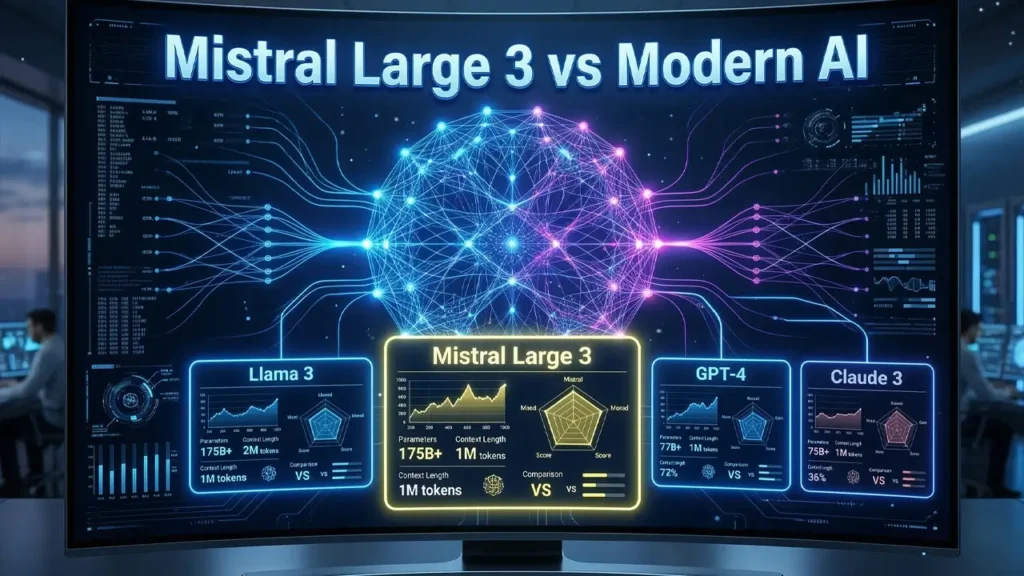
Future of Mistral Large 3
Looking ahead, the Mistral Large 3 capabilities we see today are just the beginning of a longer trajectory. Mistral AI has already announced that a reasoning version of Mistral Large 3 is in development — a variant that will incorporate extended chain-of-thought processing for even more powerful multi-step problem solving. This would place it in direct competition with OpenAI’s o-series reasoning models, but as an open-weight alternative.
On the infrastructure side, Mistral AI is playing a central role in building Europe’s sovereign AI compute capacity. At Vivatech 2025, French President Macron highlighted a historic partnership between Mistral and NVIDIA to build a European AI compute platform featuring 18,000 NVIDIA processors. This kind of state-backed infrastructure investment signals that Mistral’s ambitions extend well beyond model releases — the company is positioning itself as a foundational pillar of European AI independence.
The Mistral Large 3 capabilities in multimodal and agentic domains are also expected to expand. As AI applications increasingly involve coordinating multiple tools, processing diverse data formats, and executing long sequences of autonomous actions, models like Mistral Large 3 — designed explicitly for agentic workflows — will become more central to enterprise software architecture.
The broader significance of Mistral Large 3 for the future of AI is philosophical as much as technical. It demonstrates that open-weight models can compete at the frontier, that European AI can stand alongside American and Chinese counterparts, and that transparency and capability are not mutually exclusive. For the millions of developers and organizations worldwide who want powerful AI without proprietary lock-in, data privacy concerns, or unpredictable pricing, Mistral Large 3 represents something genuinely exciting: a world-class model that belongs to everyone.
As the AI landscape continues to evolve at remarkable speed, Mistral Large 3 is not just participating in the race — it is helping define where it is going.
1. Review
I recently discovered aiinovationhub.com while searching for information about Mistral Large 3, and honestly the article was a great surprise. The post explains the model in a very clear and simple way without overwhelming technical jargon. I especially liked the comparison with other AI systems like GPT and Claude — it helps understand where Mistral Large 3 stands in the current AI race. The visuals and structure of the article are also very clean, so it’s easy to read even for beginners. If you want to stay updated about new AI models and technologies, this site is definitely worth bookmarking.
2. Review
The post about Mistral Large 3 on aiinovationhub.com is one of the most straightforward explanations I’ve read so far. Many AI websites overload readers with complex terminology, but this article keeps things simple and practical. The section comparing Mistral Large 3 with other modern AI models was particularly useful. It helped me understand the strengths of the model and why it matters for developers and businesses. The site itself looks modern and loads quickly. Definitely a solid resource if you want to follow the latest developments in artificial intelligence.
3. Review
I came across aiinovationhub.com through a discussion about new AI models and ended up reading the article about Mistral Large 3. The content feels fresh, engaging, and very accessible even if you’re not an AI expert. The article explains the capabilities and real-world use cases of Mistral Large 3 in a way that actually makes sense. What I appreciate most is that the site focuses on practical insights rather than hype. If you’re curious about where AI technology is heading, aiinovationhub.com is a great place to start.
BestChina3DPrinters
Expert Reviews & Rankings
Independent 3D Printer Reviews
Your trusted source for Chinese 3D printer reviews, rankings, and comparisons. We buy, test, and review every printer so you can make informed decisions.