
Introduction: Why LiteRT Small Language Model Is Changing the AI Market
The world of artificial intelligence is shifting — and it’s shifting fast. For years, the dominant narrative in AI was simple: bigger is better. Larger models, more parameters, more cloud computing power. But in 2025 and heading into 2026, a quiet revolution is taking place at the edge. The LiteRT small language model is at the center of that revolution.
LiteRT — Google’s rebranded runtime for on-device AI, formerly known as TensorFlow Lite — has become one of the most important platforms for deploying machine learning models directly on mobile phones, embedded systems, and IoT devices. When combined with small language models (SLMs) in the 1–3 billion parameter range, LiteRT creates something genuinely new: a capable, intelligent, offline-ready NLP system that runs entirely on the device in your pocket or on the chip inside a smart sensor.
Why does this matter? Because three of the biggest concerns in modern AI — privacy, latency, and connectivity — are all solved at once when you run a LiteRT small language model locally. No data leaves the device. No internet connection is required. And responses come in milliseconds, not seconds. For industries like healthcare, finance, defense, and logistics, this isn’t just convenient — it’s transformational.
This article will walk you through everything you need to know about the LiteRT small language model ecosystem: how it works, why it’s becoming the new standard, how it compares to large language models, and where the market is heading through 2030.
What Is a Small Language Model for Edge AI?
Before we go deeper into LiteRT specifically, it’s worth grounding ourselves in what a small language model for edge AI actually is — and why it’s fundamentally different from what most people think of when they hear “AI language model.”
A small language model, or SLM, typically refers to a neural network trained on natural language data with a parameter count in the range of 1 billion to 7 billion parameters — with the sweet spot for edge deployment often sitting between 1B and 3B. Compare that to large language models like GPT-4, which reportedly has hundreds of billions of parameters, or Claude 3 Opus, and you begin to understand the scale difference.
But “smaller” doesn’t mean “worse.” It means optimized for a different goal.
SLMs designed for edge AI are trained and fine-tuned with specific tasks in mind: text classification, intent recognition, question answering, summarization of short documents, translation, and similar NLP tasks that can be scoped tightly. They don’t need to write poetry or generate 10,000-word essays. They need to understand a nurse’s typed note, parse a financial form, recognize a command spoken in a factory setting, or translate a phrase in a region with no cellular service.
Google’s MediaPipe LLM Inference API — part of the broader LiteRT (formerly TensorFlow Lite) ecosystem — already supports models like Gemma 2B, Phi-2, Falcon-RW-1B, and StableLM on Android devices. These models run entirely on-device, using the phone’s CPU, GPU, or dedicated NPU (Neural Processing Unit). The small language model edge AI paradigm is not theoretical. It is already shipping in production.
The key characteristics that define an SLM for edge deployment:
- Parameter count typically between 1B and 7B
- Quantized weights (int8 or int4) to reduce memory footprint
- Optimized inference graphs for ARM architectures
- Task-specific fine-tuning rather than general-purpose generation
- No cloud dependency for inference
This combination of properties is what makes the LiteRT small language model such a compelling architecture for 2026 and beyond.
How TensorFlow Lite NLP Model Works
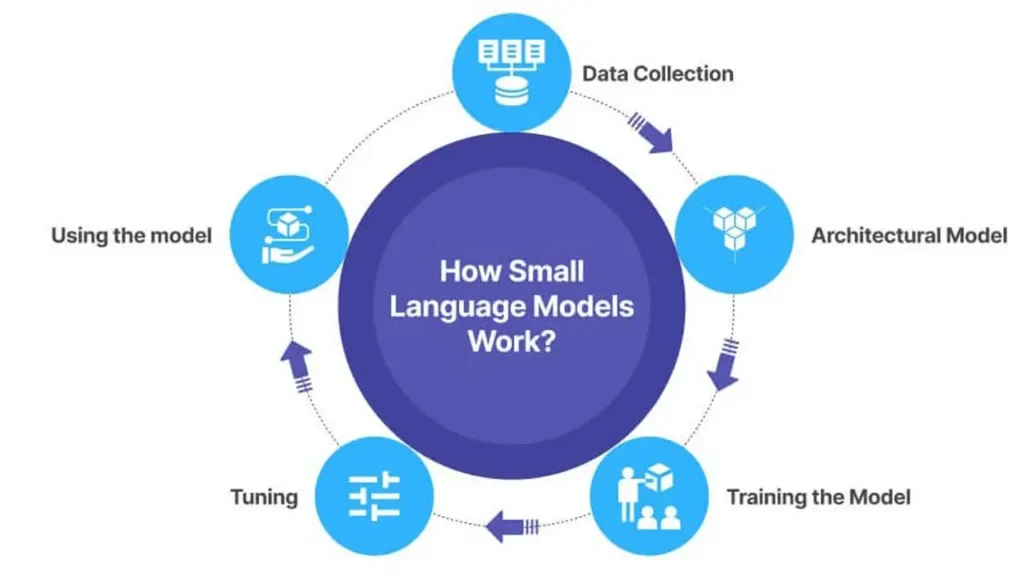
Understanding the TensorFlow Lite NLP model pipeline requires a quick look at how models get from research lab to device. The journey has several stages, and LiteRT plays a central role in making that journey efficient.
Step 1: Training in the cloud
Models like Gemma, Phi, or Falcon are initially trained on large GPU or TPU clusters in cloud environments. This is where the model learns language, reasoning patterns, and task-specific knowledge. Training a 2B parameter model still requires significant compute — but it’s orders of magnitude cheaper than training a 70B model.
Step 2: Conversion to LiteRT/TFLite format
Once trained, the model is converted using TensorFlow Lite’s conversion tools (or the newer LiteRT SDK). This conversion process transforms the model’s weights and computational graph into a flat binary format optimized for mobile and embedded inference. The .tflite file format is self-contained and portable.
Step 3: Quantization
This is one of the most important steps. Quantization reduces the precision of the model’s weights — from 32-bit floating point (FP32) down to 8-bit integers (INT8) or even 4-bit integers (INT4). This reduction in precision dramatically shrinks the model’s memory footprint and speeds up inference without a significant loss in accuracy for most NLP tasks.
According to Google’s official LiteRT documentation, INT8 quantization typically reduces model size by approximately 4x compared to FP32, with inference speed improvements of 2–3x on ARM CPUs and even greater gains on hardware with dedicated INT8 acceleration.
Step 4: Inference on device
The quantized .tflite model is loaded by the LiteRT runtime on the target device. On Android, LiteRT supports hardware acceleration via the Android Neural Networks API (NNAPI), GPU delegates, and Hexagon DSP delegates. On iOS, it integrates with Core ML. On microcontrollers, TensorFlow Lite Micro handles extremely constrained environments.
For a practical NLP task — say, classifying the intent of a user’s typed message — a 2B parameter quantized model on a mid-range Android phone might deliver results in under 100 milliseconds. A cloud-based API call for the same task, accounting for network latency, might take 500ms to several seconds.
The TensorFlow Lite NLP model pipeline, therefore, isn’t just about making models smaller. It’s about rethinking the entire inference architecture so that intelligence lives on the device.

AndreevWebStudio.com
Professional web development and design services. Custom WordPress sites, landing pages, e-commerce solutions, and 3D printing content creation for businesses and creators.
- • WordPress Development
- • Custom Web Design
- • E-Commerce Solutions
- • 3D Printing Content
Why On-Device Language Model Is Becoming the New Standard
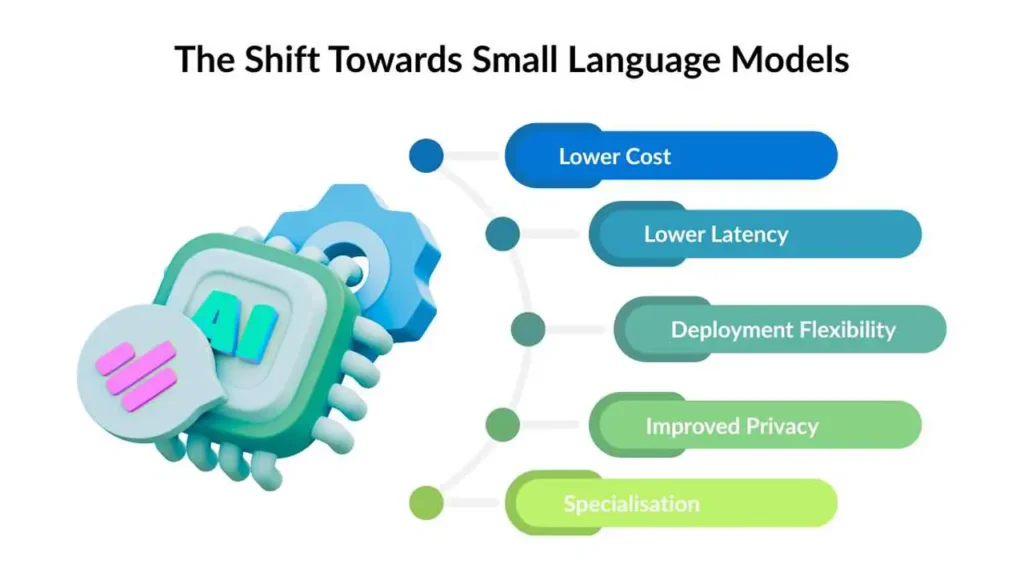
The shift toward on-device language model deployment isn’t driven by one single factor — it’s driven by a convergence of concerns that are increasingly hard to ignore.
Privacy
When you send text to a cloud-based AI service, that data travels to a server, is processed by a model running on someone else’s hardware, and potentially logged, analyzed, or retained. For a user asking a casual question, this may not feel significant. But for a doctor entering patient notes, a financial advisor summarizing a client’s portfolio, or a soldier in the field using an AI assistant, data leaving the device is an unacceptable risk.
On-device inference means data never leaves the hardware. There is no API call. There is no server log. The model runs locally, the result is generated locally, and nothing is transmitted. This is a fundamental privacy guarantee that cloud AI simply cannot offer.
Speed and Latency
Network latency is a physical constraint. Even with the fastest 5G connection, a round-trip API call introduces tens to hundreds of milliseconds of overhead — and in areas with poor connectivity, it can take seconds. For real-time applications — voice interfaces, live translation, safety-critical decision support — that latency is unacceptable.
A well-optimized on-device language model running via LiteRT on a modern smartphone can process and respond to text queries in under 100 milliseconds. That’s indistinguishable from instant for a human user.
Connectivity Independence
A significant portion of the world’s population — and virtually all remote industrial and military environments — operates with unreliable or absent internet connectivity. Deploying AI that requires cloud access to these environments is simply not viable. The on-device language model paradigm removes connectivity as a dependency entirely.
Cost
Cloud inference is not free. At scale, API costs for LLMs can be substantial. Running SLMs on-device eliminates per-query API costs, making AI economically viable for high-volume, low-margin applications.
Offline AI Language Model: Real-World Use Cases
The practical implications of the offline AI language model become vivid when you look at the industries already adopting this approach.
Healthcare
Medical professionals in rural clinics, field hospitals, or low-connectivity regions need AI assistance without cloud dependency. An offline AI language model can assist with symptom triage, medication lookup, clinical note summarization, and patient intake — all running on a tablet or smartphone with no internet connection. Patient data remains on the device, satisfying HIPAA and GDPR requirements without complex cloud data governance.
Finance
Financial advisors and auditors working with sensitive client data benefit enormously from offline AI. Document summarization, contract analysis, and anomaly detection in financial statements can all be performed locally. The regulatory benefits — no data leaving the firm’s controlled environment — are as significant as the privacy benefits.
Military and Secure Environments
Defense applications represent perhaps the most demanding use case for offline AI. In SIGINT-denied environments, in submarine operations, or in classified settings where network connections are strictly controlled, the ability to run a capable NLP model entirely offline is not a convenience — it is a mission requirement. The offline AI language model paradigm makes AI deployment feasible in environments where cloud AI is simply not an option.
Travel Applications
Travel apps that offer real-time translation, local information lookup, or conversation assistance benefit enormously from offline capability. When a traveler lands in a country with no data plan or expensive roaming, an offline language model keeps the application fully functional. Platforms serving global travelers increasingly need offline AI capability as a core product feature, not an afterthought.
Industrial IoT and Field Operations
Technicians servicing equipment in remote locations — oil rigs, wind farms, mining operations — need AI-assisted documentation, fault diagnosis, and procedure guidance without depending on connectivity. The offline AI language model enables intelligent tooling that works everywhere.
Lightweight LLM Mobile: Optimization for Smartphones
Running a language model on a smartphone presents a set of engineering challenges that don’t exist in cloud environments. The lightweight LLM mobile problem is fundamentally about fitting capable intelligence into a severely constrained resource envelope.
RAM Constraints
A typical mid-range Android phone in 2025 ships with 6–8GB of RAM. The operating system, active applications, and background processes consume a significant portion of that. A language model running on such a device needs to fit within approximately 2–4GB of RAM — which immediately rules out unquantized models above a few hundred million parameters.
Quantization — specifically INT8 and INT4 quantization — is the primary tool for solving this problem. A 2B parameter model in FP32 requires approximately 8GB of memory. The same model in INT8 requires approximately 2GB. In INT4, approximately 1GB. This compression makes on-device deployment of genuinely capable lightweight LLM mobile models feasible on mainstream hardware.
Quantization in Practice
LiteRT supports post-training quantization, quantization-aware training, and dynamic range quantization. For NLP models, quantization-aware training — where the model is trained with simulated quantization noise — typically preserves more accuracy than post-training quantization alone. Google’s official benchmarks for Gemma 2B INT8 on Pixel 8 show performance competitive with much larger cloud models on focused NLP tasks.
Pruning
In addition to quantization, pruning removes neural network weights that contribute minimally to model output. Structured pruning — which removes entire neurons or attention heads — produces models with smaller and more efficient computational graphs that run faster on mobile hardware without sacrificing accuracy on targeted tasks.
TensorFlow Lite Pipeline for Mobile
The complete LiteRT pipeline for deploying a lightweight LLM mobile model includes: model selection and task-specific fine-tuning, quantization (INT8 or INT4), graph optimization via the TFLite converter, hardware delegate selection (GPU, NNAPI, Hexagon), and runtime integration via the LiteRT Android or iOS SDK. Google’s MediaPipe framework provides higher-level APIs that abstract much of this complexity for application developers.
BestChina3DPrinters
Expert Reviews & Rankings
Independent 3D Printer Reviews
Your trusted source for Chinese 3D printer reviews, rankings, and comparisons. We buy, test, and review every printer so you can make informed decisions.
Edge AI NLP Optimization: Achieving Real Speed
Speed on edge hardware doesn’t happen automatically — it requires deliberate edge AI NLP optimization across the entire stack.
INT8 and INT4 Quantization
As discussed above, quantization is the foundational optimization. INT8 reduces memory by 4x compared to FP32; INT4 reduces it by 8x. Modern ARM processors — particularly those with dedicated NPUs like the Qualcomm Hexagon or Google’s Tensor chip — have hardware-accelerated INT8 and INT4 operations that deliver inference speeds multiple times faster than FP32 on the same hardware.
Knowledge Distillation
Distillation is the process of training a smaller “student” model to mimic the behavior of a larger “teacher” model. The student learns not just from the training data, but from the probability distributions output by the teacher — which contain richer information than hard labels. Distilled SLMs can achieve performance close to their larger teachers on specific tasks while being a fraction of the size. Google’s Gemma models, for example, benefit from distillation techniques that preserve instruction-following capability at the 2B scale.
Hardware Acceleration: The NPU Advantage
Modern mobile SoCs (System on Chip) increasingly include dedicated Neural Processing Units. Qualcomm’s Hexagon NPU, Apple’s Neural Engine, and Google’s Tensor Processing Core are all examples. These silicon blocks are specifically designed to accelerate the matrix multiply operations that dominate neural network inference. LiteRT’s hardware delegates allow models to offload computation to these units automatically, delivering inference speeds that would be impossible on CPU alone.
Attention Mechanism Optimization
Transformer-based language models spend significant compute on self-attention operations. Techniques like multi-query attention (MQA), grouped-query attention (GQA), and sliding window attention reduce the computational cost of attention without proportionate accuracy loss. Models designed specifically for edge AI NLP optimization — like Gemma, Phi-3-mini, and MobileLLM — incorporate these architectural choices from the ground up.
SLM vs LLM Performance: An Honest Comparison
One of the most common questions about the SLM vs LLM performance debate is simple: what do you actually give up when you go small? The answer is nuanced — and for most edge AI applications, it’s less than you might expect.
BestChina3DPrinters
Expert Reviews & Rankings
Independent 3D Printer Reviews
Your trusted source for Chinese 3D printer reviews, rankings, and comparisons. We buy, test, and review every printer so you can make informed decisions.
The honest SLM vs LLM performance picture is this: for complex, open-ended reasoning tasks — multi-step mathematical problem solving, long-form creative writing, nuanced ethical debate — large LLMs retain a significant advantage. The sheer scale of their training and parameter count gives them capabilities that SLMs simply cannot match.
But for the vast majority of real-world production NLP tasks — intent classification, named entity recognition, short-form summarization, translation of common phrases, document question answering, and voice command parsing — a well-fine-tuned LiteRT small language model in the 1–3B range delivers results that are genuinely competitive with much larger models, while doing so in milliseconds, on-device, with zero API cost.
The conclusion is not “SLMs are better than LLMs.” The conclusion is “SLMs and LLMs serve different problems — and for edge AI, SLMs win comprehensively.”
AI Model for Embedded Devices: Market and Outlook
The market for AI models for embedded devices is expanding rapidly across several verticals, and the LiteRT ecosystem is positioned at the center of that expansion.
IoT and Industrial Sensors
Industrial IoT deployments — manufacturing floor sensors, predictive maintenance systems, quality control cameras — increasingly require on-device intelligence. Running a lightweight NLP model on an industrial gateway device allows natural language interaction with equipment logs, automated anomaly reporting in plain language, and voice-controlled interfaces for hands-busy workers. The AI model for embedded devices market in industrial IoT is projected to grow significantly through 2028 as edge AI hardware becomes more capable and affordable.
Automotive Applications
In-vehicle AI is another major growth sector. Modern vehicles increasingly include dedicated AI accelerator chips capable of running SLMs for natural language voice interfaces, driver assistance documentation, real-time translation for international travelers, and context-aware navigation assistance. Crucially, automotive AI must function reliably without cellular connectivity — making the LiteRT small language model approach architecturally ideal. The transition to more capable in-vehicle AI, particularly in the Chinese automotive market which leads globally in smart vehicle integration, illustrates how rapidly embedded AI is moving from novelty to expectation.
Smart Home and Consumer Electronics
Smart speakers, home security systems, smart televisions, and connected appliances are all increasingly incorporating on-device NLP capabilities. Users expect voice interfaces to respond immediately and reliably — even when the home internet goes down. The shift from cloud-dependent smart devices to locally intelligent ones is already underway, and LiteRT-based SLMs are a key enabling technology for this transition. The smart device market in Asia, particularly in China and South Korea, is pioneering many of these embedded AI integrations ahead of Western markets.
Healthcare Wearables
Smartwatches and medical monitoring wearables represent an extreme end of the embedded AI spectrum. Devices with limited processors, small batteries, and no reliable connectivity need AI capabilities for health monitoring, symptom logging, medication reminders, and emergency alerting. TinyML NLP — the most constrained end of the SLM spectrum — is beginning to make language understanding viable even on these ultra-low-power devices.
Low Parameter Language Model and the Future of TinyML NLP
Looking ahead to 2026 and beyond, the trajectory for low parameter language models and TinyML NLP models is clear: they will become more capable, more efficient, and more ubiquitous.
The 2026–2030 Trajectory
Several converging trends are accelerating this future. First, hardware is improving faster than software. Each new generation of mobile SoCs delivers meaningfully more NPU performance at the same or lower power envelope. Qualcomm’s Snapdragon 8 Elite, Apple’s A18 Pro, and Google’s Tensor G4 all represent significant leaps in on-device AI performance compared to their predecessors — and the roadmap for 2026 and 2027 suggests continued rapid improvement.
Second, training techniques are improving. Advances in knowledge distillation, efficient attention mechanisms, and task-specific fine-tuning mean that models with fewer parameters can approach the task performance of much larger models. Phi-3-mini (3.8B parameters) from Microsoft, for example, achieves benchmark scores competitive with models several times its size — demonstrating that the “bigger is better” assumption is being actively dismantled by research.
Third, the ecosystem is maturing. Google’s investment in LiteRT as the successor to TensorFlow Lite signals a long-term commitment to on-device AI infrastructure. The availability of Gemma 2B, Gemma 7B, and their successors as first-party supported models for the LiteRT runtime means application developers have production-ready, well-documented, officially supported SLMs to build on.
Autonomous AI Without the Cloud
The philosophical endpoint of this trajectory is significant: AI without the cloud as the new standard. For the past decade, the dominant paradigm has been “intelligence in the cloud, interface on the device.” The LiteRT small language model ecosystem represents a fundamental inversion of that model: intelligence on the device, cloud as optional enhancement.
This shift has profound implications. It means AI becomes available to the billions of people who lack reliable internet access. It means AI becomes viable in environments — medical, military, industrial — where cloud connectivity is impossible or unacceptable. It means the economics of AI change, as per-query API costs give way to one-time model deployment costs. And it means privacy becomes structurally guaranteed rather than contractually promised.
The TinyML NLP model — running on microcontrollers with kilobytes of RAM, performing basic intent recognition or keyword spotting — represents the extreme end of this spectrum today. But as hardware and algorithms continue to improve, what is “tiny” today will encompass capabilities that seem remarkable.
By 2030, the expectation is not that every AI task will move to the edge — complex reasoning, large-scale data analysis, and creative generation will likely remain cloud-dominant. But for the broad middle ground of practical NLP tasks that billions of people and billions of devices need every day, the LiteRT small language model running entirely on-device will be the default, not the exception.
Conclusion
The LiteRT small language model represents one of the most practically important developments in applied AI in 2025 and 2026. It is not the most glamorous corner of the AI landscape — it lacks the dramatic benchmark scores of GPT-4 or the cultural cachet of multimodal foundation models. But it is arguably more consequential for the daily lives of real users and the practical deployment of AI in production environments.
By combining Google’s mature LiteRT runtime with increasingly capable small language models in the 1–3B parameter range, developers now have access to a complete, production-ready stack for deploying offline, private, fast, and cost-effective NLP intelligence on the devices that people actually use.
For edge AI, the future is already here. It fits in your pocket, runs without Wi-Fi, and doesn’t send your data anywhere. That’s not a compromise. That’s progress.
🇬🇧 John Miller ⭐⭐⭐⭐⭐
Absolutely impressed with the article on LiteRT small language models. The content is clear, practical, and explains complex AI concepts in a simple way. I especially liked the focus on edge AI and offline capabilities — super relevant today. The site is fast, well-structured, and easy to navigate. Highly recommended for anyone exploring AI trends.
🔗 https://aiinovationhub.com
🇪🇸 Carlos Rodríguez ⭐⭐⭐⭐⭐
Excelente artículo sobre modelos de lenguaje pequeños LiteRT. Explica muy bien cómo funcionan en dispositivos edge y sin conexión. El contenido es fácil de entender incluso para principiantes. El sitio es moderno y muy útil para aprender sobre inteligencia artificial.
🔗 https://aiinovationhub.com
🇸🇦 Ahmed Al-Farouq ⭐⭐⭐⭐⭐
مقال رائع حول نماذج اللغة الصغيرة LiteRT. الشرح بسيط وواضح ويغطي موضوع الذكاء الاصطناعي على الأجهزة بدون اتصال بالإنترنت بشكل احترافي. الموقع منظم وسريع ويقدم محتوى عالي الجودة. أنصح بزيارته بشدة.
🔗 https://aiinovationhub.com
🇨🇳 Li Wei ⭐⭐⭐⭐⭐
这篇关于LiteRT小型语言模型的文章非常有价值。内容清晰,解释了边缘AI和离线模型的优势。网站设计简洁,信息丰富,非常适合对人工智能感兴趣的人。
🔗 https://aiinovationhub.com
🇫🇷 Pierre Dubois ⭐⭐⭐⭐⭐
Article très intéressant sur les modèles LiteRT small language model. Les explications sont claires et modernes, surtout sur l’IA embarquée et hors ligne. Le site est bien structuré et agréable à lire. Une excellente ressource pour suivre les tendances AI.
🔗 https://aiinovationhub.com
🇩🇪 Lukas Schneider ⭐⭐⭐⭐⭐
Sehr informativer Artikel über LiteRT Small Language Models. Besonders die Erklärungen zu Edge AI und Offline-Nutzung sind hilfreich. Die Website ist übersichtlich und bietet hochwertige Inhalte. Perfekt für alle, die sich mit moderner KI beschäftigen.
🔗 https://aiinovationhub.com