
What if a single AI model could spin up a hundred specialized agents, assign each one a unique task, run them all simultaneously, and stitch the results into one polished output — all without you writing a single line of orchestration code? That is not a thought experiment anymore. That is exactly what Kimi K2.5 Swarm AI agents do, and it is reshaping how developers, researchers, and enterprises think about artificial intelligence at scale.
Moonshot AI released Kimi K2.5 on January 27, 2026, as a native multimodal model trained on 15 trillion tokens, featuring major upgrades in visual reasoning and coding — and introducing the Agent Swarm paradigm as its headline capability. In this article, we will break down every important dimension of this technology: how it works, why it matters, real-world use cases, and what it means for the future of AI agent systems.
What Is Multi Agent AI Coordination in Kimi K2.5 Swarm AI Agents
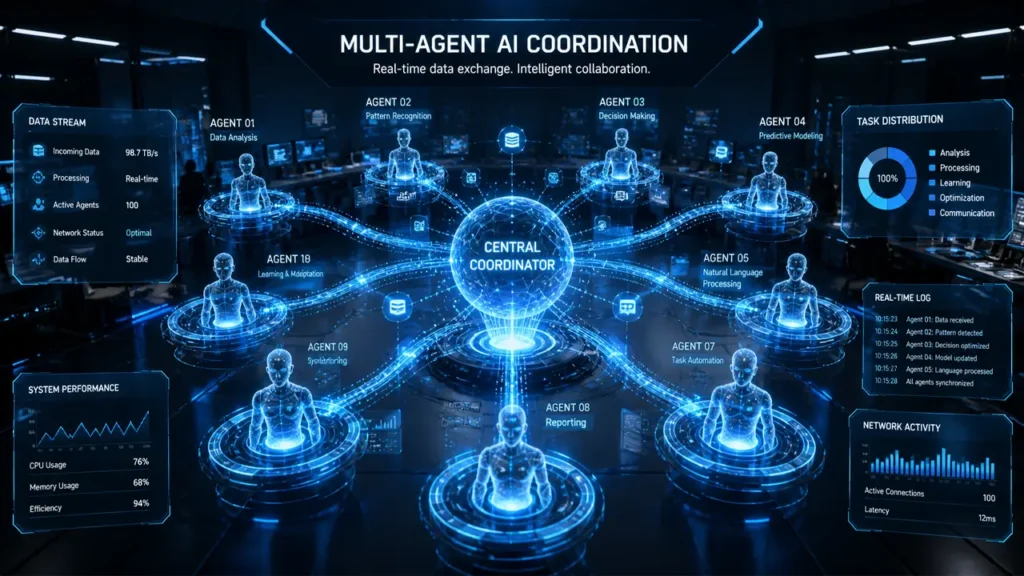
Before we go deep into the technical specifics, let us start with a simple mental model. Imagine you are managing a large research project. If you do it alone, you work through one task at a time. But if you have a team of 100 specialists — each working on their own piece simultaneously — the project gets done in a fraction of the time, and the results are far richer.
That is the core idea behind multi-agent AI coordination. Instead of one AI model processing everything sequentially, you have many agents collaborating, each handling a specific slice of the work.
In Kimi K2.5, the Agent Swarm has an orchestrator that dynamically creates specialized subagents — for example an AI Researcher, a Physics Researcher, or a Fact Checker — and decomposes complex tasks into parallelizable subtasks for efficient distributed execution. The orchestrator is not following a script you wrote in advance. It decides on the fly which agents to create, what each one should do, and when to delegate. This is self-directed coordination, and it is one of the most significant leaps in multi-agent AI design to date.
The result is a system that feels less like a chatbot and more like a small autonomous company, one that you direct at the highest level and that handles all the internal management itself.
How Kimi K2.5 Swarm AI Agents Manage a Parallel AI Agents System
Running 100 agents in parallel sounds powerful on paper, but making it work reliably is a different challenge entirely. How does the model avoid duplication? How does it keep agents from going off-track? How does it merge all those independent outputs into something coherent?
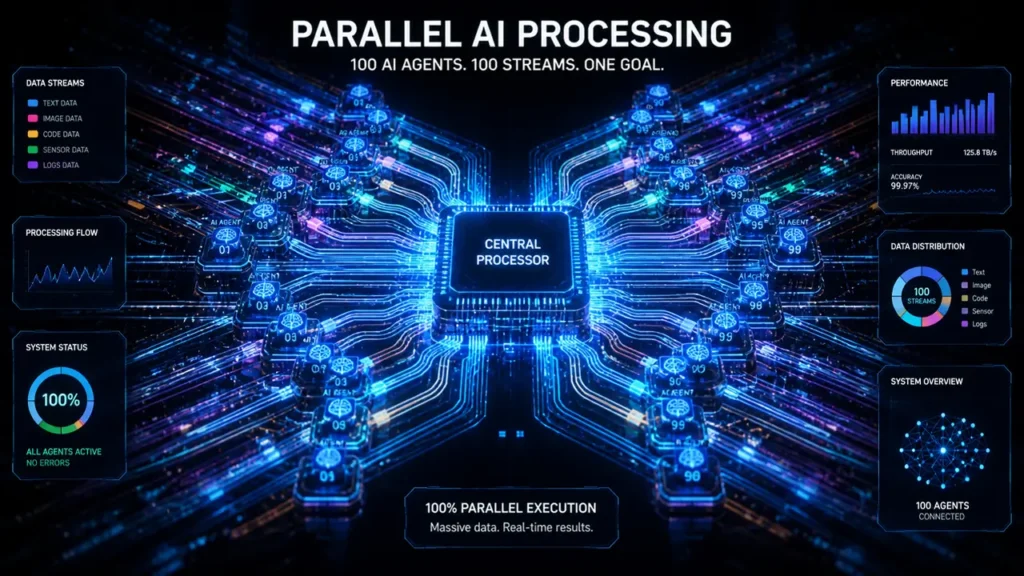
Moonshot AI addressed these engineering challenges by developing a new reinforcement learning technique called Parallel Agent Reinforcement Learning, or PARL. PARL was specifically created to train Kimi K2.5 to decompose and parallelize complex tasks while overcoming three key problems: training instability, ambiguous credit assignment, and what the team called “serial collapse” — a failure mode where the orchestrator simply runs a single long chain of steps instead of genuinely splitting work across agents.
In practice, the parallel agents system works like this. The orchestrator receives a complex task, analyzes it, and identifies which subtasks are independent enough to be handled simultaneously. It then instantiates the right number of domain-specific agents, distributes the subtasks, monitors progress, and eventually synthesizes all the results. The in Swarm Mode, the main and sub-agents are allowed a maximum of 100 steps each, giving the system a well-defined operating envelope.
The performance gains are striking. According to Moonshot AI’s official evaluations, Agent Swarm reduces end-to-end runtime by up to 80% compared to a single-agent baseline, and reduces the minimum number of critical steps needed to achieve target performance by a factor of 3x to 4.5x. For time-sensitive work — whether that is research, software engineering, or data analysis — these numbers represent a dramatic practical upgrade.
BestChina3DPrinters
Expert Reviews & Rankings
Independent 3D Printer Reviews
Your trusted source for Chinese 3D printer reviews, rankings, and comparisons. We buy, test, and review every printer so you can make informed decisions.
Architecture of Distributed AI Agents in Kimi K2.5 Swarm AI Agents
To understand why Kimi K2.5 can do what it does, you need a quick look under the hood. The model is built on the same Mixture-of-Experts architecture introduced in the original Kimi K2. It has 1 trillion total parameters, but only 32 billion are activated on any given token. A router selects 8 experts out of 384 for each forward pass, which means the model achieves the reasoning depth of a massive network while keeping latency and cost much closer to a smaller model.
For visual intelligence, Kimi K2.5 adds Moonshot’s MoonViT-3D vision encoder. The team started from a Kimi K2 checkpoint and continued pre-training with an additional 15 trillion tokens of mixed visual and text data, followed by supervised fine-tuning and reinforcement learning. The result is a model that reasons natively across both modalities — it does not simply attach vision as an afterthought.
The distributed architecture of the Agent Swarm is designed around a supervisor-plus-workers topology. The orchestrator acts as the supervisor. It maintains a global view of the task, tracks which subtasks are complete, and handles the final synthesis. Each subagent operates within its own context, focused on one piece of the problem. Crucially, the system features what Moonshot AI calls “proactive context control,” which reduces the risk of context overflow and effectively scales overall context length without requiring constant context summarization. This is important because with 100 agents all building up context simultaneously, memory management becomes a critical bottleneck — and Kimi K2.5 handles it natively.
The model supports a context window of 256,000 tokens, giving both the orchestrator and subagents enough room to handle complex, information-dense tasks without running out of working memory.
Real Use Cases of AI Multi Agent Systems in Kimi K2.5 Swarm AI Agents
Theory is great, but use cases are where technology earns its reputation. Here are concrete examples of how Kimi K2.5 Swarm AI agents are being applied across different domains.
Content Research at Scale In one of Moonshot AI’s own demonstrations, the Agent Swarm was given the task of identifying leading YouTube creators across 100 different niches. The orchestrator researched and defined each niche, then autonomously created 100 subagents to conduct parallel searches. Each subagent identified leading creators within its assigned niche, and the results — 300 YouTuber profiles in total — were aggregated into a structured spreadsheet. A task that might take a human team days was completed in a fraction of the time.
Software Engineering Kimi K2.5 includes a dedicated Agent mode with a set of preconfigured tools for software engineering tasks. It integrates with Kimi Code CLI, and is optimized for terminal use and IDEs including VSCode and Cursor. It supports vision-to-code generation, meaning it can look at a screenshot of a user interface and generate the front-end code for it. The model can also reason over massive codebases thanks to its extended context window.
Office Productivity The Agent mode handles high-density office work end to end. It can reason over large inputs, coordinate multi-step tool use, and deliver professional-quality outputs: documents, spreadsheets, PDFs, and slide decks — all directly through conversation. Moonshot AI designed two internal benchmarks to measure this: the AI Office Benchmark for end-to-end output quality, and the General Agent Benchmark for multi-step production-grade workflows.
Scientific Research Pipelines In another documented example, the Agent Swarm turned an astrophysics paper into a reusable analytical skill and generated a 40-page report, a 20,000-entry dataset, and 14 astronomy charts — all autonomously, running tasks in parallel across multiple agents.
Recruitment and HR Automation Moonshot AI demonstrated a case where 100 subagents each matched a single CV against a unique California job listing, producing 100 tailored resumes — simultaneously. This kind of parallel, personalized processing would be prohibitively slow with a single-agent system.
Autonomous AI Agents Collaboration Inside Kimi K2.5 Swarm AI Agents
One of the most fascinating aspects of Kimi K2.5 is how the agents actually “talk” to each other — or more precisely, how they do not need to talk in the way humans do. The collaboration is structural rather than conversational.
The orchestrator does not send messages back and forth with subagents in real time. Instead, it assigns scoped tasks with well-defined inputs and expected output formats. Each subagent operates independently within its scope, and the orchestrator collects and synthesizes the outputs when they are ready. This design avoids the communication overhead that would slow down a more chatty multi-agent architecture.
What makes this genuinely autonomous is that the orchestrator decides the structure of collaboration dynamically. Unlike traditional agentic frameworks where a human developer must define the workflow, the subagents, and the routing logic in advance, Kimi K2.5 makes those decisions itself at runtime. As Moonshot AI described it, the model decides when a new subagent is necessary, what it should do, and when to delegate work to it — without any pre-defined playbook.
This self-directed quality is what separates Kimi K2.5’s approach from earlier multi-agent frameworks. The intelligence lives inside the model, not in external orchestration scaffolding.
AI Agents Parallel Processing Power in Kimi K2.5 Swarm AI Agents
Speed and scale are where the Kimi K2.5 Swarm AI agents system really demonstrates its practical value. The key performance metric is wall-clock time — the actual elapsed time from when you submit a task to when you receive a completed result.
Kimi K2.5 can handle up to 1,500 parallel tool calls across its swarm. When compared to single-agent execution on wide search tasks, Agent Swarm reduces the critical path by 3x to 4.5x. The official technical report states an 80% reduction in end-to-end runtime in internal evaluations. These are not marginal improvements. They represent a qualitative shift in what is possible within a practical time window.
Consider what this means for a developer or researcher. A task that previously took an hour of compute time now takes roughly 15 minutes. A task that previously required a day of sequential AI work can potentially be completed before lunch. At enterprise scale — where thousands of such tasks run every week — the cumulative time savings are transformative.
The parallel processing capability also has implications for cost. Moonshot AI has aggressively priced the K2.5 API to make the swarm features economically viable. Input is priced at 60 cents per million tokens, cached input at 10 cents per million tokens, and output at 3 dollars per million tokens. The low cost of cached inputs is particularly relevant for Agent Swarm workflows, which often require maintaining large context windows across multiple subagents and extensive tool usage.
Swarm Intelligence AI Platform: Why Kimi K2.5 Swarm AI Agents Stand Out
There are other multi-agent AI frameworks and platforms in the market. What makes Kimi K2.5 different?
The most important distinction is that the swarm intelligence is embedded inside the model itself, not bolted on as an external layer. Most multi-agent frameworks — LangGraph, AutoGen, CrewAI, and similar tools — require a developer to define agents, assign roles, and configure the routing logic manually. Kimi K2.5 internalizes this entire process. The model was trained specifically to orchestrate itself.
This has practical implications. It means lower setup overhead for teams that want to deploy agent workflows. It means the orchestration decisions benefit from the model’s full reasoning capability, not a separate and potentially weaker routing layer. And it means the system can adapt dynamically to the structure of each unique task, rather than following a fixed blueprint.
On benchmarks, Kimi K2.5 holds its own against the leading closed models. On BrowseComp — a benchmark measuring research and information retrieval — Kimi K2.5 outperformed GPT-5.2 Pro. On WideSearch, it outperformed Claude Opus 4.5. On the Humanity’s Last Exam full benchmark with tools enabled, it achieved a score of 51.8 on text tasks and 39.8 on image tasks.
The model is also fully open-weight. Both the code repository and model weights are released under a Modified MIT License, which allows use, modification, and commercial deployment — making it accessible to a far wider range of developers and organizations than closed proprietary systems.
Here is a quick comparison of Kimi K2.5 Agent Swarm against single-agent alternatives:
Agentic Swarm Efficiency Matrix
Evaluating the architectural leap from sequential logic to Kimi K2.5 Parallel Swarms. Analyzing the transition from manual workflow orchestration to self-directed, multi-agentic system sovereignty.
| Strategic Pillar | Kimi K2.5 (Agent Swarm) | Typical Single-Agent |
|---|---|---|
| Parallel Orchestration & Concurrency | ||
|
Agent Concurrency
|
100 Agents
Autonomous Sub-Swarm
|
1 Unit
Sequential Only
|
| Parallel Tooling |
1,500 Calls
Simultaneous Execution
|
Sequential Bottleneck |
| Cognitive Efficiency & Runtime | ||
| Runtime Reduction |
80% Reduction
Delta vs Single-Agent
|
Baseline (0%) |
| Orchestration Setup | Self-Directed | Manual Workflow |
| Vision Architecture | Native MoonViT-3D | Text-centric Add-on |
| Economic Sovereignty & Governance | ||
| Input Cost / 1M |
$0.60
|
$1.50 – $15.00
|
| Model Governance | Modified MIT (Open) | Closed API / Restricted |
Kimi K2.5 Swarm
Native MoonViT-3D vision and self-directed orchestration enable massive parallel tasks with proactive context control.
Single-Agent Systems
Sequential task execution with manual workflow overhead and external summarization requirements.
Large Scale AI Agent Orchestration and the Future of AI Agent Systems
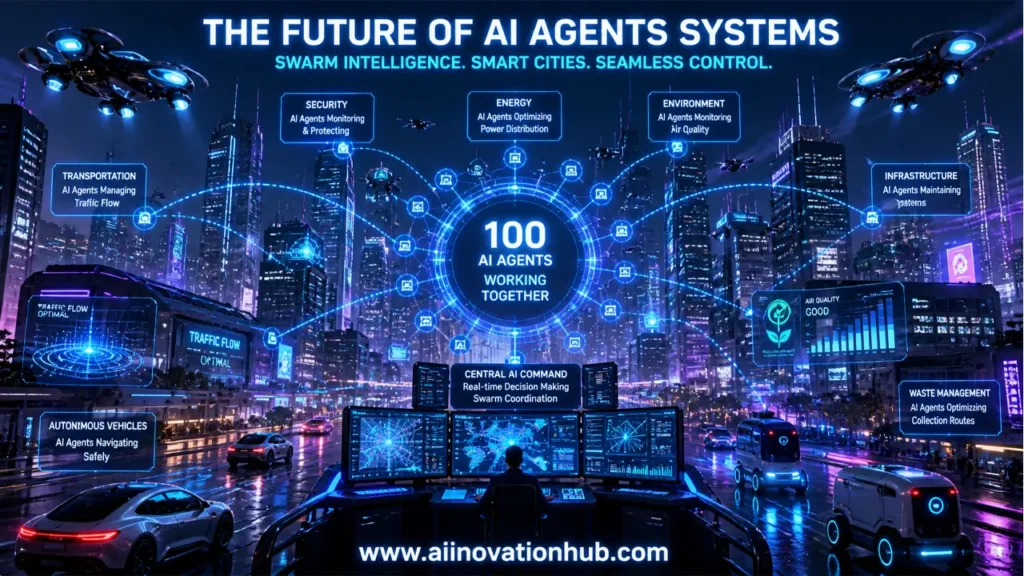
Kimi K2.5 did not arrive in a vacuum. It is part of a broader and accelerating trend toward large-scale AI agent orchestration — the idea that the most powerful AI applications of the near future will not be single models answering single questions, but coordinated networks of agents tackling complex, long-horizon problems autonomously.
The trajectory is already visible in Moonshot AI’s own roadmap. The successor model Kimi K2.6, released on April 20, 2026, pushes the Agent Swarm system to 300 sub-agents and 4,000 coordinated steps, up from 100 agents and 1,500 steps in K2.5. K2.6 also extends the context window to 262,144 tokens and introduces a “Claw Groups” research preview, which lets agents running on different devices and different underlying models collaborate with a human in a shared workspace. These are not incremental tweaks — they are architectural expansions that define what large-scale AI orchestration will look like in production.
For enterprises, this shift has profound implications. The primary bottleneck for AI-assisted work is no longer model intelligence — it is the ability to scale that intelligence across many parallel workstreams simultaneously. A single engineer directing a swarm of 100 autonomous sub-agents can accomplish what previously required entire teams. This changes how organizations think about AI investment, headcount, and the design of automated business processes.
For the open-source community, Kimi K2.5 represents a meaningful proof point that frontier-grade agentic intelligence does not have to live behind a closed API. With open weights, a permissive license, and compatibility with standard inference engines like vLLM and SGLang, the model puts genuine swarm-scale AI capability into the hands of any developer with the right hardware.
The broader direction is toward what researchers and industry analysts are calling “AI-native workflows” — business processes that are designed from the ground up around autonomous agents, rather than processes where AI is retrofitted onto existing human workflows. Kimi K2.5 is one of the clearest early signals of what that future looks like in practice.
Final Verdict on Kimi K2.5 Swarm AI Agents
So where does Kimi K2.5 land in the landscape of modern AI, and is it worth your attention?
The short answer is yes — and for more than one reason.
From a technical standpoint, the Agent Swarm is a genuinely novel contribution. The combination of PARL training, self-directed orchestration, proactive context control, and native multimodality produces a system that is qualitatively different from bolting a multi-agent framework onto an existing LLM. The benchmarks back this up: performance at or above GPT-5.2 and Claude Opus 4.5 on key agentic evaluations, with an 80% runtime reduction over single-agent baselines.
From a practical standpoint, the open-weight release under a Modified MIT License is a significant gift to the developer community. Combined with very competitive API pricing and compatibility with standard tooling, Kimi K2.5 is genuinely accessible — not just theoretically available.
From a strategic standpoint, Moonshot AI’s rapid iteration from K2 to K2.5 to K2.6 within less than a year signals a team that is moving with serious velocity. Organizations building AI-powered products or workflows should absolutely be tracking this model family.
The honest caveat is that Agent Swarm is still in beta, and like all beta technology, real-world deployments will surface edge cases and limitations that benchmarks do not capture. Prompt engineering, task decomposition quality, and the specific domain of work will all influence how well the swarm performs in your specific context.
But as a demonstration of what multi-agent AI coordination can look like when it is built into the model rather than assembled on top of it, Kimi K2.5 is one of the most compelling examples available today. Whether you are a developer, a researcher, or an enterprise technology leader, this is a system worth understanding deeply — because the architectural ideas it embodies are going to define AI agent systems for years to come.
🇺🇸 English Review
This article about Kimi K2.5 Swarm is seriously impressive. The explanation of how 100 AI agents work together is clear, engaging, and easy to understand even for beginners. The site aiinovationhub.com delivers high-quality insights into real AI trends. Definitely worth bookmarking if you want to stay ahead in AI.
🇪🇸 Reseña en Español
Este artículo sobre Kimi K2.5 Swarm es increíblemente interesante. Explica de manera clara cómo funcionan 100 agentes de IA en paralelo. El sitio aiinovationhub.com ofrece contenido moderno y útil sobre inteligencia artificial. Muy recomendable para quienes quieren entender el futuro de la tecnología.
🇸🇦 مراجعة باللغة العربية
هذا المقال عن Kimi K2.5 Swarm مميز للغاية. يشرح بطريقة بسيطة كيف يمكن لـ 100 وكيل ذكاء اصطناعي العمل معًا في نفس الوقت. موقع aiinovationhub.com يقدم محتوى احترافي ومفيد لكل من يهتم بعالم الذكاء الاصطناعي. أنصح بمتابعته باستمرار.
🇨🇳 中文评价
这篇关于Kimi K2.5 Swarm的文章非常有价值。它清晰地解释了100个AI代理如何同时协同工作。aiinovationhub.com提供了高质量的人工智能内容,非常适合想了解AI未来发展的人阅读。强烈推荐!
🇫🇷 Avis en Français
Cet article sur Kimi K2.5 Swarm est vraiment fascinant. Il explique clairement comment 100 agents d’IA peuvent fonctionner en parallèle. Le site aiinovationhub.com propose un contenu de grande qualité sur les technologies modernes. À lire absolument pour rester à jour dans le domaine de l’IA.
🇩🇪 Bewertung auf Deutsch
Dieser Artikel über Kimi K2.5 Swarm ist äußerst informativ. Die Funktionsweise von 100 parallel arbeitenden KI-Agenten wird verständlich erklärt. Die Website aiinovationhub.com bietet hochwertigen Content über aktuelle AI-Trends. Sehr empfehlenswert für alle, die sich für Zukunftstechnologien interessieren.