
1. Introduction: Why Flux 2 AI Image Generator Is the New “Noisy” Star of Generative Graphics
The landscape of generative artificial intelligence has undergone a seismic shift in late 2025, a transformation largely driven by the meteoric rise of the Flux 2 AI image generator. In an industry previously dominated by the aesthetic hegemony of Midjourney and the corporate ubiquity of OpenAI’s DALL-E, a new contender has emerged from the technological heart of Europe.
The Flux 2 AI image generator is not merely another iteration in the endless parade of diffusion models; it represents a fundamental rethinking of how visual intelligence should be architected, distributed, and integrated into professional workflows. The “noise” surrounding this release is deafening, yet unlike the ephemeral hype cycles that characterize much of the tech sector, the excitement around the Flux 2 AI image generator is grounded in substantial technological breakthroughs and a disruptive “open core” philosophy that challenges the walled gardens of its predecessors.
The Flux 2 AI image generator has rapidly ascended to become the focal point of the generative graphics conversation because it addresses the core frustrations of the professional creative class. While earlier models dazzled hobbyists with surrealist capabilities, they often failed the “production test”—the rigorous demands of prompt adherence, spatial logic, and character consistency required by design studios and marketing agencies.
The Flux 2 AI image generator enters the arena with a promise of “visual intelligence” rather than mere image synthesis. This distinction is critical. By prioritizing a deep understanding of the physical world, accurate text rendering, and multi-reference conditioning, the Flux 2 AI image generator bridges the uncanny valley that has long separated AI-generated novelties from usable industrial assets.
Central to the narrative of the Flux 2 AI image generator is the concept of “open weights.” In an era where leading AI labs are increasingly closing their doors, Black Forest Labs (BFL) has taken a bold stance by releasing powerful versions of the Flux 2 AI image generator to the community. This strategic decision has galvanized a global army of developers, researchers, and artists who are now building the next generation of creative tools on top of the Flux architecture. From local deployments on NVIDIA RTX GPUs to serverless inference on Cloudflare’s edge network, the Flux 2 AI image generator is becoming the ubiquitous infrastructure of the visual web.
As we delve into this comprehensive analysis, we will explore why the Flux 2 AI generator is being hailed as the most significant release of 2025. We will examine the architectural innovations that allow the Flux 2 AI generator to render 4-megapixel images with photorealistic fidelity. We will dissect the business strategy that propelled Black Forest Labs to a multi-billion dollar valuation. And, crucially, we will provide the context needed to understand why professionals are migrating from established platforms to the Flux 2 AI generator.
For those seeking to navigate this complex ecosystem, the Flux 2 AI generator represents not just a tool, but a platform—a foundational layer that is best understood through deep technical engagement, with resources like aiinovationhub.com serving as a critical gateway for mastering these new capabilities.
The ubiquity of the Flux 2 AI generator in current discourse is also a reflection of its versatility. It is no longer sufficient for a model to simply exist; it must integrate. The Flux 2 AI generator has achieved this through strategic partnerships with industry titans like Adobe, enabling it to live directly inside Photoshop, and infrastructure giants like Cloudflare, allowing it to run on the edge.
This report will detail how the Flux 2 AI generator is reshaping the economics of creativity, offering a “best of both worlds” scenario where open innovation meets enterprise-grade reliability. The Flux 2 AI generator is, without hyperbole, the new standard bearer for generative graphics, and its impact will be felt for years to come.
Ready to go beyond reviews and actually use the smartest AI tools in your daily workflow? Explore curated AI apps, prompts and automation bundles on our new marketplace at https://aiinnovationhub.shop/ — handpicked for creators, founders and students who want real productivity boosts, not just hype and buzzwords, draining their energy completely.
2. Black Forest Labs Flux 2: Team, History, Investors, and Strategy
To fully grasp the significance of the Black Forest Labs Flux 2 release, one must first understand the pedigree of the organization behind it. Black Forest Labs is not a scrappy startup finding its footing; it is a high-precision engineering powerhouse born from the very team that ignited the generative AI revolution. The founders, including Robin Rombach, Andreas Blattmann, and Patrick Esser, were the key researchers behind the original Stable Diffusion models at Stability AI and the CompVis group at LMU Munich.
Their departure and subsequent founding of Black Forest Labs signaled a desire to return to the roots of scientific rigor and open scientific collaboration, principles that are deeply embedded in the DNA of the Flux 2 AI generator.
The Black Forest Labs Flux 2 strategy is predicated on the belief that visual intelligence is a fundamental technology that should not be monopolized. This “Open Core” philosophy distinguishes them sharply from competitors like Midjourney or Google. While others build moats, Black Forest Labs builds bridges. By releasing the weights of the Flux 2 AI generator (specifically the [dev] variants), they invite the global research community to scrutinize, optimize, and build upon their work.
This crowdsourced R&D creates a feedback loop that accelerates the development of the Flux 2 AI generator far faster than any single internal team could achieve. However, this is balanced by a pragmatic commercial strategy involving the Black Forest Labs Flux 2 [pro] models—API-gated, high-performance engines designed for enterprise scale and safety.
This dual approach has resonated profoundly with the venture capital community. In late 2025, the company secured a staggering $300 million Series B funding round, propelling the valuation of Black Forest Labs to $3.25 billion post-money. This is not merely a financial milestone; it is a validation of the Flux 2 AI generator as a critical piece of global AI infrastructure. The round was led by Salesforce Ventures and AMP, with participation from a broad coalition including Andreessen Horowitz (a16z), NVIDIA, General Catalyst, and Temasek.
The involvement of NVIDIA as a strategic investor is particularly noteworthy for the Flux 2 AI generator. It suggests that the hardware giant views Flux not just as software, but as a workload that drives demand for their next-generation Blackwell chips. This partnership ensures that the Flux 2 AI image generator is optimized at the hardware level, utilizing FP8 quantization and tensor core acceleration to deliver performance that outperforms unoptimized competitors. It is a symbiotic relationship: NVIDIA provides the compute, and the Flux 2 AI generator provides the reason to use it.
Furthermore, the integration of Black Forest Labs Flux 2 into the ecosystems of other investors, such as Canva and Adobe (via Adobe Ventures), creates a built-in distribution network. The Flux 2 AI generator is not fighting for users one by one; it is being deployed wholesale to millions of creatives through the tools they already use daily. This B2B2C (Business to Business to Consumer) strategy allows Black Forest Labs to focus on model architecture while partners handle the user interface and customer acquisition.
The rapid ascent of the Flux 2 AI generator also positions Black Forest Labs as the primary European challenger in the generative AI arms race. Based in Freiburg, Germany, but with a footprint in San Francisco, the company embodies a transatlantic synthesis of European academic rigor and Silicon Valley scaling ambition. As regulations around AI tighten, particularly in the EU, having a “homegrown” champion like Black Forest Labs Flux 2 becomes strategically important for the continent’s digital sovereignty. The Flux 2 AI generator is thus more than a product; it is a geopolitical asset in the battle for AI supremacy.
Ultimately, the strategy behind Black Forest Labs Flux 2 is one of ubiquity. By making the Flux 2 AI image generator the most accessible, most capable, and most integratable model on the market, they aim to become the default standard—the “Linux of visual synthesis.” Whether via a paid API call or a local GPU run, the goal is for every AI-generated image in the future to trace its lineage back to the Flux architecture. This ambition, fueled by deep pockets and deeper research, drives the relentless hype and adoption we see today on platforms like aiinovationhub.com.
3. Transition from FLUX.1 to FLUX.2: Architecture, Parameters, and Quality
The evolution from Flux 1 vs Flux 2 represents a quantum leap in the capabilities of generative media. While FLUX.1 established Black Forest Labs as a serious contender, the Flux 2 AI generator is the realization of a mature, production-ready architecture. The transition is marked by significant enhancements in parameter count, resolution handling, and the fundamental mathematics governing the generation process.
At the core of the Flux 2 AI generator lies a massive 32-billion-parameter Rectified Flow Transformer. This is a substantial increase in model size compared to many open-weight predecessors, allowing the Flux 2 AI generator to store an incredibly dense representation of the visual world. In the Flux 1 vs Flux 2 comparison, this increased capacity translates directly to “world knowledge.” The model understands not just “a cat,” but the specific physics of how light interacts with fur, the structural integrity of complex machinery, and the subtle cultural nuances of diverse global aesthetics.
One of the most critical architectural shifts in the Flux 2 AI image generator is the use of Rectified Flow matching. Traditional diffusion models rely on a stochastic process of removing noise, which can be computationally expensive and prone to artifacts. Rectified Flow, employed by the Flux 2 AI image generator, creates a straighter, more deterministic path from the noise distribution to the data distribution. This mathematical elegance allows the Flux 2 AI generator to generate higher quality images in fewer steps, or significantly better images at the same step count, compared to the diffusion-based FLUX.1.
The resolution capabilities in the Flux 1 vs Flux 2 debate are a decisive win for the newer model. The Flux 2 AI generator is engineered to natively generate images at up to 4 megapixels. This is not merely upscaling; the model’s latent space was retrained from scratch to handle high-frequency details at this scale. In practical terms, this means users can generate 2048×2048 textures or wide cinematic shots without the structural breakdown—such as duplicating heads or melting limbs—that plagued earlier models when pushed beyond their training resolution. The Flux 2 AI image generator solves the “Learnability-Quality-Compression” trilemma, delivering sharp, coherent details that were previously impossible without complex multi-pass workflows.
Another major differentiator in the Flux 1 vs Flux 2 comparison is the introduction of advanced multi-reference conditioning. While FLUX.1 could handle basic image prompts, the Flux 2 AI generator can ingest up to 10 reference images simultaneously. This capability is powered by a sophisticated vision-language backbone that fuses these inputs into a single coherent latent representation. This allows for true character consistency—a holy grail for storytellers—where a subject’s identity is preserved across different lighting, poses, and styles. The Flux 2 AI generator treats these references not just as “style” but as structural constraints, enabling professional workflows that FLUX.1 simply could not support.
The Flux 2 AI image generator also brings massive improvements in typography and text rendering. By leveraging a more powerful text encoder and the larger parameter space, the Flux 2 AI image generator can render legible, correctly spelled text on signs, logos, and user interfaces. In the Flux 1 vs Flux 2 analysis, this is often cited as the feature that moves the model from “art toy” to “design tool.” Designers can now trust the Flux 2 AI generator to create mockups that require minimal post-production text overlay.
Furthermore, the Flux 2 AI image generator has been optimized for modern hardware in ways that FLUX.1 was not at launch. Thanks to the collaboration with NVIDIA, the Flux 2 AI generator supports FP8 quantization out of the box, reducing VRAM usage by 40% while maintaining near-native performance. This democratization of access ensures that the power of the 32-billion-parameter Flux 2 AI image generator is available not just to data centers, but to prosumers with RTX 4090s.
Finally, the Flux 1 vs Flux 2 story is cemented by industry validation. It was the FLUX.1 architecture that MLCommons chose to replace Stable Diffusion v2 in the prestigious MLPerf Training v5.1 benchmark, recognizing it as the new state-of-the-art standard. The Flux 2 AI generator builds upon this validated foundation, pushing the envelope of what is computationally possible in text-to-image generation.
4. Flux 2 vs Midjourney: A Honest Comparison for Artists, Brands, and Marketers
The rivalry between Flux 2 vs Midjourney is the defining narrative of the generative AI space in 2025. For years, Midjourney has held an unassailable position as the king of aesthetics, known for its distinct, painterly style and high-contrast “vibes.” However, the Flux 2 AI image generator challenges this dominance by targeting the very weaknesses of Midjourney’s closed-garden approach: control, consistency, and integration.
When analyzing Flux 2 vs Midjourney, the fundamental difference lies in philosophy. Midjourney functions as an “opinionated” artist; it often ignores specific parts of a prompt in favor of making the image look “better” according to its internal aesthetic biases. The Flux 2 AI image generator, conversely, acts as a precise illustrator. It prioritizes prompt adherence and “physical world grounding.” If a user asks the Flux 2 AI image generator for a “cluttered desk with a red coffee cup on the left and a blue notebook on the right,” it will place them exactly there. Midjourney might rearrange the scene for better composition, frustrating users who need specific staging.
Table 1: Flux 2 vs Midjourney Feature Comparison
AI Image Generator Comparison: Flux 2 (Commercial) vs Midjourney v7 (Artistry)
The comparison highlights the divergence in AI imaging goals: Flux 2 focuses on reliable instruction-following and enterprise features (like open weights and privacy), while Midjourney excels in aesthetic quality and artistic curation.
| Feature | Flux 2 AI Image Generator | Midjourney v7 | Competitive Edge |
|---|---|---|---|
| Philosophy | "Instruction Following" & Realism | "Aesthetic Curation" & Artistry | Flux 2 for commercial work; MJ for inspiration. |
| Prompt Adherence | Exceptionally High. Handles complex logic ("A on B") & spatial relations. | High, but prioritizes "vibe" over logic. | Flux 2 is reliable for specific staging. |
| Text Rendering | Native, legible text for UI, logos, and signs. | Improved, but unreliable for long strings. | Flux 2 dominates typography use cases. |
| Resolution | Native 4 Megapixels. | ~2K class (upscaled). | Flux 2 offers higher native fidelity. |
| Consistency | Multi-Reference (up to 10) for hard identity lock. | Style/Character Reference. Good but drifts. | Flux 2 enables recurring characters. |
| Accessibility | Open Weights, API, On-Premise, Local Run. | Closed (Discord/Web). | Flux 2 integrates into any pipeline. |
| Privacy | Can run offline or in private cloud. | Data lives on MJ servers. | Flux 2 for enterprise IP security. |
In the context of Flux 2 vs Midjourney for brands, consistency is the killer app. A marketing campaign requires a consistent character or product across thirty different scenes. Midjourney's stochastic nature makes this a battle of re-rolling. The Flux 2 AI image generator, with its robust multi-reference support, allows a brand to upload a product shot and generate endless lifestyle variations where the product remains recognizable. This reliability makes the Flux 2 AI image generator a viable replacement for traditional photography in e-commerce, whereas Midjourney remains a tool for mood boarding.
The Flux 2 vs Midjourney debate also touches on workflow. Midjourney forces users into its ecosystem—Discord or its web alpha. The Flux 2 AI image generator meets users where they are. Through Flux 2 Adobe integration or ComfyUI, Flux lives inside the tools artists already use. This friction-less integration is a significant factor in the shift towards the Flux 2 AI image generator. An artist in Photoshop can generate a layer using Flux without breaking their flow, while a Midjourney user must context-switch to a browser, generate, download, and re-import.
However, Midjourney is not without its strengths. In the Flux 2 vs Midjourney comparison, Midjourney still often wins on "zero-shot aesthetics." For a user who wants a beautiful image with a lazy, three-word prompt, Midjourney's heavy stylization does the heavy lifting. The Flux 2 AI image generator might return a flatter, more realistic image that requires more detailed prompting or post-processing to achieve a cinematic look. This makes Midjourney arguably better for hobbyists or pure ideation, while the Flux 2 AI image generator is the tool for professionals who know exactly what they want.
Ultimately, the Flux 2 vs Midjourney conclusion is that the market is bifurcating. Midjourney is evolving into a media brand and a consumer experience. The Flux 2 AI image generator is evolving into infrastructure. For the artist who wants a partner to surprise them, Midjourney remains potent. But for the artist, agency, or developer who demands control, precision, and scalability, the Flux 2 AI image generator is the undisputed superior choice in 2025.
5. How Flux 2 Becomes the "Best Midjourney Alternative 2025" in the Creative Studio Ecosystem
The search for the best Midjourney alternative 2025 is driven not just by image quality, but by the maturing needs of the creative industry. As AI generation moves from "experimentation" to "production," studios are finding that the "discord-bot" model of Midjourney is insufficient for collaborative, high-velocity workflows. The Flux 2 AI image generator has emerged as the clear answer, rapidly consolidating its position as the standard backend for creative studios worldwide.
One of the primary drivers for the Flux 2 AI image generator becoming the best Midjourney alternative 2025 is the need for "pipeline integration." In a modern VFX or design studio, assets move through a complex chain of software: Blender for blocking, ControlNet for posing, and Photoshop for finishing. The Flux 2 AI image generator, being open and API-accessible, slots perfectly into this chain. A technical director can build a custom Python script that takes a 3D blockout, sends it to the Flux 2 AI image generator via API (e.g., Cloudflare Workers), and returns a textured concept art overlay automatically. This level of automation is impossible with Midjourney's closed ecosystem.
The Flux 2 AI image generator also wins the title of best Midjourney alternative 2025 through its economic flexibility. Studios operating at scale cannot rely on a "fair use" policy that throttles them during crunch time. The Flux 2 AI image generator offers transparent, scalable pricing. Whether running locally on existing render farm GPUs (effectively free) or using a dedicated enterprise endpoint, studios can forecast costs accurately. The ability to pay per megapixel or per second via providers like Fal.ai ensures that costs align with project budgets, a critical factor for agency profitability.
Furthermore, the Flux 2 AI image generator addresses the critical issue of Intellectual Property (IP) and data privacy. For studios working on sensitive IP—such as unannounced films or strict NDA automotive projects—uploading prompts and reference images to a public cloud is a non-starter. The Flux 2 AI image generator allows for "air-gapped" or private cloud deployments. Being able to host the Flux 2 AI image generator on a secure, internal server ensures that no proprietary concept art ever leaves the studio's perimeter. This security feature alone makes it the best Midjourney alternative 2025 for the Fortune 500.
We are also seeing a rise in "Hybrid Creativity" where the Flux 2 AI image generator is used for specific tasks where Midjourney fails.
- Case Study: Typography and UI: A branding agency uses the Flux 2 AI image generator to generate package designs. The model's ability to render correct text means they can show clients "near-final" mockups with the actual brand name, rather than the gibberish text typical of other models.
- Case Study: Merchandise: An e-commerce studio uses the Flux 2 AI image generator with multi-reference conditioning to place a specific t-shirt design onto models of various ethnicities and body types, ensuring the fabric warp and lighting are realistic. The Flux 2 AI image generator acts as a virtual photo studio.
The community aspect also contributes to the status of the Flux 2 AI image generator as the best Midjourney alternative 2025. Sites like aiinovationhub.com are filled with custom "LoRAs" (Low-Rank Adaptations) built for Flux. These community-trained add-ons allow studios to instantly adopt a specific art style—say, "1980s Anime" or "Technical Blueprint"—without training a model from scratch. While Midjourney has "style references," the granular control of downloadable, mixable weights for the Flux 2 AI image generator provides a depth of customization that professionals crave.
In summary, the Flux 2 AI image generator is the best Midjourney alternative 2025 because it treats the user as a professional. It offers the tools of industry—APIs, local hosting, fine-tuning, and precise control—rather than the tools of a gamified app. For the ecosystem of creative studios, the Flux 2 AI image generator is not just an alternative; it is the upgrade they have been waiting for.
6. Flux 2 Adobe Integration: How FLUX Models Are Embedded in Photoshop and Firefly
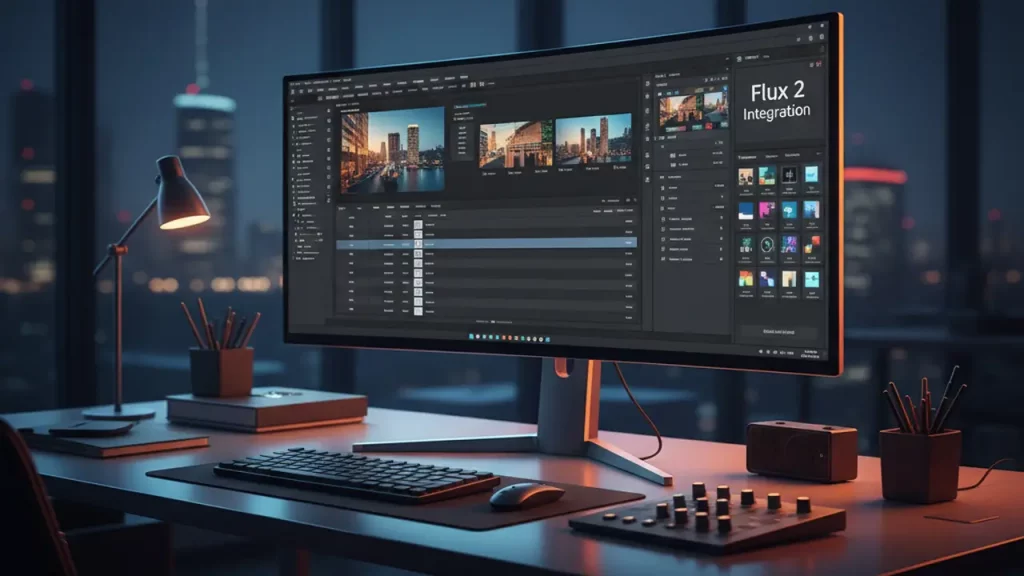
The Flux 2 Adobe integration marks a watershed moment in the commercialization of open-weight AI. Adobe, the titan of creative software, has historically been cautious, relying on its own Firefly models trained on "safe" stock data. However, the sheer quality and demand for the Flux 2 AI image generator (and its pro variants) compelled a strategic shift. By integrating Flux 2 Adobe integration directly into the Creative Cloud, Adobe has effectively acknowledged that Black Forest Labs is defining the frontier of image synthesis.
For the everyday designer, the Flux 2 Adobe integration means that the power of the Flux 2 AI image generator is available directly inside Photoshop and the Firefly web app. Users accessing tools like "Generative Fill" or "Text to Image" in the Firefly interface can now select Flux 1.1 Pro and Flux.1 Kontext (and increasingly Flux 2 variants as they roll out) from the model dropdown menu. This removes the friction of "app switching." A retoucher working on a portrait can use the Flux 2 AI image generator to expand the background or change the subject's clothing without ever leaving their primary workspace.
A key component of the Flux 2 Adobe integration is the Flux.1 Kontext model. This variant is specifically engineered for "image-to-image" and in-painting tasks, which are central to professional editing. Unlike a standard text-to-image prompt, Kontext analyzes the pixel structure, lighting, and grain of the existing image to ensure that new generations blend seamlessly. This makes the Flux 2 AI image generator an incredibly powerful "smart brush." If a user wants to replace a generic car in a photo with a futuristic vehicle, the Flux 2 Adobe integration ensures that the new car matches the perspective and shadows of the original scene perfectly.
The significance of the Flux 2 Adobe integration extends to enterprise safety. Adobe's primary value proposition is copyright safety. By partnering with Black Forest Labs, Adobe extends its "Content Credentials" ecosystem to include images generated by the Flux 2 AI image generator. When a user generates an image using Flux via Firefly, it is tagged with metadata indicating its AI origin and the model used. This transparency is crucial for commercial clients who need to track the provenance of their assets. The Flux 2 Adobe integration thus provides a "sanctioned" way for corporate designers to use frontier open models within compliance frameworks.
The Flux 2 Adobe integration also highlights the symbiotic relationship between BFL and established tech giants. Rather than trying to build a competitor to Photoshop, Black Forest Labs has positioned the Flux 2 AI image generator as the engine inside Photoshop. This strategy ensures massive adoption. Millions of Creative Cloud subscribers effectively become users of the Flux 2 AI image generator, often without realizing the technical complexity running under the hood. For Adobe, offering the Flux 2 AI image generator prevents user churn to external tools like Midjourney. For BFL, it provides a steady stream of API usage and brand validation.
In practical terms, the Flux 2 Adobe integration allows for workflows like "Generative Ideation Boards." Designers use the Flux 2 AI image generator via Firefly Boards to rapidly generate high-fidelity mood boards. Because Flux excels at photorealism and text, these boards look less like "AI sludge" and more like finished conceptual pitches. The ability to then drag these assets into Photoshop and refine them using the same underlying model creates a unified, high-quality pipeline that is reshaping the modern design studio.
7. Flux 2 Cloudflare Workers AI: Deep Integration at the Infrastructure Level
The deployment of Flux 2 Cloudflare Workers AI represents a paradigm shift in the accessibility and economics of high-performance AI. Traditionally, running a behemoth like the 32-billion-parameter Flux 2 AI image generator required significant infrastructure investment—either purchasing expensive H100 GPUs or managing complex, idle-prone clusters on AWS. Cloudflare has disrupted this model by hosting the Flux 2 AI image generator on its Workers AI platform, a serverless inference solution that brings the model to the edge of the network.
The Flux 2 Cloudflare Workers AI integration allows developers to access the full power of the Flux 2 AI image generator via a simple API call. This is "Serverless GPU" computing. A developer building an app in London sends a request, and Cloudflare routes it to the nearest available GPU capacity, executes the inference, and returns the image. The developer does not manage servers, does not worry about scaling during traffic spikes, and pays only for what they use. This democratization of infrastructure is a key factor in the explosion of apps built on the Flux 2 AI image generator.
The technical implementation of Flux 2 Cloudflare Workers AI is robust. It supports multipart form data, a crucial feature for the Flux 2 AI image generator's multi-reference capabilities. Developers can send a JSON object containing the prompt and parameters, alongside binary streams for up to four reference images (for character consistency or style transfer), all in a single HTTP request. This streamlined data handling reduces latency and complexity, making it easier to build interactive applications like "virtual try-ons" or "personalized avatar generators" that rely on the Flux 2 AI image generator.
The pricing model for Flux 2 Cloudflare Workers AI is particularly attractive for startups and independent developers. Cloudflare utilizes a "Neuron" based pricing or a per-step calculation.
- Cost Efficiency: The specific pricing for the Flux 2 AI image generator is quoted at $0.00021 per input 512x512 tile per step and $0.00041 per output tile per step.
- Granularity: This granular pricing means developers pay exactly for the compute intensity of their request. A quick 4-step preview generation costs a fraction of a full 50-step high-res final render. This flexibility allows applications to offer "draft" modes to users for cheap, saving the heavy costs for the final "export," a business model optimization made possible by the Flux 2 Cloudflare Workers AI structure.
The Flux 2 Cloudflare Workers AI integration also enables "Generative Media on Demand." Because the inference happens on Cloudflare's global network, the latency is minimized. A news website could dynamically generate a unique header image for every article based on its summary text using the Flux 2 AI image generator, served from the edge just like a cached JPEG. E-commerce sites can generate personalized product backgrounds for each visitor based on their browsing history. The friction of AI generation is reduced to that of a database query.
Furthermore, this integration aligns with the "Open Core" strategy of Black Forest Labs. By making the Flux 2 AI image generator available on a platform as ubiquitous as Cloudflare, they ensure that the Flux 2 AI image generator becomes the default engine for the "AI Web." It lowers the barrier to entry for millions of web developers who are comfortable with JavaScript and APIs but terrified of Python and CUDA. The Flux 2 Cloudflare Workers AI partnership is effectively the bridge connecting the specialized world of AI research to the generalist world of web development.
8. Flux 2 MLPerf Benchmark: Why This Benchmark Matters
In the high-stakes world of enterprise AI, trust is not built on viral Twitter posts but on rigorous, reproducible data. The performance of the Flux 2 AI image generator (specifically its foundational Flux.1 architecture) in the Flux 2 MLPerf benchmark (MLPerf Training v5.1) provides precisely this validation. MLPerf is the industry standard for measuring AI performance, maintained by MLCommons, a consortium including leaders like Google, NVIDIA, Intel, and Meta.
The inclusion of the Flux architecture in MLPerf is a historic milestone. In the v5.1 round, MLCommons explicitly replaced the aging Stable Diffusion v2 benchmark with Flux.1 (specifically the 11.9B parameter variant) as the new standard for text-to-image training.
- Significance: This substitution signals that the industry now considers the Flux 2 AI image generator's architecture (Transformer-based Rectified Flow) to be the representative workload for modern generative AI. It is an acknowledgment that the "UNet" era of Stable Diffusion is passing and the "Transformer" era of Flux is the present and future.
The Flux 2 MLPerf benchmark results were dominated by NVIDIA. Using their next-generation Blackwell architecture, NVIDIA achieved a "clean sweep," setting the fastest training times for Flux. A cluster of 1,152 Blackwell GPUs was able to train the Flux model in approximately 12.5 minutes.
- Implication for Flux 2: While these benchmarks measure training speed, they are a proxy for the maturity of the software and hardware stack supporting the Flux 2 AI image generator. The fact that NVIDIA is optimizing its deepest software libraries (like CuDNN and TensorRT) to run Flux fast means that Flux 2 AI image generator users will see continuous performance gains. It ensures that the model runs efficiently not just on supercomputers, but on the RTX GPUs in creative studios.
For enterprise CTOs, the Flux 2 MLPerf benchmark is critical for procurement. When a company decides to invest in on-premise hardware to run a generative AI service, they need to know that the model they choose is supported by hardware vendors. The MLPerf validation guarantees that the Flux 2 AI image generator is a "first-class citizen" in the data center. It de-risks the adoption of the Flux 2 AI image generator, moving it from "experimental open source" to "enterprise-grade infrastructure."
Moreover, the benchmark highlights the computational complexity of the Flux 2 AI image generator. With 12-32 billion parameters, it is a heavy workload. The benchmark results help organizations size their infrastructure correctly. It provides the hard data needed to calculate the Total Cost of Ownership (TCO) for running the Flux 2 AI image generator at scale versus using a closed API. By establishing a baseline, the Flux 2 MLPerf benchmark brings transparency to the often opaque economics of AI compute.
Ultimately, the Flux 2 MLPerf benchmark cements the status of Black Forest Labs. It places their technology alongside Llama 3 (LLM) and RetinaNet (Computer Vision) as one of the pillars of modern AI. For a relatively young company, having their model selected as the global standard for measurement is a massive endorsement of the engineering quality behind the Flux 2 AI image generator.
9. Flux 2 Pricing and Plans: Economics for Freelancers, Studios, and SaaS
Navigating the Flux 2 pricing and plans can be complex because, unlike a monolithic service like Midjourney, the Flux 2 AI image generator is available through multiple channels. This fragmentation is a feature, not a bug, allowing users to choose the cost structure that best fits their volume and technical capability.
9.1 The "Free" Option: Open Weights
For enthusiasts, researchers, and studios with existing hardware, the Flux 2 AI image generator (specifically the [dev] and [schnell] variants) can be run for "free."
- Mechanism: Users download the weights from Hugging Face and run them via ComfyUI or Forge WebUI.
- Cost: $0 in licensing. The cost is the hardware. A user needs a GPU with significant VRAM (e.g., NVIDIA RTX 3090/4090 with 24GB) to run the model effectively, especially the 32B parameter versions, though FP8 quantization makes it feasible on consumer cards.
- Target Audience: Hobbyists, Privacy-focused users, Technical Artists.
9.2 API Pay-Per-Use: The Developer Standard
For developers building apps or studios integrating Flux into pipelines, API providers offer a pay-as-you-go model.
- Black Forest Labs API: Access to the Flux 2 AI image generator [pro] capabilities. Pricing is typically tiered around resolution.
- Pro Model: ~$0.03 - $0.05 per image (standard resolution).
- Flex Model: ~$0.06 per megapixel (higher quality, slower).
- Fal.ai / Replicate: These partners host the model and offer competitive pricing.
- Fal.ai: Charges based on megapixels. E.g., $0.03 for the first MP + $0.015 per additional MP. This incentivizes efficient resolution usage.
- Replicate: Often charges by time (e.g., H100 GPU seconds). If the Flux 2 AI image generator takes 3 seconds to generate an image on an H100, the cost might be under $0.01, making it potentially cheaper for simpler prompts.
- Cloudflare Workers AI: Charges by "neurons" or steps. As detailed, roughly $0.00062 per tile per step (input+output combined). This is ideal for high-volume, low-resolution automated tasks.
9.3 SaaS Subscriptions: The "Midjourney Replacement"
For non-technical users, third-party services wrap the Flux 2 AI image generator in a user-friendly web interface (like Poe, Freepik, or specialized "Flux" sites).
- Cost: Typically $20 - $40 per month for a credit allotment (e.g., 1000 fast generations).
- Benefit: No hardware required, no code required. It directly replaces the Midjourney subscription line item in a freelancer's budget.
Table 2: Flux 2 Pricing & Use Case Scenarios
AI Image Generator Deployment Guide by User Persona
Choosing the right platform for AI image generation (e.g., Stable Diffusion, Flux) depends on budget, required quality, and the need for data privacy. Solutions range from free local software to custom enterprise cloud contracts.
| Persona | Recommended Path | Estimated Cost | Why? |
|---|---|---|---|
| Hobbyist / Gamer | Local Run (ComfyUI) | Free (Hardware dependent) | Total control, privacy, and necessary for learning advanced prompt engineering and model merging. |
| Freelancer | SaaS Wrapper (e.g., Poe) | $20/month | Predictable billing, easy UI, and access to multiple models without managing local installations. |
| Tech Startup | Cloudflare / Replicate API | ~$0.02 per image | Scalable, low-latency, and pay only for active users—ideal for integration into a product feature. |
| High-End Studio | Fal.ai / BFL Direct API | $0.05 per image (High Res) | Access to best quality models (Pro/Ultra) and reliability with predictable quality. |
| Enterprise | Private Cloud Deployment | Custom Contract | **Data sovereignty**, guaranteed SLA, and indemnification necessary for handling proprietary intellectual property (IP). |
The Flux 2 pricing and plans ecosystem essentially kills the "subscription fatigue" for businesses. A studio doesn't need to buy 50 Midjourney seats at $30/month if they only use the tool sporadically. They can set up a shared API key for the Flux 2 AI image generator and pay exactly $42.50 one month and $4.00 the next, depending on project load. This economic elasticity is a major selling point for the Flux 2 AI image generator in the B2B market.
10. Conclusion: Why Flux 2 AI Image Generator Is Anchored as the Best Midjourney Alternative 2025
As the dust settles on the frenetic developments of 2025, the Flux 2 AI image generator stands not merely as a competitor, but as a defining pillar of the new creative economy. Black Forest Labs has successfully navigated the treacherous path from research lab to industrial powerhouse, securing its future with a $3.25 billion valuation and a war chest of $300 million in funding. This financial stability assures users that the Flux 2 AI image generator is here to stay, supported by a long-term roadmap and a coalition of powerful allies like NVIDIA and Salesforce.
The narrative of the Flux 2 AI image generator is one of convergence. It brings together the open-source ethos of the early AI days with the reliability and quality of enterprise software. It offers the Flux 2 Adobe integration for the mainstream creative, the Flux 2 Cloudflare Workers AI infrastructure for the developer, and the Flux 2 MLPerf benchmark validation for the CTO. It creates a unified ecosystem where a single model architecture—the Flux 2 AI image generator—can serve every need from a quick thumbnail generation to a 4-megapixel billboard render.
For the artist and the studio, the choice is becoming increasingly clear. While Midjourney remains a potent tool for abstract ideation, the Flux 2 AI image generator has secured the title of best Midjourney alternative 2025 for professional production. Its unparalleled prompt adherence, robust text rendering, and multi-reference consistency solve the practical problems that have held AI art back from full commercial adoption. The Flux 2 AI image generator turns AI from a slot machine into a precision instrument.
As Black Forest Labs moves forward, the focus will shift to ecosystem expansion—more integrations, faster inference, and even more capable multimodal models. But the foundation is laid. The Flux 2 AI image generator has redefined the benchmarks for quality and openness. For those ready to embrace this new standard, the journey is just beginning. To stay ahead of this rapidly evolving curve, to find the latest LoRAs, and to master the technical workflows that unlock the full potential of this model, we recommend bookmarking aiinovationhub.com—your essential guide to the Flux 2 AI image generator and the future of visual intelligence.
Discover more from AI Innovation Hub
Subscribe to get the latest posts sent to your email.