
DeepSeek V4.1 Flash is the newest release in the DeepSeek lineup, and it arrives with a clear promise: high generation speed, native visual understanding, and a much lower cost of inference than the models that came before it. For developers, AI engineers, and teams building agents, that combination matters more than any single headline number. A model can be brilliant on paper, but if it is slow, memory-hungry, or expensive to serve, it rarely survives contact with a real production workload.
This release takes aim at exactly that gap. Instead of chasing size alone, the DeepSeek team rebuilt how the model reads and writes text, how it stores memory during long conversations, and how it is priced for everyday use. The result is a model that sits at the compact end of its new architectural family, yet competes with, and in several areas outperforms, the larger flagship it replaces.
In this article, we walk through everything worth knowing. We cover the asymmetric architecture, the scale of the underlying network, the million-token context, the memory savings, the benchmark picture, the comparison with the Pro tier, the API integration details, the pricing structure, and the open-source availability. Whether you are deciding if it fits your stack or simply want to understand what changed, the sections below give you a clear and practical overview.
Who This Guide Is For
This guide is written for three groups of readers. Developers will find the API and migration notes most useful. Technical decision-makers will care about cost, memory efficiency, and the comparison with the Pro tier. AI enthusiasts will enjoy the architectural explanation and the open-weights story. Each section stands on its own, so feel free to jump to the part that matters most to you.
Inside the Causal Encoder-Decoder Architecture
The most interesting change in this release is structural. The model is built on a Causal Encoder-Decoder architecture, an asymmetric design that treats reading and writing as two different jobs with two different computational needs. Most large language models use the same machinery for both: the same layers process your prompt and generate the answer. That is simple, but it is not always efficient, because understanding a long prompt and producing a short, careful reply are very different tasks.
Asymmetric Processing: 8B In, 16B Out
Under this design, the model activates roughly 8 billion parameters on the input side and 16 billion parameters on the output side. The input stage, the encoder, handles the prompt, the documents, the code, or the conversation history. The output stage, the decoder, produces the response token by token.
Why does this asymmetry matter? Because the input side can be lean. Reading a prompt is a parallel operation, and a smaller active footprint there means the model digests long inputs quickly. The output side gets a larger active budget because generation quality depends heavily on the capacity available when each token is chosen. In practice, this split lets DeepSeek V4.1 Flash balance speed and quality instead of forcing a compromise between them.
Faster Time to First Token
The practical benefit shows up in the metric users feel most directly: time to first token. When you send a long prompt, the delay before the first word appears is largely determined by how quickly the model can process the input. Because the encoder side is intentionally compact, that delay shrinks considerably. For interactive applications such as chat assistants, coding copilots, and voice interfaces, this responsiveness is the difference between a tool that feels instant and one that feels sluggish.
It also helps agent workflows, where a model may be called dozens or hundreds of times in a single task. Each call carries a large block of context, and shaving time off every one of them compounds into a dramatically faster overall run.
552B MoE Multimodal Model: Big Capacity, Small Active Footprint
Behind the efficient surface sits a very large network. This is a 552B MoE multimodal model, meaning it holds 552 billion total parameters organized as a Mixture-of-Experts. In a Mixture-of-Experts design, the network is divided into many specialized sub-networks called experts. For each token, a routing mechanism selects only a small subset of them to do the work. The rest stay idle.
Why Mixture-of-Experts Matters
This is how a model can have enormous knowledge capacity without paying the full computational price on every step. Total parameters represent how much the model can know and how many specialized skills it can store. Active parameters represent how much computation is spent per token. By keeping the active count low relative to the total, the model delivers the breadth of a giant network at a fraction of the serving cost.
That trade-off is central to the whole design philosophy here. Even though this is the most compact model in the new architectural family, it draws on that 552-billion-parameter pool. DeepSeek V4.1 Flash therefore offers a wide base of learned capability while staying quick and economical during inference.
Native Visual Understanding
The model is also multimodal. It supports native analysis of images and other visual data directly, without bolting on a separate vision adapter or an external captioning step. That distinction is more important than it sounds. Pipelines that convert an image into text before passing it to a language model inevitably lose detail, add latency, and introduce another component that can fail. A natively multimodal model reads the visual information itself.
Typical use cases include interpreting charts and diagrams, reading screenshots of user interfaces, extracting information from scanned documents, and reasoning about photographs. For developers building document-processing tools or visual agents, having this capability inside a single model simplifies the architecture and reduces cost.

AndreevWebStudio.com
Professional web development and design services. Custom WordPress sites, landing pages, e-commerce solutions, and 3D printing content creation for businesses and creators.
- • WordPress Development
- • Custom Web Design
- • E-Commerce Solutions
- • 3D Printing Content
Working With Ultra-Long Context in DeepSeek V4.1 Flash
Context length determines what kinds of problems a model can tackle in one pass. A short window forces you to chop documents into pieces, summarize aggressively, and hope nothing important falls through the cracks. DeepSeek V4.1 Flash is designed to remove much of that friction.
The 1M Token Context Window Explained
The headline figure is a 1M token context window. That means a single request can contain up to one million tokens of input. To put that in perspective, it is enough room for an entire mid-sized codebase, several full-length books, or a very long history of conversation with a user, all at once.
This is made possible by a hybrid attention mechanism. Standard attention scales poorly as sequences grow, because every token must be compared against every other token, and the cost climbs steeply with length. A hybrid approach combines different attention strategies so that the model can keep track of what matters across a huge span of text without paying the full quadratic price. The details are technical, but the outcome is simple: long inputs become practical rather than prohibitively expensive.
Practical Use Cases for Long Context
Several scenarios benefit immediately from this capacity:
- Codebase analysis. Load an entire repository and ask the model to trace a bug, explain an architecture, or plan a refactor with full visibility of every file.
- Document research. Feed in contracts, research papers, or regulatory filings and ask cross-document questions without building a retrieval system first.
- Persistent assistants. Keep a long conversation history intact so the assistant remembers earlier decisions, preferences, and constraints.
- Agent memory. Allow autonomous agents to accumulate tool outputs and observations across many steps without constantly truncating their own history.
Of course, a large window is not a license to be careless. Retrieval and careful prompt design still improve results and lower cost. But having the headroom changes the default: you start by trying to give the model everything it needs, rather than fighting to fit things in.
KV Cache Compression: Doing More With Less Memory
Long context creates a hidden problem that engineers know well: the key-value cache. During generation, a transformer stores intermediate attention data for every token it has already seen, so it does not have to recompute it. This KV cache grows with the length of the context, and for million-token sequences it can consume enormous amounts of accelerator memory. In many deployments, memory, not raw computation, is the real bottleneck.
The Numbers: One Quarter the HBM, One Eighth the SSD
This is where KV cache compression becomes one of the most valuable parts of the release. Compared with the previous generation, the new model requires four times less high-bandwidth memory, or HBM, which is one quarter of the earlier requirement. It also needs eight times less SSD storage, or one eighth. These are not marginal improvements. They change the economics of serving long-context workloads.
HBM is the fastest and most expensive memory on an accelerator. Reducing the amount each request needs means more simultaneous requests can fit on the same hardware. SSD capacity matters because many serving systems offload or persist cache data to disk so that repeated prefixes can be reused. Shrinking that footprint by a factor of eight makes caching far cheaper to maintain.
Why This Matters for AI Agents
Agents are particularly sensitive to these costs. An agent typically works in loops: it reads a state, calls a tool, receives a result, and appends everything to a growing context. The same long prefix is reused again and again. Efficient cache handling directly lowers the cost of each loop iteration, which is critical when a single task may involve hundreds of steps. With DeepSeek V4.1 Flash, the memory savings translate into lower serving costs and, ultimately, into prices that make large-scale agent deployment more realistic.
DeepSeek V4.1 Flash Benchmarks: Coding, Math and Reasoning
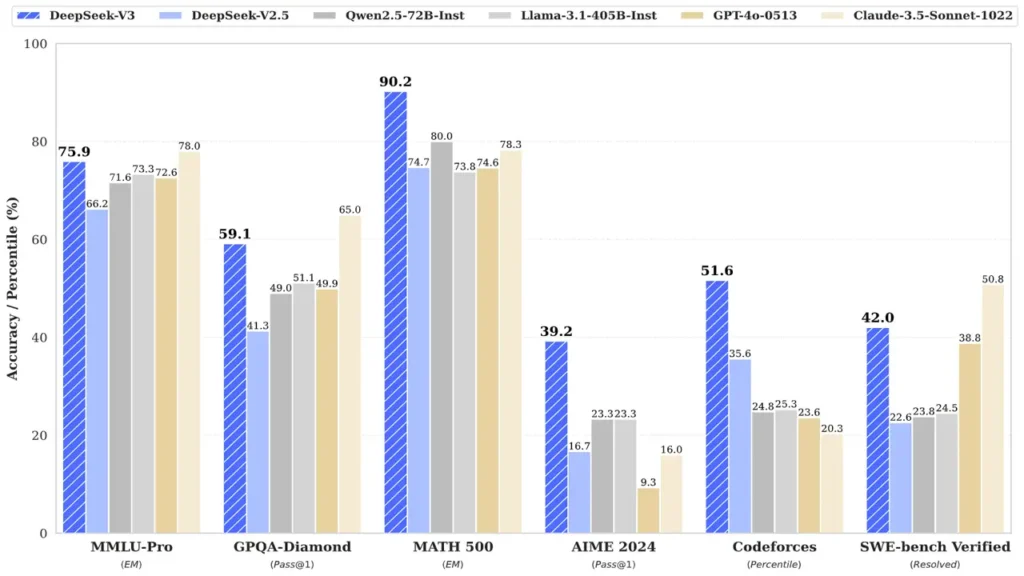
Architecture and efficiency are only valuable if the model also performs. This is where the picture gets compelling. According to the release information, improvements in pre-training methods and a large-scale reinforcement learning post-training phase have pushed the model past earlier flagship models in programming, mathematics, and logical reasoning.
The Role of Reinforcement Learning
Reinforcement learning after pre-training has become a major driver of capability in recent models. Instead of simply predicting the next token from a static dataset, the model is trained against tasks that have verifiable outcomes, such as code that passes tests or math problems with checkable answers. It learns to produce longer chains of careful reasoning and to correct its own mistakes along the way.
For a compact model, this kind of training is especially effective, because it concentrates capability where it counts. The model does not need to be the largest in the family if its post-training is strong enough to extract the best performance from the capacity it has.
What the Results Suggest
Across coding tasks, the model shows stronger ability to write, debug, and reason about software. In mathematics, it handles multi-step problems more reliably. In logic and general reasoning, it follows longer chains of inference without losing the thread. The notable point is the direction of the comparison: a model positioned as the fast, efficient option is matching or beating the earlier, higher-tier offerings.
As always with benchmark claims, a sensible approach is to treat published scores as a starting point. The most reliable test is your own workload. Run the model on a sample of your real prompts, compare outputs against your current solution, and measure both quality and cost. Benchmarks tell you where to look; your own evaluation tells you whether to commit.
DeepSeek V4.1 Flash vs V4 Pro: Which One Should You Use?
One of the more surprising aspects of this release is how it reshapes the relationship between the Flash and Pro tiers. Traditionally, a Pro model is the premium option: slower and costlier, but better. Here, the newer compact model has changed that assumption.
Speed, Cost and Quality
In the comparison of DeepSeek V4.1 Flash vs V4 Pro, the newer Flash model comes out ahead on speed, on cost, and on answer quality. That is an unusual outcome. It happens because the newer model benefits from the updated architecture, the improved training recipe, and the efficiency gains described above, while the older Pro model was built on the previous generation’s design.
| Factor | V4.1 Flash | V4 Pro |
|---|---|---|
| Generation speed | Faster | Slower |
| Serving cost | Lower | Higher |
| Answer quality | Stronger in reported tests | Previous-generation level |
| Memory footprint | Much smaller KV cache | Larger |
Request Redirection Until V4.1 Pro Arrives
Because the newer model is simply better across these dimensions, the company is redirecting requests from the older Pro version to the new model until V4.1 Pro is released. For most users, this means no urgent migration work. Existing integrations continue to function, and they begin benefiting from the upgraded model automatically.
That said, if your application depends on very specific behavior from the older model, it is worth testing. Subtle differences in tone, formatting, or edge-case handling can matter for sensitive pipelines. A short regression run over your key prompts will reveal whether anything needs adjustment. In many cases, you will find that DeepSeek V4.1 Flash handles those prompts as well or better, while costing less to run.
Using the deepseek-flash API Model
For developers, integration is refreshingly simple. The technical identifier you need is the deepseek-flash API model name. There is no elaborate setup, no new endpoint to learn, and no complicated configuration to apply.
Connecting in One Line
To use the model, set the model parameter to deepseek-flash in your API request. That is the entire change for a new integration. If you have worked with chat-completion style APIs before, the request structure will feel familiar: you send a list of messages, choose the model, set your generation parameters, and read the response.
A typical workflow looks like this:
- Obtain an API key from the platform dashboard.
- Configure your client with the correct base address and your key.
- Set the model field to deepseek-flash.
- Send your messages, including images if you want to use the multimodal capability.
- Stream or collect the response and handle it as usual.
Backward Compatibility and Routing
Existing users do not need to rush. The older identifiers, deepseek-v4-flash and deepseek-v4-flash-vision-exp, are automatically routed to the new version. This backward compatibility means applications already in production keep working without code changes. Over time, though, it is good practice to update your configuration to the current identifier so that your codebase reflects what is actually running.
Routing also simplifies things for teams that previously had to choose between a text model and a separate experimental vision model. With a single identifier now covering both text and visual input, the architecture of your application can be cleaner. You no longer need conditional logic to decide which model to call based on whether an image is attached. DeepSeek V4.1 Flash handles both through the same entry point.
DeepSeek V4.1 Flash API Pricing and Ways to Save
Pricing is where efficiency gains become tangible. The architectural improvements discussed earlier, especially the memory savings, are what allow DeepSeek V4.1 Flash API pricing to remain attractive even as capability rises. While you should always check the official pricing page for current rates, it is useful to understand the structure and the levers you can pull to reduce your bill.
Cache-Hit Savings
The first lever is caching. When part of your prompt matches a previously processed prefix, such as a long system prompt, a shared document, or the accumulated history of an agent loop, the system can reuse the stored computation rather than starting from scratch. Tokens served from cache are billed at a significantly lower rate than fresh input tokens.
This has direct implications for how you design prompts. To maximize cache hits:
- Place stable content, such as instructions and reference material, at the beginning of the prompt.
- Put variable content, such as the user’s latest question, at the end.
- Avoid inserting timestamps or random identifiers early in the prompt, since they break prefix matching.
- Reuse the same system prompt across requests wherever possible.
Because of the compressed KV cache, storing and reusing those prefixes is cheaper for the provider, and that saving is passed on to you.
Off-Peak API Discount
The second lever is timing. The platform offers an off-peak API discount of 50% for usage during low-demand hours. This is ideal for background jobs that do not need an immediate answer, such as bulk document summarization, dataset labeling, large-scale evaluation runs, nightly report generation, and batch code analysis.
If your workload can tolerate scheduling flexibility, shifting it into the discounted window cuts the cost in half. Combined with cache-hit pricing, the savings can be substantial. A well-designed pipeline, one that keeps prefixes stable and runs heavy asynchronous work off-peak, can reduce effective cost dramatically compared with a naive approach.
Estimating Your Costs
A simple method for estimating spend is to separate your traffic into categories. Interactive requests pay standard rates, ideally with high cache-hit ratios. Batch requests go off-peak at the discounted rate. Measure the average input and output token counts for each category, multiply by the relevant rates, and add them up. Run a small pilot first to confirm your assumptions before scaling.
Open Weights and DeepSeek V4.1 Flash Hugging Face Availability
Beyond the hosted API, one of the defining features of the DeepSeek approach is openness. The model is supported by the open-source community, and the weights and code are published so that researchers and engineers can inspect, run, and build on them.
Where to Find the Model
The central hub is DeepSeek V4.1 Flash Hugging Face, where the model weights, documentation, and technical details are made available. Hugging Face is the standard place to download open models, review model cards, discuss issues, and find community fine-tunes and quantized variants. For anyone who wants to study the architecture in detail or experiment with the model outside the hosted service, it is the natural starting point.
The model is also accessible through other popular channels. Ollama makes it easy to run models locally with minimal setup, which is convenient for developers who want to prototype on their own hardware or keep data on-premises. OpenRouter provides a unified API across many providers, which is useful if you want to switch between models or compare them without rewriting your integration.
Local Deployment Considerations
Running a model of this scale locally is not trivial, and it is worth being realistic. With 552 billion total parameters, the full model demands serious hardware, typically a multi-accelerator server rather than a single consumer GPU. The memory improvements from KV cache compression help, particularly for long contexts, but the weights themselves still require substantial capacity.
For many teams, the practical path is a hybrid one: use the hosted API for general work and consider self-hosting when data sovereignty, customization, or very high sustained volume justify the infrastructure. Open weights keep that option available, and that flexibility is a meaningful advantage over closed alternatives. It also fosters a healthy ecosystem, since the community can build tooling, quantizations, and fine-tunes that extend what the model can do.
Final Thoughts: Is This the Right Model for You?
This release shows that progress in AI is not only about making models bigger. By rethinking the architecture with an asymmetric encoder-decoder design, compressing the memory that long contexts demand, and investing heavily in reinforcement learning, the DeepSeek team has produced a compact model that outperforms its larger predecessor in speed, cost, and quality.
Here is a quick summary of the key points:
- An asymmetric design with 8 billion active parameters on input and 16 billion on output speeds up time to first token.
- A 552-billion-parameter Mixture-of-Experts base provides broad capability with native multimodal understanding.
- A million-token context window opens the door to whole-codebase and whole-book workflows.
- KV cache compression cuts HBM needs to one quarter and SSD needs to one eighth.
- The simple deepseek-flash identifier, backward-compatible routing, cache-hit pricing, and a 50% off-peak discount make adoption easy and affordable.
- Open weights and wide availability keep the ecosystem flexible.
If you build coding tools, document-analysis systems, or autonomous agents, this model deserves a place on your evaluation list. Start with a small pilot, measure quality and cost against your current setup, and let your own results guide the decision. For most teams, the combination of strong reasoning, long context, and efficient pricing makes DeepSeek V4.1 Flash one of the most compelling options available today.