
AI energy consumption is no longer a niche technical topic — it is one of the most talked-about challenges facing the technology industry today. As artificial intelligence continues to grow at a breathtaking pace, the amount of electricity required to train, run, and scale these systems is drawing serious attention from governments, investors, engineers, and everyday users alike. Whether you work in tech, care about the environment, or simply use AI-powered tools in your daily life, understanding what is happening with AI energy consumption matters more than ever.
In this guide, we will walk through everything you need to know — from the basics of how much power modern AI systems actually use, to the innovative solutions being developed to make AI more sustainable. We keep things friendly, factual, and grounded in real data, so let’s dive in.

1. Introduction: Why AI Energy Consumption Is Becoming a Global Concern
Over the past few years, AI electricity consumption has jumped from a background infrastructure concern to front-page news. The reason is simple: the scale of AI deployment has exploded. Models like large language models (LLMs), image generators, and recommendation engines now serve hundreds of millions of users simultaneously, and each query, each inference, each training run consumes real electrical energy.
According to the International Energy Agency (IEA), global data center electricity consumption was estimated at around 200–250 terawatt-hours (TWh) in 2022. The IEA’s 2024 report on electricity projected that data center demand — driven significantly by AI workloads — could more than double by 2026, reaching upwards of 500 TWh annually. To put that in perspective, that is roughly equivalent to the entire electricity consumption of a mid-sized European country.
AI energy consumption is becoming a global concern for several reasons:
- Climate commitments — Countries and corporations have set net-zero targets, and runaway energy use from AI threatens those goals.
- Grid pressure — Surging demand from data centers puts pressure on national electricity grids, especially during peak periods.
- Resource competition — Water and land required for data center cooling compete with other societal needs.
- Cost — Electricity is one of the largest operational costs for AI companies, making efficiency a financial imperative as well as an environmental one.
Understanding AI energy consumption is therefore not just an engineering problem. It is a policy problem, a business problem, and increasingly, a social responsibility issue.
2. The Scale of AI Energy Consumption in Modern AI Models
To appreciate why AI power requirements are so significant, it helps to understand where the energy actually goes. AI systems consume electricity at two major stages: training and inference.
Training is the process of teaching a model by processing enormous datasets. It is computationally intensive and typically happens once (or periodically when models are updated). Training a large language model can require thousands of specialized chips running for weeks or months.
Inference is what happens every time you use an AI product — when ChatGPT answers your question, when a recommendation engine suggests a product, or when a fraud detection system evaluates a transaction. While a single inference uses far less energy than training, inference happens billions of times per day across the global AI ecosystem.
A widely cited 2019 study from the University of Massachusetts Amherst estimated that training a single large NLP (natural language processing) model could emit as much CO₂ as five average American cars over their entire lifetimes. Since then, models have grown dramatically larger. GPT-3, released in 2020, had 175 billion parameters. Newer models are estimated to be even larger, with some reports suggesting models with over a trillion parameters are in development or deployment.
The IEA estimates that a single ChatGPT query consumes roughly 10 times the electricity of a standard Google Search. When multiplied by the hundreds of millions of daily interactions, the cumulative AI electricity consumption becomes enormous.
Sustainability Impact Matrix
Quantifying the energy delta between legacy search protocols and frontier generative AI architectures across micro and macro scales.
| Activity Classification | Energy Intensity | Verification Source |
|---|---|---|
|
Macro: Model Training
GPT-3 Training Cycle
Single optimization run completion.
|
~1,287 MWh
Equivalent to ~120 US homes/year
|
OpenAI / Academic Estimates |
|
Micro: Inference
Single ChatGPT Query
Real-time token generation.
|
0.001 – 0.01 kWh
|
IEA (International Energy Agency), 2024 |
|
Micro: Search
Google Search Request
Legacy index retrieval.
|
~0.0003 kWh
|
Google Environmental Report |
|
Global Projection
AI Data Center Demand
Estimated annual global aggregate.
|
~500 TWh / year
2026 Forecast Baseline
|
IEA Electricity Report 2024 |
GPT-3 Optimization
Infrastructure (2026)
Scroll for detailed micro-interaction benchmarks
These numbers illustrate just how significant AI power requirements have become and why the industry is racing to find solutions.
3. How AI Data Centers Handle Massive AI Energy Consumption
The physical home of all AI workloads is the data center — a facility packed with thousands of specialized servers, networking equipment, and storage systems. AI data center energy use is driven not just by the computing hardware itself, but by the entire ecosystem needed to keep that hardware running reliably.
Modern AI data centers are typically filled with Graphics Processing Units (GPUs) or specialized AI chips like Google’s Tensor Processing Units (TPUs). These chips are extraordinarily powerful but also draw enormous amounts of electricity. A single NVIDIA H100 GPU — currently one of the most widely used chips for AI training — has a thermal design power (TDP) of 700 watts. A rack of 8 such GPUs alone consumes 5,600 watts continuously.
Beyond the chips themselves, data centers require:
- Power delivery infrastructure — Transformers, UPS systems, and power distribution units to safely route electricity.
- Cooling systems — Servers generate tremendous heat, and that heat must be removed to prevent hardware failure. Cooling can account for 30–40% of total data center energy use.
- Networking — High-speed interconnects between servers add to the power load.
- Lighting and facility management — Though minor compared to computing, these also contribute.
A key metric used to evaluate data center efficiency is Power Usage Effectiveness (PUE), developed by The Green Grid industry consortium. PUE is the ratio of total facility energy to the energy actually used by computing equipment. A perfect PUE of 1.0 means all energy goes directly to computing. The global average PUE for data centers is approximately 1.58, according to the Uptime Institute’s 2023 Global Data Center Survey. Hyperscale operators like Google report average PUE values closer to 1.10, reflecting their investment in efficiency.
AI energy consumption grows as the number of data centers multiplies. In the United States, Virginia’s “Data Center Alley” already hosts one of the highest concentrations of data centers in the world, and new campuses are being announced regularly in Ireland, Singapore, the Netherlands, and beyond.
4. The Environmental Impact of AI Energy Consumption
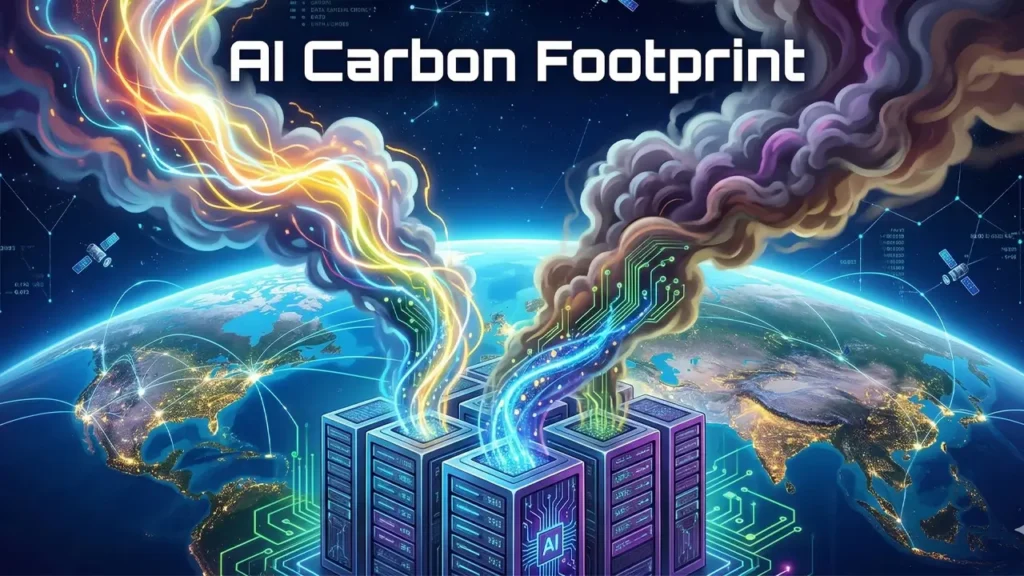
The AI carbon footprint is one of the most important and contested topics in the AI sustainability debate. Carbon emissions from AI depend heavily on two factors: how much electricity is consumed, and how clean that electricity is.
A data center powered entirely by renewable energy has a near-zero direct carbon footprint from its electricity use. A data center in a region that relies heavily on coal-fired power plants will have a much higher carbon footprint for the same workload.
According to Google’s 2023 Environmental Report, the company’s total operational carbon footprint (Scope 1 and Scope 2 emissions) was approximately 10.2 million metric tons of CO₂ equivalent — a figure that has grown as AI workloads expanded, despite significant investments in renewable energy purchasing.
Microsoft’s 2023 Environmental Sustainability Report acknowledged that its Scope 3 carbon emissions (which include those from its supply chain and the energy used by customers of its cloud services) increased by 30% between 2020 and 2023, largely due to data center expansion driven by AI demand.
The AI carbon footprint extends beyond electricity to include:
- Hardware manufacturing — Producing GPUs and servers requires rare earth minerals and energy-intensive fabrication processes.
- Water consumption — Many data center cooling systems use evaporative cooling, which consumes millions of gallons of water. Microsoft reported in its 2023 sustainability report that its global water consumption increased significantly as AI server deployments expanded.
- Electronic waste — Hardware replacement cycles in AI data centers generate e-waste.
These factors together create a complex environmental picture. AI energy consumption is not just about kilowatt-hours — it is about the full lifecycle impact of building and operating the global AI infrastructure.
5. Data Center Sustainability Strategies
Addressing data center sustainability requires a multi-pronged approach. The industry has developed several strategies that are already showing results:
1. Improving PUE Hyperscale operators have made dramatic improvements in cooling and power efficiency, bringing average PUE values well below the industry average. Techniques include hot/cold aisle containment, free cooling (using outside air when temperatures allow), and advanced airflow management.
2. Hardware Efficiency Gains Each generation of AI chips tends to deliver more computation per watt. NVIDIA’s H100 delivers significantly better performance-per-watt than its predecessor, the A100. This means that as hardware improves, the same computational work can be done with less energy.
3. Geographic Optimization Locating data centers in cooler climates reduces cooling energy needs. Iceland and the Nordic countries have become popular data center locations precisely because cold ambient air can be used for free cooling, and hydroelectric power is abundant.
4. Circular Economy Practices Leading operators are extending hardware lifetimes, refurbishing and redeploying servers, and implementing robust recycling programs for end-of-life equipment.
5. Workload Scheduling Some operators schedule intensive AI training jobs during periods of high renewable energy availability — for example, at night when wind energy output is high — to reduce the carbon intensity of their electricity consumption.
Optimization Strategy Matrix
Strategic pathways for mitigating the carbon footprint of frontier AI through hardware evolution, facility engineering, and intelligent workload orchestration.
| Mitigation Strategy | Efficiency Potential | Adoption Maturity |
|---|---|---|
|
PUE Optimization
Power Usage Effectiveness tuning.
|
Up to 40% Reduction
Overhead/Cooling delta
|
Widespread
Standard in Hyperscale DC
|
|
Silicon Efficiency
Next-gen NPU/GPU architecture.
|
2–4x Performance/Watt
Compute throughput gain
|
Growing
NVIDIA Blackwell / Custom TPU
|
|
Geographic Siting
Cold-climate data centers.
|
20–30% Cooling Save
Passive thermal management
|
Increasing
Nordic & Arctic expansion
|
|
Workload Shifting
Carbon-aware scheduling.
|
Significant Carbon Reduction
Grid intensity alignment
|
Early Stage
Research & Batch processing
|
Next-Gen Chip Performance
PUE Optimization
Scroll for full technical strategy audit
Data center sustainability is not a future aspiration — it is an active engineering discipline with measurable outcomes today.
6. Cooling Technologies Reducing AI Energy Consumption
One of the most active areas of innovation in managing AI data center cooling is the development of advanced thermal management technologies. Cooling is a major driver of total AI energy consumption, and new approaches are delivering substantial savings.
Air Cooling remains the most common approach. Hot/cold aisle containment systems direct cool air precisely to server intakes and capture hot exhaust air efficiently. Precision air conditioning units have become far more efficient over the past decade.
Liquid Cooling is rapidly gaining adoption in AI-specific deployments. Direct liquid cooling (DLC) pipes chilled water directly to server components, removing heat far more efficiently than air. This approach can reduce cooling energy by up to 40% compared to traditional air cooling.
Immersion Cooling takes liquid cooling further by submerging entire servers in non-conductive dielectric fluid. The fluid absorbs heat directly from chips and is then pumped through a heat exchanger. Immersion cooling can achieve PUE values extremely close to 1.0 and is increasingly used in high-density GPU deployments for AI training.
Heat Reuse is an emerging practice in which waste heat from data centers is captured and redirected to heat nearby buildings or district heating networks. Several data center operators in Finland, Sweden, and Denmark have implemented heat reuse programs that effectively offset energy use elsewhere in the community.
Google has pioneered the use of machine learning to optimize cooling systems themselves. In 2016, Google’s DeepMind team applied reinforcement learning algorithms to the management of cooling systems in Google data centers, achieving energy savings of around 40% for cooling — a breakthrough that demonstrated AI could be part of its own solution.
The race to innovate in AI data center cooling reflects the simple economic reality: cooling is expensive, and even modest percentage improvements translate to millions of dollars saved annually at scale.
7. Renewable Power Solutions for AI Energy Consumption
Perhaps the most impactful lever for addressing AI energy consumption at the systems level is transitioning the electricity supply itself to renewable energy for AI operations. This is where the largest technology companies have been making their most ambitious commitments.
Power Purchase Agreements (PPAs) allow data center operators to contract directly with renewable energy developers — wind farms, solar parks, and hydroelectric facilities — to purchase electricity at fixed prices over long terms. These agreements provide revenue certainty to renewable developers and allow tech companies to claim a portion of their electricity comes from clean sources.
Google, Amazon, and Microsoft are among the world’s largest corporate buyers of renewable energy. According to BloombergNEF’s 2023 Corporate Energy Market Outlook, technology companies accounted for a disproportionate share of global corporate renewable energy procurement, reflecting the scale of their data center operations.
On-site generation is also growing. Some large data center campuses are installing solar panels directly on rooftops and adjacent land. While on-site solar cannot meet the full demand of a hyperscale facility, it contributes meaningfully to the renewable energy mix.
Nuclear energy is emerging as a serious option for 24/7 clean power for AI workloads. In 2023 and 2024, several major technology companies signed agreements to purchase power from nuclear facilities — including agreements related to small modular reactors (SMRs), which are next-generation nuclear designs that can be built closer to demand centers. Microsoft signed a landmark agreement to purchase power from the restarted Three Mile Island nuclear plant in Pennsylvania specifically to support its AI data center growth.
Grid storage and flexibility — Battery storage systems at data center sites allow operators to store cheap renewable energy during periods of oversupply and discharge it during peak demand, reducing reliance on fossil-fuel peaker plants.
Renewable energy for AI is not a silver bullet, but it is one of the most powerful tools available for decoupling AI energy consumption from carbon emissions.
8. Building Sustainable AI Infrastructure
Beyond power supply, sustainable AI infrastructure requires rethinking how AI systems are designed, deployed, and managed from end to end.
Modular data center design allows capacity to scale precisely with demand, avoiding the inefficiency of building large facilities that sit partially empty for years. Prefabricated modular units can be deployed quickly and upgraded incrementally.
Edge computing distributes AI workloads closer to where they are needed — reducing the distance data must travel and potentially allowing workloads to be served by local renewable energy sources. For inference-heavy applications, edge deployment can significantly reduce the load on centralized hyperscale facilities.
Software-defined infrastructure enables more granular control of compute resources, allowing unused servers to be powered down during low-demand periods rather than idling at full power. Virtualization and containerization technologies maximize the utilization of every server, ensuring that hardware is doing useful work rather than consuming electricity while idle.
Responsible procurement means selecting hardware suppliers with strong environmental credentials — companies that use renewable energy in their manufacturing, minimize water use in chip fabrication, and offer take-back programs for end-of-life equipment.
Transparency and reporting is an increasingly important dimension of sustainable AI infrastructure. Leading operators publish detailed sustainability reports with granular data on energy use, carbon emissions, water consumption, and waste. This transparency creates accountability and allows industry benchmarking.
Building truly sustainable AI infrastructure requires all of these elements working together — and a cultural commitment within organizations to treat sustainability as a first-class engineering and business priority, not an afterthought.
9. Energy-Efficient AI Models and Algorithm Optimization
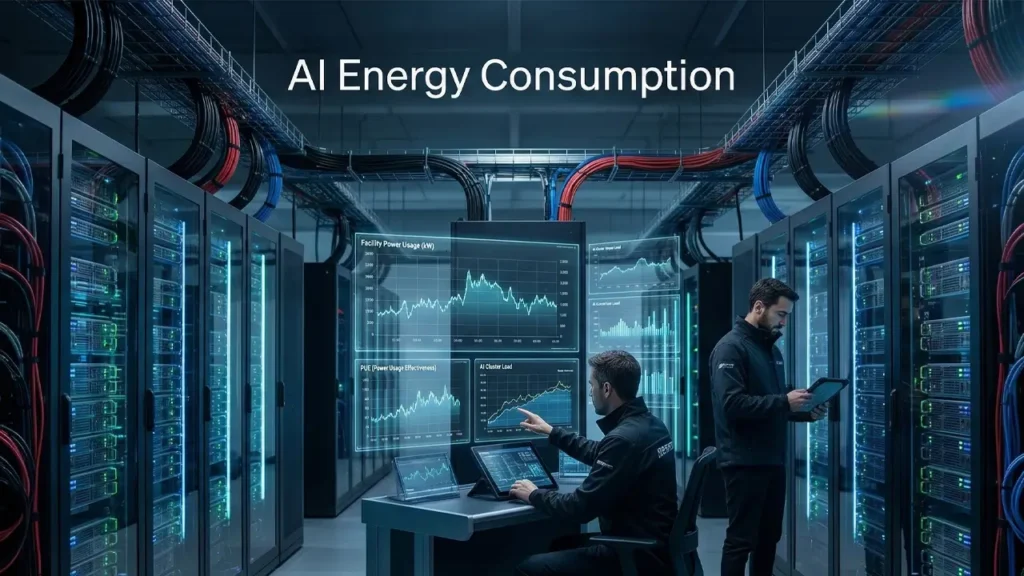
One of the most promising and underappreciated areas of AI energy consumption reduction lies not in the data center, but in the AI models and algorithms themselves. Energy efficient AI models can dramatically reduce power requirements without sacrificing capability.
Model compression techniques such as pruning (removing unnecessary connections in a neural network), quantization (reducing the numerical precision of model weights), and knowledge distillation (training smaller models to mimic larger ones) can reduce model size and inference energy by factors of 2x, 5x, or even 10x with minimal performance loss.
Sparse models activate only a subset of their parameters for any given input, rather than running the entire model every time. Mixture-of-Experts (MoE) architectures, used in models like Google’s Gemini, route each query to the most relevant subset of the model, dramatically reducing the computation required per inference.
Efficient training methods such as transfer learning and fine-tuning allow organizations to adapt existing pre-trained models to new tasks at a fraction of the energy cost of training from scratch. This avoids redundant computation and reduces cumulative AI electricity consumption across the industry.
Hardware-software co-design — developing algorithms specifically optimized for the hardware they run on — can yield significant efficiency gains. NVIDIA’s FlashAttention algorithm, for example, was designed to improve the memory efficiency of transformer models on GPU hardware, reducing both computation time and energy use.
Carbon-aware training involves scheduling intensive AI training runs in geographic regions and at times when the electricity grid is cleanest — essentially shifting workloads to where renewable energy is most abundant at any given moment. Tools and APIs for carbon-aware computing are being developed by organizations including the Green Software Foundation.
A landmark 2022 paper from Google researchers showed that a combination of efficient model architectures, better hardware, and cleaner energy had the potential to reduce the carbon footprint of AI inference by up to 1,000x compared to a baseline of older, less efficient approaches. This suggests that algorithmic progress can be just as impactful as infrastructure investment in addressing AI energy consumption.
Inference Efficiency Matrix
Evaluating frontier model optimization techniques to minimize energy intensity while managing architectural and accuracy trade-offs.
| Optimization Technique | Efficiency Impact | Strategic Trade-off |
|---|---|---|
|
Quantization (INT8)
|
2–4x Speedup
Reduced memory bandwidth
|
Minor Accuracy Loss
Slight degradation in zero-shot logic.
|
|
Pruning
|
10x Size Reduction
Weight sparsity optimization
|
Retraining Overhead
Requires fine-tuning to recover performance.
|
|
Mixture-of-Experts
|
Large Active Compute Savings
Sparse parameter activation
|
Routing Complexity
Increased architectural and VRAM overhead.
|
|
Distillation
|
5–10x Compactness
Student-teacher knowledge transfer
|
Training Cost
High GPU-hour requirement for transfer.
|
|
Carbon Scheduling
|
Significant Carbon Reduction
Grid intensity alignment
|
Latency Constraints
Not suitable for real-time inference.
|
Quantization (INT8)
Inference Speedup & Reduced VRAM
Minor accuracy/precision loss
Distillation
High compactness for edge devices
Intensive one-time training cost
Scroll for full technical audit of 5 core strategies
The takeaway is clear: AI energy consumption can be attacked from both ends — reducing the power required per computation and ensuring that the power used is as clean as possible.
10. Final Verdict: Can Green AI Solve the AI Energy Consumption Crisis?
So, can green AI technology truly solve the AI energy consumption crisis? The answer is nuanced — and genuinely hopeful, if the right actions are taken.
The challenge is real and growing. According to the IEA’s Electricity 2024 report, global data center electricity demand is on track to grow significantly through the rest of this decade, driven primarily by AI. Without decisive action, this growth risks undermining climate commitments, straining electricity grids, and creating a problematic dependency between AI progress and fossil fuel consumption.
But the solutions are also real and advancing rapidly:
- Renewable energy procurement is scaling quickly, with major tech companies committing to 24/7 clean energy matching rather than annual averages.
- Cooling innovation — from liquid immersion to AI-optimized thermal management — is cutting overhead energy use by 30–40%.
- Algorithm efficiency is improving, with techniques like quantization, sparse architectures, and hardware-software co-design delivering dramatic reductions in energy per useful computation.
- Policy support is growing, with the European Union’s Energy Efficiency Directive including data center-specific requirements and the U.S. Department of Energy publishing guidelines for efficient federal data center operations.
- Industry transparency is increasing, with more companies publishing detailed sustainability data and third-party organizations beginning to develop standardized AI carbon accounting frameworks.
The path forward requires all stakeholders to act — AI developers optimizing their models, data center operators investing in efficiency and renewables, policymakers creating supportive regulatory frameworks, and users and organizations making informed choices about the AI services they use.
AI energy consumption will remain one of the defining sustainability challenges of the 2020s. But green AI technology — combining clean power, efficient infrastructure, and smarter algorithms — gives us a credible, practical roadmap to ensure that the age of artificial intelligence does not come at an unacceptable cost to our planet.
The future of AI and the future of a sustainable planet do not have to be in conflict. With the right investment, innovation, and intention, they can — and must — go hand in hand.
Professional Web Development and SEO Services