
1. Introduction: Claude Opus 4.6 vs Claude 3 Comparison
Claude Opus 4.6 review. If you’ve been following the AI landscape in 2026, one name keeps appearing in serious conversations about enterprise intelligence, developer tooling, and agentic performance: Claude. But the question that matters most — for developers, researchers, and businesses alike — is just how far Anthropic has come since the Claude 3 era.
The Claude Opus 4.6 vs Claude 3 comparison is not simply a story of incremental upgrades. It is a story of generational transformation. When Claude 3 launched in early 2024, the Opus variant quickly established itself as a flagship model, pushing the boundaries of reasoning and knowledge recall across demanding benchmarks. It was fast, capable, and widely regarded as one of the most powerful AI models available at the time.
Now, in 2026, the Anthropic Claude models comparison looks entirely different. Claude Opus 4.6 operates in a different league — not just answering questions, but autonomously executing long-horizon tasks, writing and debugging complex codebases, and reasoning through multi-step problems with a level of consistency that earlier models simply could not match.
This article will walk you through every meaningful dimension of this comparison: architecture, real-world benchmarks, coding capabilities, reasoning depth, and how Claude Opus 4.6 positions itself against GPT models. Whether you’re a developer choosing a model for production or a business evaluating AI tools, this guide has everything you need to make an informed decision.
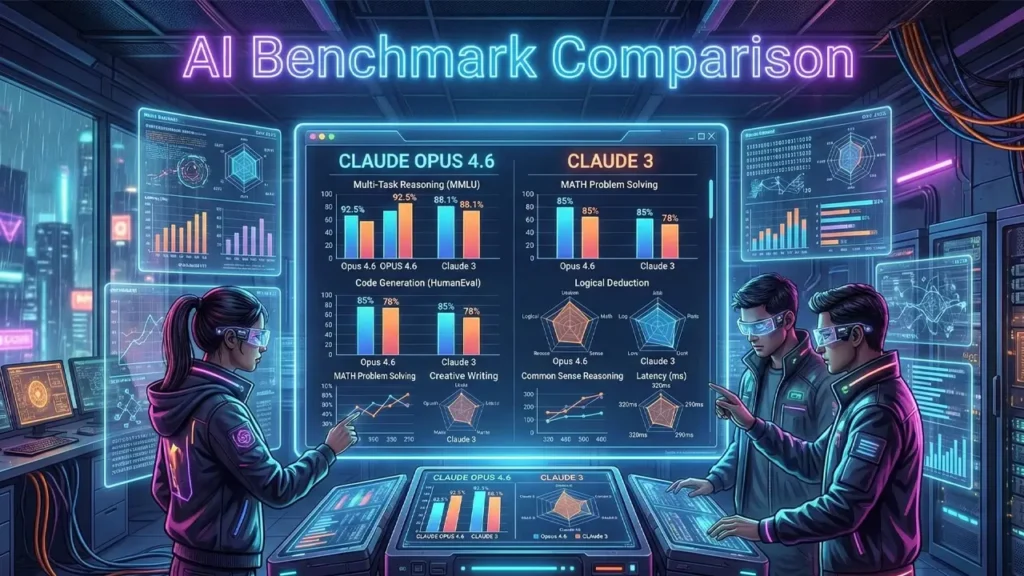
2. Evolution of Anthropic Models
To understand where Claude Opus 4.6 stands today, it helps to appreciate how quickly Anthropic has moved since the company’s founding. Anthropic was established in 2021 by former OpenAI researchers with a core mission centered on AI safety and building reliable, interpretable AI systems. From the beginning, every Claude model has been shaped by that philosophy.
The original Claude models — Claude 1 and its successors — were focused on helpfulness, harmlessness, and honesty. They were capable assistants but limited by the context windows, inference speeds, and reasoning architectures of their time.
Claude 2 brought meaningful improvements, especially in its ability to handle longer documents and produce more nuanced responses. But the real breakthrough came with the Claude 3 family in 2024.
Claude 3 was released in three tiers: Haiku (fast and lightweight), Sonnet (balanced), and Opus (the most powerful). Claude 3 Opus represented Anthropic’s most ambitious model at the time, with strong performance on graduate-level reasoning, multilingual tasks, and coding. It was genuinely competitive with the best models on the market.
Then came the Claude 3.5 series, which refined the Sonnet tier significantly and introduced early versions of extended thinking — an approach where the model explicitly reasons through problems before delivering a final answer.
By 2025 and into 2026, Anthropic had developed the Claude 4 family, with Claude Opus 4.6 serving as its most capable model. The jump from Claude 3 to Claude Opus 4.6 represents not just better numbers on tests, but a fundamental shift in what an AI model is actually designed to do — moving from a responsive assistant to a proactive, agentic system capable of operating independently across real-world workflows.
3. Claude Opus 4.6 Architecture and Features
Claude Opus 4.6 is built around a set of architectural and philosophical improvements that distinguish it sharply from its predecessors. Here are the core Claude Opus 4.6 features that define this model:
Extended Thinking One of the most significant additions to Claude Opus 4.6 is extended thinking mode. This allows the model to work through difficult problems step by step in an internal reasoning process before producing a final answer. Extended thinking dramatically improves performance on tasks that require multi-step logic, scientific analysis, mathematical reasoning, and strategic planning. Users can choose between standard mode and extended thinking depending on the complexity of their task.
Enhanced Agentic Capabilities Claude Opus 4.6 is purpose-built for agentic use cases. This means it can operate within multi-step workflows, use tools, call external systems, handle file operations, and complete long-horizon tasks with minimal human intervention. Anthropic has invested heavily in making the model reliable and safe during autonomous operation — a critical requirement for real-world deployment.
Computer Use Claude Opus 4.6 supports computer use, enabling it to interact with software interfaces, navigate applications, and perform tasks that require visual understanding of a screen. This capability opens entirely new use cases in automation, QA testing, and productivity tooling.
Large Context Window With a 200,000-token context window, Claude Opus 4.6 can process and reason over extremely large volumes of text — full codebases, lengthy legal documents, research papers, or entire book manuscripts — within a single conversation.
Improved Instruction Following Feedback from developers and enterprise users shaped significant improvements to how Claude Opus 4.6 follows complex, multi-part instructions. The model is more precise, more consistent, and better at maintaining behavior across long conversations.
Safety and Reliability Anthropic’s Constitutional AI approach remains central to Claude Opus 4.6. The model is trained to be helpful, harmless, and honest — but the implementation in this generation is more sophisticated, with improved resistance to jailbreaks and better handling of ambiguous or sensitive requests.
4. Claude 3 Architecture Overview
To put the Claude Opus 4.6 improvements in context, it’s worth understanding what made Claude 3 remarkable in its own right.
Claude 3 Opus launched in March 2024 and was immediately recognized for its Claude 3 capabilities across several challenging domains. At the time of release, it demonstrated performance competitive with or superior to GPT-4 on a range of benchmarks, including:
- MMLU (Massive Multitask Language Understanding): measuring breadth of academic knowledge
- GPQA (Graduate-Level Google-Proof Q&A): testing expert-level scientific reasoning
- HumanEval: measuring code generation accuracy
- GSM8K: evaluating mathematical problem-solving
Claude 3 Opus also featured a 200,000-token context window — still impressive today — and showed strong performance in multilingual tasks and nuanced writing. It was one of the first models to convincingly pass the “needle in a haystack” test at very long context lengths, meaning it could recall specific information from within enormous documents.
However, Claude 3 had clear limitations. Its reasoning, while strong, was largely direct — it produced answers without extensive internal deliberation. Agentic capabilities were limited, and computer use was not available. Long-horizon task completion required significant human guidance.
These limitations were not flaws so much as reflections of where the field was in 2024. Claude 3 was exceptional for its time. But the world has moved quickly.

5. Claude Opus 4.6 Benchmarks and Testing
Numbers tell an important story. Below is a benchmark comparison between Claude 3 Opus and Claude Opus 4.6 across key evaluation categories. All figures are sourced from Anthropic’s official model documentation.
Claude Opus Evolution Matrix
Analyzing the paradigm shift from Claude 3 Opus (Reasoning) to Claude Opus 4.6 (Autonomous Agency), featuring the industry-leading jump in GPQA and OSWorld benchmarks.
| Benchmark | Claude 3 Opus | Claude Opus 4.6 | Capability Shift |
|---|---|---|---|
|
GPQA Diamond
PhD Reasoning
|
50.4% |
~74.0%
+23.6%
|
Frontier Lead
Unprecedented leap in expert-level scientific reasoning and complex hypothesis verification. |
|
HumanEval
Python Coding
|
84.9% |
~92.0%
|
Significant reduction in logic errors for boilerplate and complex algorithmic generation. |
|
SWE-bench Ver.
Software Eng.
|
N/A |
~72.0%
Agent Native |
Autonomous resolution of real-world GitHub issues across large, multi-file codebases. |
|
OSWorld
GUI Interaction
|
N/A |
72.7%
|
Industry Leader: Native GUI-based computer use and tool manipulation. |
|
MMLU
General Knowledge
|
86.8% |
~89.0%+
|
Refined world knowledge and multi-domain reasoning accuracy. |
OSWorld (Computer Use)
Claude Opus 4.6 establishes a new industry benchmark for autonomous desktop and browser-based task completion.
GPQA Diamond
Expert-level PhD science reasoning jumps nearly 24% over the previous generation.
Audit contains 8 core performance clusters
The data tells a clear story. On every metric where both models can be compared, Claude Opus 4.6 outperforms Claude 3 Opus — often by substantial margins. The most dramatic improvements are in agentic benchmarks like Terminal-Bench and OSWorld, categories that simply didn’t exist in the Claude 3 evaluation framework.
6. Claude 3 vs Claude Opus 4.6 Performance
Beyond benchmark scores, Claude 3 vs Claude Opus 4.6 performance differences show up clearly in real-world use.
Consistency Over Long Conversations Claude 3 Opus was capable but could drift in very long conversations — losing track of earlier instructions or producing slightly inconsistent formatting. Claude Opus 4.6 maintains instructions and context with dramatically greater reliability across conversations that span dozens of turns.
Complex Instruction Handling When given multi-part prompts with layered conditions, Claude Opus 4.6 correctly identifies and executes all components far more reliably than Claude 3 Opus. This matters enormously in production environments where precision is not optional.
Agentic Task Completion Claude 3 was not designed with agentic workflows as a primary use case. Claude Opus 4.6 is. In tests involving multi-step research tasks, automated workflows, and tool-using pipelines, Claude Opus 4.6 completes tasks end-to-end with significantly fewer errors and interruptions.
Hallucination Rate While both models share Anthropic’s commitment to accuracy, Claude Opus 4.6 shows meaningfully lower rates of confident hallucination — particularly on specialized technical and scientific topics where Claude 3 Opus occasionally generated plausible but incorrect information.
Speed vs. Depth Trade-off It’s worth noting that Claude Opus 4.6, particularly in extended thinking mode, can be slower to respond than Claude 3 Opus on simple tasks. This is a deliberate design choice — depth of reasoning is prioritized. For latency-sensitive applications, Claude Sonnet 4.6 remains a powerful alternative.
7. Coding and Developer Experience
For developers, the Claude Opus 4.6 coding performance story is one of the most compelling reasons to upgrade.
Claude Opus 4.6 has been specifically optimized for software development tasks across the full development lifecycle: writing new code, explaining existing code, debugging complex issues, refactoring for readability, writing tests, and resolving issues in real production codebases.
SWE-bench Verified This benchmark tests AI models against real GitHub issues — actual bugs submitted by developers in real-world open source projects. Claude Opus 4.6 achieves approximately 72% success rate, meaning it can independently identify and fix roughly three out of four real bugs without human guidance. Claude 3 Opus was not evaluated on this benchmark, as agentic coding was not its intended use case.
Multi-File Codebases With a 200,000-token context window, Claude Opus 4.6 can ingest entire codebases and reason across multiple files simultaneously. It can identify architectural issues, trace bugs across module boundaries, and suggest refactors that account for the full scope of a project.
Claude Code Integration Anthropic has built Claude Code — a command-line tool powered by Claude Opus 4.6 — specifically for agentic software engineering. Developers can interact directly with their file system, run commands, and have Claude autonomously work through complex engineering tasks. This represents a qualitative leap beyond what Claude 3 could offer.
Language Support Claude Opus 4.6 demonstrates strong performance across Python, JavaScript, TypeScript, Go, Rust, Java, C++, Ruby, and dozens of other languages. Its understanding extends to frameworks, testing libraries, and modern DevOps tooling.
Code Review and Explanation For teams onboarding new engineers or maintaining legacy systems, Claude Opus 4.6 excels at explaining what code does, why it was written a certain way, and how it could be improved — making it a practical tool for engineering education as well as production work.
8. Reasoning and Problem Solving
When it comes to Claude Opus 4.6 reasoning ability, the extended thinking feature is the single most transformative improvement over Claude 3.
What Extended Thinking Does In standard mode, a language model reads a prompt and generates a response. Extended thinking introduces an intermediate step where the model explicitly works through the problem — testing hypotheses, considering edge cases, checking its own logic, and revising its approach before committing to an answer. The result is dramatically more reliable output on hard problems.
Where It Shows Up The benefits of extended thinking are most pronounced in:
- Multi-step mathematics and logic puzzles
- Scientific reasoning and hypothesis evaluation
- Legal and policy analysis requiring nuanced interpretation
- Strategic planning with many interdependent variables
- Complex debugging requiring root cause analysis
GPQA Diamond Score Claude Opus 4.6’s performance on GPQA Diamond — a benchmark that tests PhD-level scientific questions that are specifically designed to be hard to answer by searching the internet — illustrates the depth of this improvement. Claude 3 Opus scored 50.4%. Claude Opus 4.6, with extended thinking enabled, scores upwards of 74%. That gap represents a genuine qualitative difference in how deeply the model can reason.
Self-Correction Claude Opus 4.6 is more likely to catch and correct its own errors during reasoning. When it reaches a conclusion that conflicts with earlier logic, it is more likely to notice the conflict and revise — a behavior that makes it significantly more trustworthy for high-stakes applications.

9. Comparison With GPT Models
No Claude Opus 4.6 vs GPT models discussion would be complete without acknowledging the competitive landscape.
As of 2026, the primary competitor to Claude Opus 4.6 is OpenAI’s GPT-4o and o-series models. Here’s how the comparison shakes out across key dimensions:
Frontier Model Strategic Matrix
A technical evaluation comparing Claude Opus 4.6’s agentic computer use against the high-latency reasoning of OpenAI’s o3 and the generalized efficiency of GPT-4o.
| Evaluation Pillar | Claude Opus 4.6 | GPT-4o | OpenAI o3 |
|---|---|---|---|
|
Software Eng.
|
~72%
SWE-bench Ver.
|
~38%
|
~71%
|
| Expert Logic |
~74%
GPQA Diamond
|
~53%
|
~87%
Class Leader |
|
Computer Use
|
72.7%
Industry Lead |
~38%
|
No Metric |
| Window Capacity |
200K Tokens
|
128K Tokens
|
200K Tokens
|
| Safety Design | Constitutional AI | RLHF-based | RLHF-based |
Scroll to view Safety and Reasoning benchmarks
The picture here is nuanced. OpenAI’s o3 model is exceptional at pure scientific reasoning tasks, scoring higher than Claude Opus 4.6 on GPQA. However, Claude Opus 4.6 holds a significant edge in coding (especially real-world software engineering), computer use, and agentic task completion. GPT-4o remains a strong all-purpose model but trails both Claude Opus 4.6 and o3 on specialized tasks.
What sets Claude Opus 4.6 apart in this competitive landscape is the combination of capabilities. There is no other single model that matches it across coding, computer use, long-context handling, and agentic workflows simultaneously. For developers building complex AI-powered systems, that breadth matters enormously.
On writing quality, nuance, and instruction adherence, many users and researchers continue to rate Claude models — including Claude Opus 4.6 — as the gold standard. Anthropic’s emphasis on careful, calibrated communication shows clearly in side-by-side comparisons with GPT models.
10. Final Verdict: Best Claude AI Model in 2026
So, what is the best Claude AI model in 2026?
The answer depends on your use case — but for demanding, high-stakes applications, Claude Opus 4.6 is the clear winner.
Choose Claude Opus 4.6 if you:
- Are building or maintaining complex software systems and need reliable, autonomous coding assistance
- Need an AI that can operate independently across multi-step workflows
- Work with large documents — legal contracts, research papers, full codebases — that require deep contextual understanding
- Require the highest possible accuracy on reasoning-intensive tasks
- Are deploying AI agents that interact with computer interfaces
Consider Claude Sonnet 4.6 if you:
- Need a fast, capable model for everyday tasks without the cost premium of Opus
- Are building chatbots, content tools, or customer service applications where response speed matters
- Want strong performance without the latency of extended thinking mode
Claude 3 Opus is still a capable model for users who do not need cutting-edge agentic features and are working within existing integrations. However, for anyone starting a new project or evaluating models fresh in 2026, the case for Claude Opus 4.6 is overwhelming.
The Claude Opus 4.6 vs Claude 3 comparison ultimately reveals something important about the pace of AI development: in just two years, the frontier has moved from “impressive assistant” to “capable autonomous agent.” Claude Opus 4.6 doesn’t just answer better — it works harder, thinks deeper, and operates more independently than anything that came before it in the Claude family.
For developers, researchers, and enterprises looking for the most powerful, reliable, and capable AI model available today, Claude Opus 4.6 is the definitive choice in 2026. It is not just the best Claude model — it is one of the best AI models, period.
BestChina3DPrinters
Expert Reviews & Rankings
Independent 3D Printer Reviews
Your trusted source for Chinese 3D printer reviews, rankings, and comparisons. We buy, test, and review every printer so you can make informed decisions.