
Qwen3.5-397B-A17B Model
If you’ve been following the world of artificial intelligence over the past couple of years, you already know that the pace of progress is nothing short of breathtaking. But every once in a while, a model arrives that genuinely shifts the conversation — and the Qwen3.5-397B-A17B model is exactly that kind of release.
Unveiled on February 16, 2026, by the Qwen team at Alibaba Cloud, this is the flagship entry in the new Qwen3.5 family. It’s a massive, open-weight, natively multimodal AI that doesn’t just compete with proprietary giants — it openly challenges them. For developers, researchers, and enterprise teams searching for a powerful, controllable, and cost-effective foundation model, Qwen3.5-397B-A17B may very well be the most important open-source release of 2026.
The Qwen team describes Qwen3.5 as a significant leap forward, integrating breakthroughs in multimodal learning, architectural efficiency, reinforcement learning scale, and global accessibility to empower developers and enterprises with unprecedented capability and efficiency.
What makes Alibaba Qwen AI stand out here isn’t just the raw size of this model. It’s the combination of scale, efficiency, and native multimodality packaged under a permissive open license — a formula that no other lab has quite managed at this level. Let’s dive in and unpack what’s really going on under the hood.
2. Qwen3.5 397B Parameters Explained
The model name tells you a lot right away: 397 billion total parameters. That’s an enormous number, and it’s worth spending a moment understanding what it actually means in practice.
Parameters are essentially the learned weights inside a neural network — the numerical values that the model adjusts during training to get better at predicting language, reasoning through problems, and understanding images. More parameters, in general, means more capacity for the model to store knowledge and perform complex tasks. The current generation of frontier models operates in the range of hundreds of billions to over a trillion parameters.
But here’s where the Qwen3.5 397B parameters story gets really interesting: the model doesn’t use all 397 billion parameters at the same time. Qwen3.5 is a native vision-language foundation model with 397B total parameters but only 17B activated per forward pass via sparse MoE routing. This is the magic of Mixture-of-Experts architecture, which we’ll explore in the next section.
The practical implication is remarkable. At 256K context lengths, Qwen3.5 decodes 19 times faster than Qwen3-Max and 7.2 times faster than Qwen 3’s 235B-A22B model. Alibaba is also claiming the model is 60% cheaper to run than its predecessor and eight times more capable of handling large concurrent workloads.
As a large scale transformer model, Qwen3.5-397B-A17B also brings an expanded vocabulary to the table. The model’s vocabulary has grown to 250,000 tokens, up from 150,000 in prior Qwen generations and now comparable to Google’s ~256K tokenizer. This has direct efficiency implications — more expressive tokenization means fewer tokens are needed to represent the same content, translating to real cost savings at scale.
The disk footprint for the full-precision model is approximately 807GB, but thanks to quantization techniques like 3-bit and 4-bit compression, teams can run it on hardware as accessible as a 192GB Mac device — a fact that opens up this frontier-class model to a much wider audience.
3. Qwen3.5 Architecture Deep Dive
If you ask most people to describe a modern large language model, they’d say “a transformer with attention.” Qwen3.5-397B-A17B goes several steps beyond that. Its Qwen3.5 architecture is a carefully engineered hybrid that combines three major innovations: Mixture-of-Experts (MoE) routing, Gated Delta Networks, and early-fusion multimodal training.
Hybrid MoE with Gated Delta Networks
The model features an Efficient Hybrid Architecture: Gated Delta Networks combined with sparse Mixture-of-Experts deliver high-throughput inference with minimal latency and cost overhead.
The architectural layout is highly structured. The model has 60 layers with a 15 × (3 × (Gated DeltaNet → MoE) → 1 × (Gated Attention → MoE)) layout. Gated DeltaNet uses 64 linear attention heads for V, 16 for QK, with head dimension 128. Gated Attention uses 32 heads for Q, 2 for KV with head dimension 256, and RoPE dimension 64.
What makes Gated Delta Networks special is their linear complexity relative to sequence length. This allows the model to handle massive contexts with significantly reduced computational overhead. Traditional full attention scales quadratically — meaning doubling the context length quadruples the compute. Linear attention breaks that wall, enabling long-context tasks that were previously prohibitively expensive.
Expert Routing at Scale
The model jumps from 128 experts in the previous Qwen3 MoE models to 512 experts in the new release. The routing activates 10 routed + 1 shared expert per token. There’s also a dedicated Shared Expert mechanism — a dense MLP that processes every token to capture universal features, improving training stability and overall model performance.
Native Vision Integration
Perhaps the most architecturally significant change from prior generations is how vision is handled. Qwen3.5 is “multimodal by design,” featuring a DeepStack Vision Transformer. It treats video as a third dimension using Conv3d for patch embeddings to capture temporal dynamics natively. The DeepStack mechanism merges features from multiple layers of the visual encoder rather than just the last layer, capturing both fine-grained and high-level visual details.
This early-fusion approach is a fundamental departure from bolted-on vision adapters. The visual and language representations are unified from the ground up during pre-training, giving the model a coherent understanding of multimodal content rather than a patchwork of separately trained systems.
Context Length
The native context window is 256K tokens (262,144 tokens), extensible to 1 million tokens via YaRN scaling. The hosted Qwen3.5-Plus variant on Alibaba Cloud provides 1 million token context by default, making it suitable for processing entire codebases, long legal documents, or hours of video in a single pass.
4. Qwen3.5 Performance Benchmark Results
Numbers speak louder than marketing copy. Let’s look at what the Qwen3.5 performance benchmark results actually show across the most widely-used evaluation suites.
Frontier Model Performance Audit
Comprehensive evaluation across knowledge, advanced reasoning, multimodal understanding, and autonomous agentic workflows.
| Benchmark | Capability Context | Score / Accuracy |
|---|---|---|
|
MMLU / Pro
General Knowledge
|
Academic breadth across 57 subjects and advanced professional reasoning. |
88.6%
Professional Tier |
|
AIME 2026
Complex Reasoning
|
Invitational Math Examination; measures deep logical chains and proofs. |
91.3%
SOTA Level |
|
GPQA Diamond
Domain Expertise
|
PhD-level science questions that are difficult even for non-expert humans to verify. |
88.4%
|
|
SWE-Bench Verified
Software Eng.
|
Measures autonomous ability to resolve real-world GitHub issues and repository logic. |
76.4%
Top Tier |
|
VideoMME
Vision-Language
|
Comprehensive video understanding benchmark utilizing visual and subtitle context. |
87.5%
|
|
OCRBench
Extraction
|
High-fidelity document parsing and text extraction accuracy. |
93.1%
|
|
TAU2-Bench
Agentic Flow
|
Evaluation of multi-step task completion and autonomous tool orchestration. |
86.7%
|
AIME 2026
Measures advanced invitational-level competition math and multi-step logical proofs.
SOTA LevelSWE-Bench Verified
Autonomous resolution of GitHub issues and real-world repository maintenance.
Top TierScroll to view 13 cross-domain evaluations
According to independent analysis, Qwen3.5-397B-A17B ranks #3 among open-weight models on the Artificial Analysis Intelligence Index with a score of 45 — a significant upgrade from Qwen3-235B-A22B-2507.
It’s worth noting that the model also has some areas to watch. Hallucination remains higher than peers: the model still has a high hallucination rate relative to leading open-weight models, with an AA-Omniscience Index of -32, though this is a 16-point improvement over the previous Qwen3 235B. This is an important consideration for enterprise deployments where factual accuracy is mission-critical.
5. Qwen3.5 vs GPT-4 Comparison
One of the most common questions people ask when a new model drops is: “How does it stack up against the established players?” The Qwen3.5 vs GPT-4 comparison is particularly relevant because GPT-4 has served as an industry benchmark for general enterprise AI capability for years.
The landscape has shifted significantly. Qwen3.5-397B-A17B claims competitive results against GPT-5.2, Claude Opus 4.5, and Gemini 3 Pro on general reasoning and coding benchmarks. These are the current frontier proprietary models — the fact that an open-weight model is trading blows with them is genuinely new territory.
For a practical enterprise AI model comparison, the picture becomes even more interesting when you factor in cost and deployment flexibility:
Strategic Intelligence Matrix
Contrasting Qwen3.5’s open-weight Mixture-of-Experts (MoE) efficiency against GPT-4’s proprietary dense-scaling infrastructure.
| Capability | Qwen3.5-397B-A17B | GPT-4 (OpenAI) |
|---|---|---|
|
Architecture
|
Sparse MoE
397B Total / 17B Active
High-efficiency parameters routing.
|
Dense Transformer
~1.8T (Estimated)
SaaS-locked hyperscale weights.
|
|
Governance
|
Apache 2.0
Open Weights + Self-Hosting
Full infrastructure sovereignty.
|
Proprietary
Closed Weights / Cloud Only
Third-party service dependency.
|
|
Inference Cost
|
~$0.60
per 1M input tokens
|
$2.50 – $10.00
per 1M input tokens
|
|
Multilingual
|
201 Languages Supported | ~50+ Primary Languages |
|
Reasoning Mode
|
Built-in “Thinking” Logic
Native toggle for latent reasoning.
|
Managed via o1/o3-series models. |
Open Apache 2.0
Self-hostable weights
Proprietary
Cloud-locked API
~$0.60
~$10.00
Audit covers 9 key performance indicators
The hosted Qwen3.5-Plus variant on Alibaba Cloud is reportedly about 1/18th the cost of Google’s Gemini 3 Pro , which signals a dramatic shift in the economics of frontier AI access. For enterprise teams previously locked into expensive API agreements, this represents a genuinely viable alternative — especially for teams who want to run AI models within their own infrastructure.
One key differentiator worth highlighting: Qwen3.5 supports both thinking and non-thinking modes within a single model. This is a reversal compared to the Qwen3 family, where Alibaba released separate instruct and thinking variants. That consolidation simplifies deployment pipelines significantly.
6. Is Qwen3.5 an Open Source Large Language Model?
Short answer: yes, and with an extremely permissive license. Qwen3.5-397B-A17B is a fully open source large language model — meaning the weights are publicly downloadable, you can inspect and modify the model, and you can use it commercially.
Qwen3.5-397B-A17B is released under the Apache 2.0 license, which allows commercial use. This is significant. Apache 2.0 is one of the most permissive open-source licenses available. It grants developers and companies the freedom to use, modify, and distribute the model, even as part of proprietary products, without needing to open-source their own work in return.
The model is available through several channels. You can download the weights directly from Hugging Face under the model ID Qwen/Qwen3.5-397B-A17B. It’s also available via ModelScope for users in regions where Hugging Face access may be limited. For API access without self-hosting, the model is available through Alibaba Cloud Model Studio (as Qwen3.5-Plus), as well as third-party providers like Together AI, which offer OpenAI-compatible endpoints.
The hosted Qwen3.5-Plus version corresponds to Qwen3.5-397B-A17B and adds production features including 1M context length by default, official built-in tools, and adaptive tool use.
For enterprise teams with strong data privacy requirements — healthcare providers, financial institutions, government agencies — the ability to self-host a frontier-class model without any data leaving their infrastructure is a major selling point. This is the kind of flexibility that proprietary API-only models simply cannot offer.
7. Multimodal Capabilities of Qwen3.5
One of the most exciting aspects of Qwen3.5-397B-A17B is that it’s a genuine multimodal AI model 2026 — not a language model with a vision adapter bolted on, but a model trained from scratch with unified multimodal representations.
Qwen3.5-397B-A17B is the first Qwen open-weight model with native vision input, supporting image and video natively. Previously, Alibaba maintained separate model lines for vision (Qwen3-VL) and text-only (Qwen3). Qwen3.5-397B-A17B unifies these into a single model, following the broader industry trend toward natively multimodal foundation models.
What this means in practice:
The model can process high-resolution images up to 1344×1344 pixels, making it capable of detailed UI screenshot analysis, pixel-perfect element detection, and complex visual reasoning. For video, it can natively watch and understand multi-hour recordings, thanks to the Conv3d patch embedding architecture that treats temporal dynamics as a first-class input modality.
Benchmark scores reflect this depth: 87.5% on VideoMME with subtitles, 84.7% on VideoMMMU, 86.7% on MLVU, 90.8% on OmniDocBench1.5, and 93.1% on OCRBench.
The document processing scores in particular are striking for enterprise use. With 93.1% on OCRBench and over 82% on CC-OCR, the model handles complex document layouts, tables, mixed-language content, and handwritten materials at near-human accuracy.
Code as a modality: Qwen3.5 also treats code as a native capability, not an afterthought. With 76.4% on SWE-Bench Verified and 83.6% on LiveCodeBench v6, it demonstrates the ability to not just generate code snippets, but autonomously navigate real software engineering workflows — understanding codebases, writing patches, and debugging across multiple files. It also supports SWE-Bench Multilingual at 69.3%, which means this capability extends across programming languages and international development environments.
The combination of vision, video, document, and code understanding in a single unified model creates compound capabilities that are greater than the sum of their parts — a model that can read a product requirements document, look at UI mockups, understand an existing codebase, and then write working code, all within a single context window.
8. Chinese AI Language Model Impact
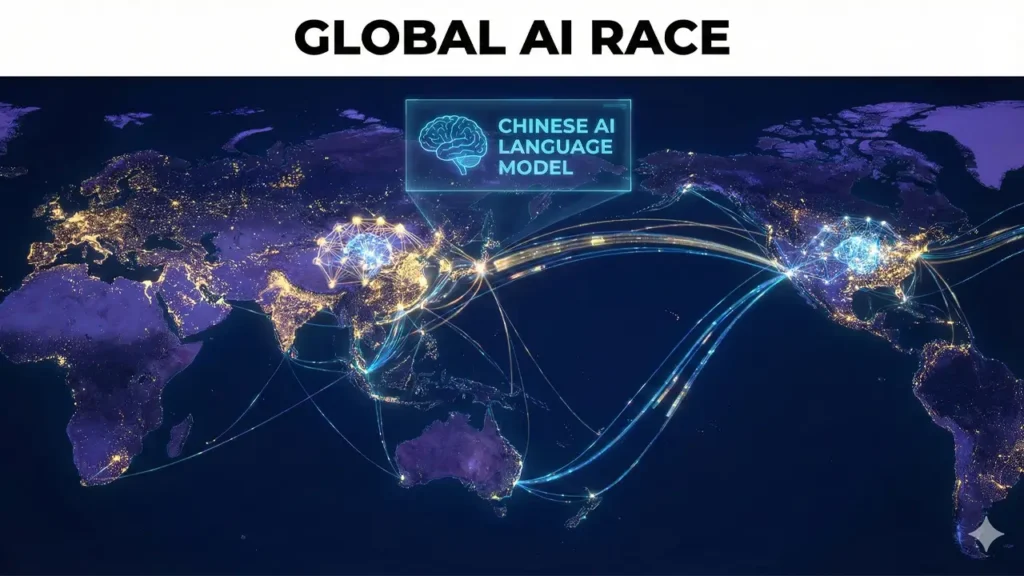
Qwen3.5-397B-A17B doesn’t exist in a vacuum. It’s part of a broader and accelerating trend: Chinese AI labs producing frontier-quality Chinese AI language models that are genuinely competitive — and in some areas superior — to their American counterparts.
Qwen3.5 follows other Chinese model labs like Z.ai, Minimax, and Kimi in refreshing their leading models. It is described as a very welcome headline model refresh from China’s most prolific open model lab.
The global competitive dynamics here are meaningful. For much of the 2023–2024 period, the conventional wisdom was that Chinese AI models lagged behind OpenAI and Anthropic by roughly 6–12 months. That gap has closed dramatically. Models like DeepSeek V3, Kimi K2.5, and now Qwen3.5 are scoring competitively or outperforming proprietary models from US labs on a wide range of independent benchmarks.
What’s particularly notable about Qwen3.5’s approach is the emphasis on openness. While US frontier labs like OpenAI, Anthropic, and Google have moved increasingly toward closed, API-only models, Chinese labs like Alibaba, DeepSeek, and Baidu have continued releasing high-quality open weights. This creates a fascinating dynamic: the most capable openly available AI models in the world are now predominantly coming from Chinese research organizations.
The release marks a meaningful moment in enterprise AI procurement. For IT leaders evaluating AI infrastructure for 2026, Qwen3.5 presents a different kind of argument: that the model you can actually run, own, and control can now trade blows with the models you have to rent.
The multilingual story is also part of the global competition. Language support expands from 119 languages in Qwen3 to 201 languages and dialects in Qwen3.5. This positions the model for deployment across Southeast Asia, Africa, and the Middle East — regions where English-centric models often fall short and where there is enormous untapped demand for AI capabilities.
9. Enterprise Use Cases of Qwen3.5-397B-A17B Model
When it comes to real-world deployment, the enterprise AI model comparison story for Qwen3.5-397B-A17B is compelling across multiple verticals. Let’s walk through some of the most promising enterprise applications.
Strategic Sector Matrix
Mapping frontier model capabilities to enterprise-scale requirements across finance, engineering, healthcare, and autonomous automation.
| Industry Sector | Core Use Cases | Technical Edge |
|---|---|---|
|
|
Regulatory compliance, document synthesis, automated report generation. |
Long Context (1M) Multilingual OCR
|
|
|
Autonomous code review, complex bug resolution, codebase navigation. |
SWE-Bench: 76.4% 256K Window
|
|
|
Clinical note extraction, medical triage support, peer-review synthesis. |
GPQA Diamond Reasoning
|
|
|
GUI automation, web browsing agents, tool orchestration. |
OSWorld: 62.2% TAU2-Bench: 86.7%
|
Software Engineering
Autonomous code review, bug fixing, and codebase navigation across distributed repositories.
Automation & Agents
GUI and OS-level automation, web-native agents, and sophisticated tool orchestration.
Audit covers 7 major industry sectors
The model is designed for developers and enterprises building multimodal AI applications including conversational chat, retrieval-augmented generation (RAG), vision-language understanding and reasoning, tool/function calling, and agentic workflows.
The RAG use case is particularly strong here. With a 256K native context window and robust document processing scores, Qwen3.5 can ingest and reason over large internal knowledge bases — technical documentation, compliance libraries, historical records — without the chunking and retrieval trade-offs that plague smaller-context models.
Agentic workflow capabilities include 69.0–78.6% on BrowseComp, 74.0% on WideSearch, 72.9% on BFCL-V4, 65.6% on ScreenSpot Pro, and 62.2% on OSWorld-Verified. These scores represent the model’s ability to navigate real desktop and browser environments autonomously — a capability that’s increasingly central to enterprise automation pipelines in 2026.
For infrastructure teams, the recommended serving configuration is tensor parallel size 8 on NVIDIA B200 GPUs using SGLang, with support for Multi-Token Prediction (MTP) to improve throughput. The model is also confirmed to run on AMD Instinct GPUs with ROCm-based vLLM, broadening hardware compatibility beyond the Nvidia ecosystem.
10. Final Verdict: Should You Use Qwen3.5-397B-A17B Model?
Let’s be direct: the Qwen3.5-397B-A17B model is one of the most significant open-weight AI releases in recent memory. It’s not perfect — no model is — but what it offers at its price point and with its license terms is genuinely extraordinary.
Here’s the honest summary. On the positive side, you get frontier-class intelligence (ranked #3 among open-weight models by Artificial Analysis), native multimodality across text, image, and video, an Apache 2.0 license that allows full commercial use and self-hosting, a 256K native context window with 1M available via the hosted API, support for 201 languages, and inference speeds that are dramatically faster and cheaper than prior Qwen generations. On the other hand, hallucination rates remain higher than some peers, the full model requires substantial GPU infrastructure to self-host (8× NVIDIA B200 recommended), and as with any open-weight model, enterprise teams will need to invest in safety and alignment evaluation for their specific use cases.
The release marks a meaningful moment in enterprise AI procurement. Qwen3.5-397B-A17B represents a monumental leap in Alibaba Cloud’s AI strategy, transitioning from a strong open-source contender to a dominant frontier-level system designed for the agentic AI era.
Who should use it?
If you’re a developer building AI-powered applications and want maximum capability under an open license, this model deserves to be at the top of your evaluation list. If you’re an enterprise team that has been paying premium API costs for proprietary models and wants to explore self-hosted alternatives, Qwen3.5-397B-A17B is now a credible option. If you operate globally across multiple languages, the 201-language support combined with frontier-level reasoning is a combination no other open-weight model currently matches.
The Chinese AI language model ecosystem has matured rapidly, and Qwen3.5-397B-A17B is its clearest proof point yet. The era of assuming that “frontier AI = proprietary API” is over. The open-source community now has a model that can genuinely compete — and the competitive pressure this creates will ultimately benefit everyone building with AI, regardless of which model they choose.
For AI developers, enterprise architects, and technology strategists: keep this model on your radar. It’s not just a benchmark winner — it’s a signal of where the entire industry is heading.
If you’re exploring cutting-edge technology beyond AI models, it’s worth checking out the world of advanced hardware too. From high-precision machines to professional-grade printing solutions, the innovation ecosystem is expanding fast. Discover detailed reviews, comparisons, and expert insights here: https://bestchina3dprinters.com/ — a solid resource for anyone serious about next-generation manufacturing tools.