
If you’ve ever wished you could just describe a software idea and have an entire development team build it for you — welcome to 2026. The MetaGPT multi agent framework is doing exactly that, and it’s turning heads across the AI and software development world. Whether you’re a developer, a startup founder, or just someone fascinated by what AI can actually do today, this breakdown is for you. Let’s dig in.
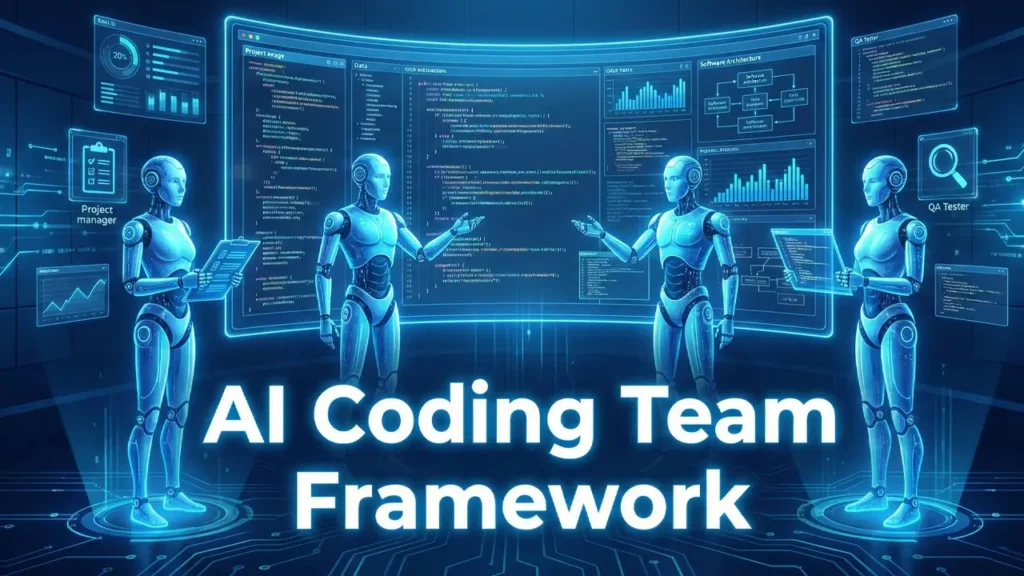
1. What Is the MetaGPT Multi Agent Framework?
The MetaGPT multi agent framework is not a chatbot. It’s not a single AI model answering questions. It’s something far more ambitious: a multi agent AI system that replicates the structure of a real software company using large language models.
Developed by a team led by Sirui Hong and researchers affiliated with DeepWisdom, MetaGPT was introduced in a research paper titled “MetaGPT: Meta Programming for A Multi-Agent Collaborative Framework” (2023). The core idea is elegant: instead of one AI trying to do everything, you assign different AI agents to different professional roles — just like a real company would.
Think of it as a virtual software studio. You walk in with a one-line idea. The system takes it from there: analyzing requirements, planning architecture, writing code, reviewing it, and producing documentation. All of this happens through a coordinated multi agent AI system where each agent knows its role and communicates through structured protocols.
What makes MetaGPT genuinely different from other AI tools is its use of Standard Operating Procedures (SOPs). These are predefined workflows that govern how agents collaborate, what they produce at each step, and how outputs are passed between roles. The result is a system that doesn’t just generate code — it generates organized, documented, structured software projects.
2. How Does the MetaGPT Multi Agent Framework Work?
To understand how the MetaGPT multi agent framework operates, you need to understand how large language model agents talk to each other — and how MetaGPT structures those conversations.
At its core, MetaGPT uses a shared message pool architecture. Rather than agents calling each other directly (which creates chaos at scale), every agent publishes messages to a central pool. Other agents subscribe to the messages that are relevant to their role. This publish-subscribe model keeps communication clean, traceable, and scalable.
Here’s what that looks like in practice:
When you give the system a task — say, “build a web-based to-do list app” — the following chain of large language model agents gets activated:
The Product Manager agent receives your input and produces a Product Requirements Document (PRD). This is a structured specification: what the software should do, who the users are, what the key features are.
That PRD is published to the shared pool. The Architect agent subscribes to it and produces a system design document — deciding on the tech stack, the architecture pattern, the data models.
The Project Manager agent reads the design and breaks it into specific coding tasks, producing a task list.
The Engineer agents pick up tasks and write actual code, guided by the architecture.
The QA Engineer agent then reviews the code, writes tests, and flags issues.
Every step produces a structured artifact — a document, a diagram, a code file. This is the MetaGPT philosophy: don’t just chat, produce deliverables. The MetaGPT multi agent framework enforces this discipline through its SOP system, making the entire pipeline feel less like an AI experiment and more like a real development workflow.
3. MetaGPT GitHub Repository: Why It Exploded
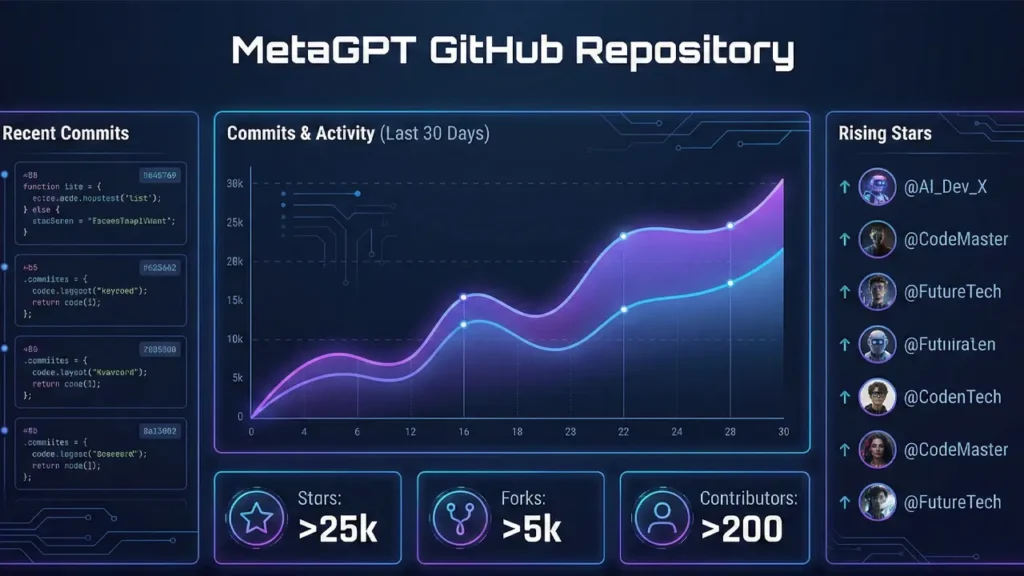
The MetaGPT GitHub repository (github.com/geekan/MetaGPT) is one of the most starred AI repositories in recent history. Shortly after its public release in 2023, it garnered tens of thousands of GitHub stars within days — a clear signal that the developer community saw something genuinely new here.
So why did the MetaGPT GitHub repository blow up so fast?
Timing. It arrived at the exact moment when the world was saturated with single-agent chatbots. Developers were hungry for something that went beyond “ask and answer.” MetaGPT offered a peek into what coordinated, role-based AI could look like.
Openness. The full source code is available. The research paper is publicly accessible. You can run it yourself, modify it, extend it, and build on top of it. This open-source approach democratized access to multi-agent AI in a way that proprietary tools couldn’t match.
Documentation. The repository includes detailed setup instructions, example outputs, and configuration guides. For a research-grade framework, the usability was surprisingly good.
Community. Hundreds of contributors have submitted pull requests, added features, translated documentation, and created tutorials. The MetaGPT GitHub repository is a living project, not an abandoned experiment.
The paper that accompanied the release benchmarked MetaGPT against other multi-agent approaches and showed it outperforming prior work on the HumanEval software engineering benchmark — a result that gave the framework serious academic credibility alongside its popular appeal.
4. Why This Is More Than an AI Chatbot
It’s tempting to lump MetaGPT in with tools like ChatGPT or GitHub Copilot. But that comparison misses the point. The MetaGPT multi agent framework represents a fundamentally different category: autonomous AI agents for coding.
Here’s the key distinction. A traditional LLM-based chatbot responds to your prompts. You write, it responds, you evaluate. It’s reactive. You are the project manager, the architect, the QA engineer — the AI is just a very smart autocomplete.
Autonomous AI agents for coding flip this model. You provide a goal. The system decomposes it, plans it, executes it, and self-corrects — often without further input from you. The agents have roles, responsibilities, and communication channels. They don’t wait for you to guide each step.
This is not theoretical. MetaGPT can, when given a reasonably specific task, produce a full project folder including: a PRD, a system design document, class diagrams, API specifications, implementation code, and unit tests. The quality is not always production-ready, but the completeness of the output is remarkable.
The gap between a chatbot and autonomous AI agents for coding is the difference between hiring a consultant who answers your questions and hiring a team that delivers a product. MetaGPT is, at least conceptually, in the second category.
5. AI Coding Team Framework: The Virtual Company Model
One of MetaGPT’s most distinctive features is how explicitly it models a software company. The AI coding team framework at the heart of MetaGPT isn’t just a collection of AI models — it’s a hierarchy of roles with defined responsibilities and communication protocols.
The roles in the default MetaGPT configuration include:
Product Manager — Translates your user requirement into a formal PRD. Defines features, user stories, and success criteria.
Architect — Designs the technical solution. Selects the architecture, identifies components, and maps out data flows.
Project Manager — Breaks the architecture into actionable tasks. Creates the task list that engineers will execute.
Engineer — Implements the code based on task specifications and architectural guidelines.
QA Engineer — Reviews the code, identifies bugs, writes test cases, and validates outputs.
Each role in this AI coding team framework is implemented as a separate agent with its own system prompt, its own subscriptions in the message pool, and its own output format. They don’t overlap arbitrarily — they follow a structured workflow that mirrors how real software teams operate.
This is what makes MetaGPT so compelling to professional developers: it doesn’t just generate code, it generates code in context — with documentation, architecture decisions, and test coverage that reflect how real teams work.
6. AI Software Development Automation in Reality
Let’s be concrete. What does AI software development automation actually look like when you run MetaGPT?
You install the framework (Python-based, available via pip), configure your API key for an underlying LLM like GPT-4 or a compatible model, and then run a command like:
python -m metagpt "Design a simple blog platform with user authentication"
The system begins its pipeline. Within minutes (or hours, depending on task complexity and API speed), it produces a structured output directory containing documents, diagrams, and code files.
The level of AI software development automation here is not superficial. MetaGPT produces:
A Product Requirements Document that itemizes features and user stories. A technical design specifying the stack, components, and APIs. A class diagram (often rendered as a Mermaid.js diagram) visualizing the system structure. Actual Python (or other language) code files implementing the described classes and functions. Unit tests validating the implementation.
Is it perfect? No. Complex, novel problems still challenge the system. Debugging and integration require human expertise. But for well-scoped, clear requirements, the degree of AI software development automation MetaGPT achieves is genuinely impressive — and it improves with each new release.

7. AI Project Management Agents: Planning Without a Human Manager
One of the less discussed but deeply interesting aspects of MetaGPT is what it tells us about AI project management agents.
Project management is, at its core, an information-transformation task: take a high-level goal, decompose it into tasks, assign responsibilities, track dependencies, and monitor progress. It turns out that LLMs are surprisingly good at this — when given the right structure.
In MetaGPT, the AI project management agents role (filled by the Project Manager agent) takes the architecture document and produces a detailed task breakdown. Each task specifies: what needs to be built, which class or module it belongs to, what dependencies it has, and what the expected output is.
This task list then feeds directly into the engineering phase. Engineers don’t have to interpret vague requirements — they receive structured specifications. The AI project management agents pattern here removes ambiguity at exactly the point where real-world projects most often fail: the translation from “what we want” to “what we build.”
Future versions of MetaGPT are exploring more dynamic project management — where agents can reprioritize tasks based on discovered complexity, flag blockers, and update plans mid-execution. The vision is a system that doesn’t just start a project but actively manages it through completion.
8. Open Source Multi Agent Framework and the Future of Development
MetaGPT’s decision to operate as an open source multi agent framework is not just a licensing choice — it’s a philosophical stance that has shaped the entire ecosystem around it.
Because it’s open source, researchers can study how multi-agent coordination actually works at scale. Developers can extend MetaGPT with new agent roles, new communication protocols, or connections to external tools and APIs. Companies can deploy it internally, customizing workflows to match their specific development processes.
The open source multi agent framework model also accelerates learning. Bugs get found faster. Edge cases get documented. Alternative approaches get proposed and tested. The community around MetaGPT has contributed agents for new roles (like a Data Analyst or a DevOps Engineer), integrations with tools like GitHub and Jira, and support for additional LLM backends beyond OpenAI’s APIs.
More broadly, MetaGPT represents a glimpse into what software development might look like when AI handles more of the mechanical work. Human developers increasingly become architects of systems, definers of requirements, and evaluators of outputs — rather than line-by-line implementers. The open source multi agent framework model ensures that this future is built transparently, collaboratively, and accessibly.
9. AI Development Workflow Automation: Pros and Cons
No framework is perfect. Here’s an honest look at the AI development workflow automation that MetaGPT offers — what it does well and where it still falls short.
Architecture Comparison
Analyzing the leap from conversational code generation to autonomous multi-agent software development frameworks.
| Architectural Dimension | Standard LLM (Chat) | MetaGPT Framework |
|---|---|---|
| Task Decomposition |
Manual User must define steps & scope. |
Autonomous SOP-driven agentic breakdown. |
| System Artifacts | Optional / Fragmented | PRDs, Design Docs, API Specs |
| Role Specialization | Generic Assistant |
PM
Architect
QA
|
| Final Deliverable | Markdown Code Snippets | Full Project Workspace |
| Barrier to Entry | Low (Web Interface) | Moderate (Python/Environment Config) |
| Compute / API Cost | 1x Query Cost | Nx Multi-agent Logic Calls |
| Production Latency | Instant (Seconds) | Iterative (Minutes) |
| Sovereignty | Proprietary / Locked | Open Source (MIT) |
| Target Objective | Snippets & Refactoring | End-to-End Scaffolding |
Manual User Drive
Auto SOP Cycles
Standard: Markdown snippets and isolated code blocks.
MetaGPT: Production-structured repository including PRDs and unit tests.
Audit continues across 11 key dimensions
Strengths of MetaGPT’s AI development workflow automation:
The structured output discipline is genuinely valuable. Even when the code needs revision, having a PRD and architecture document auto-generated saves hours of work. The role-based model scales more gracefully than single-agent approaches — you can add more agents, more specialized roles, and more tools without redesigning the entire system. And the open-source nature means you’re not locked into any single provider.
Limitations to be aware of:
The cost per task is higher — multiple agents mean multiple API calls, and for complex projects this can add up. Execution time is longer than a single chatbot response. And the quality of output is deeply dependent on the quality of your initial requirement. Vague inputs produce vague outputs, even with a sophisticated pipeline. Human review remains essential.
10. Final Verdict: Should You Use the MetaGPT Multi Agent Framework?
Here’s the bottom line on the MetaGPT multi agent framework: it’s one of the most important demonstrations of what multi-agent AI can achieve, and it’s worth your attention whether you’re a developer, researcher, or AI enthusiast.
Is it ready to replace your entire engineering team? Not today. The outputs require skilled human review, the costs can be significant for large tasks, and complex real-world requirements can still confuse the agents. But as a tool for rapid prototyping, project scaffolding, proof-of-concept development, and exploring what AI-assisted development looks like, it is genuinely impressive and genuinely useful.
The framework is also a template for how AI systems should be designed: with clear roles, structured communication, traceable artifacts, and a workflow that mirrors human best practices. As the underlying LLMs improve, the outputs of MetaGPT will improve alongside them — and the architecture will scale in ways that single-agent tools simply cannot.
If you’re building software today and haven’t experimented with the MetaGPT multi agent framework, it’s worth an afternoon to try. Clone the repository, give it a clear task, and watch a virtual team of AI agents get to work. It won’t be perfect — but it’ll change how you think about what AI can do in software development.
Want to go deeper into multi-agent AI? We regularly break down the most important frameworks, tools, and research in the space. Find more detailed analyses, tutorials, and comparisons at www.aiinovationhub.com — your resource for staying ahead in the AI development landscape.
AI is evolving fast — from multi-agent software teams like MetaGPT to real-world automation in hardware. But innovation doesn’t stop at code. If you’re serious about building, prototyping, or launching physical products, the next logical step is 3D printing. Whether you’re a startup founder, engineer, or tech enthusiast, having the right printer changes everything. Precision, speed, material compatibility — it all matters. That’s why we recommend exploring one of the most focused platforms on Chinese 3D printing technology. Discover detailed comparisons, expert insights, and the best models available today at https://bestchina3dprinters.com/ — your gateway to powerful, affordable manufacturing tools.