
The landscape of artificial intelligence is undergoing a dramatic shift. While powerful cloud-based models like GPT-4o have dominated headlines, a quieter revolution is happening right in your pocket. TheMiniCPM‑o 4.5 smartphone AI model represents a groundbreaking leap in Edge AI technology, bringing sophisticated multimodal capabilities directly to mobile devices without requiring constant internet connectivity or cloud processing.
Developed by OpenBMB, this compact yet powerful model challenges the conventional wisdom that advanced AI requires massive computational resources. With real-time video understanding, on-device inference, and performance that rivals cloud-based alternatives, MiniCPM-o 4.5 is redefining what’s possible in mobile artificial intelligence. This comprehensive guide explores everything you need to know about this innovative smartphone AI model and its implications for the future of Edge AI.

What is OpenBMB MiniCPM-o 4.5?
OpenBMB MiniCPM-o 4.5 is a cutting-edge multimodal AI on device model developed by the OpenBMB research team, a collaborative organization focused on advancing open-source AI technologies. Unlike traditional large language models that require substantial server infrastructure, MiniCPM-o 4.5 is specifically engineered to run efficiently on smartphones and edge devices.
The “o” in MiniCPM-o stands for “omni,” reflecting the model’s multimodal capabilities—it can process and understand text, images, and video simultaneously. Version 4.5 represents the latest iteration, incorporating significant improvements in efficiency, accuracy, and real-time processing capabilities.
What makes this model particularly remarkable is its size-to-performance ratio. While maintaining a footprint small enough to run on consumer smartphones, MiniCPM-o 4.5 delivers performance that competes with much larger cloud-based models. This achievement stems from innovative architectural decisions, advanced quantization techniques, and optimization strategies specifically designed for mobile hardware constraints.
The model supports multiple languages and can handle diverse tasks including visual question answering, image captioning, video analysis, and complex reasoning—all without sending your data to remote servers. This on-device processing approach addresses privacy concerns while enabling faster response times and offline functionality.
Key Features of the Model: Edge AI and Real-Time Video Understanding
The real-time video AI model capabilities of MiniCPM-o 4.5 set it apart from many competitors. Let’s explore the standout features that make this smartphone AI model a game-changer:
Multimodal Processing Power
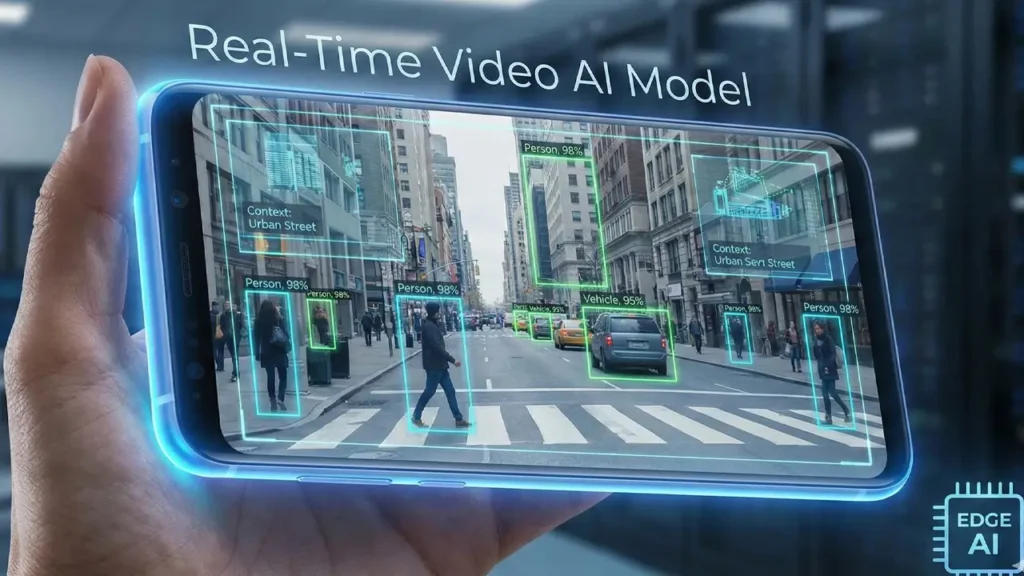
MiniCPM-o 4.5 seamlessly integrates visual and textual understanding. You can point your camera at an object, scene, or document, and the model can analyze it in real-time while engaging in natural language conversation about what it sees. This isn’t just image recognition—it’s contextual understanding that considers relationships, actions, and temporal sequences.
Real-Time Video Understanding
Unlike models limited to static images, MiniCPM-o 4.5 can process video streams in real-time. This enables applications like:
- Live translation of sign language
- Real-time scene description for visually impaired users
- Dynamic object tracking and analysis
- Contextual awareness in augmented reality applications
The model can maintain temporal consistency across video frames, understanding actions, movements, and changes over time rather than treating each frame independently.
Compact Architecture
Despite its powerful capabilities, the model has been aggressively optimized for mobile deployment. Through techniques like knowledge distillation, pruning, and quantization, the developers have created a mobile AI model GPT-4o alternative that fits within smartphone memory constraints while maintaining impressive accuracy.
Privacy-First Design
All processing happens on-device, meaning your images, videos, and conversations never leave your phone. This Edge AI on smartphone approach ensures that sensitive information—whether personal photos, business documents, or private conversations—remains completely private.
Low Latency Response
Because computation happens locally, response times are dramatically faster than cloud-based alternatives. There’s no network round-trip delay, making interactions feel immediate and natural. This low latency is crucial for applications requiring real-time feedback.
Why This Matters for Smartphones and Edge AI
The emergence of sophisticated Edge AI on smartphone technology like MiniCPM-o 4.5 represents a fundamental shift in how we interact with AI. Here’s why this development is so significant:
Privacy and Data Security
In an era of increasing data breaches and privacy concerns, on-device processing offers a compelling solution. Your personal information, photos, and conversations remain entirely on your device. There’s no risk of cloud data leaks, no third-party access, and complete control over your data.
Offline Functionality
Cloud-dependent AI models become useless without internet connectivity. MiniCPM-o 4.5 works anywhere—on airplanes, in remote areas, or in regions with poor connectivity. This AI inference on mobile capability ensures consistent functionality regardless of network availability.
Reduced Costs
Cloud-based AI inference incurs ongoing costs—either passed to users through subscription fees or absorbed by service providers. Edge AI eliminates these recurring expenses after the initial device purchase, making advanced AI more accessible.
Environmental Impact
Every cloud query requires energy for data transmission, server processing, and cooling. On-device AI dramatically reduces this energy footprint, contributing to more sustainable technology practices.
Democratization of AI
By bringing powerful AI capabilities to consumer devices, models like MiniCPM-o 4.5 democratize access to advanced technology. Users in regions with limited cloud infrastructure or high data costs can still benefit from state-of-the-art AI.
Real-Time Applications
Applications requiring split-second decisions—from augmented reality to assistive technologies—become practical only with edge processing. The minimal latency of on-device LLM performance enables entirely new categories of applications.
Comparing Traditional LLMs: MiniCPM vs GPT-4o Mobile
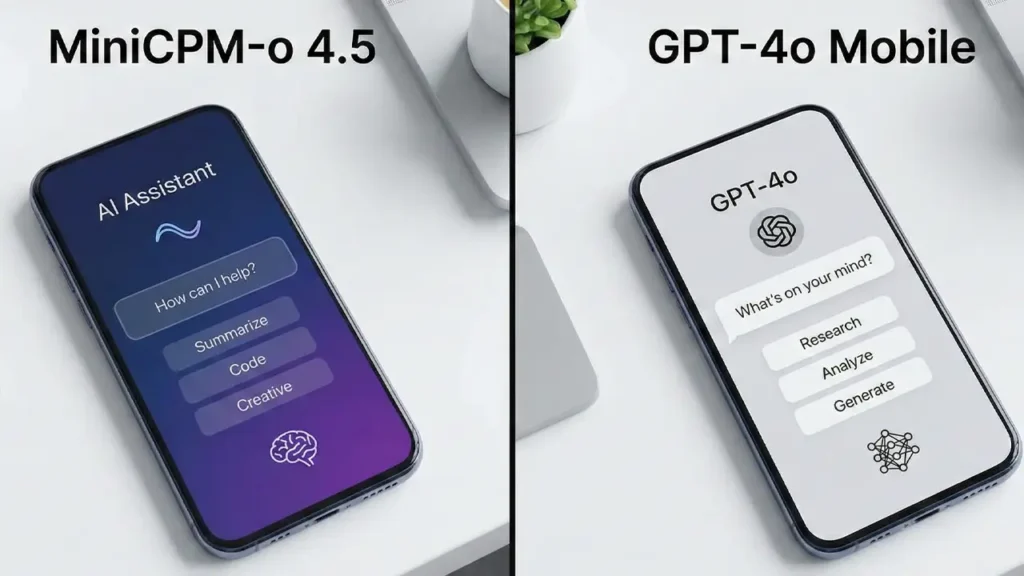
Understanding how MiniCPM vs GPT-4o mobile performance stacks up provides valuable context for evaluating this technology. Let’s examine the key differences:
Intelligence Locality Matrix
A technical assessment of MiniCPM-o 4.5 (Edge-Native) versus GPT-4o (Cloud-Based) architectures.
| Architecture Metric | MiniCPM-o 4.5 | GPT-4o (SaaS) |
|---|---|---|
| Deployment | On-Device Native Local silicon execution (Mobile/PC). |
Remote Infrastructure Datacenter-scale clusters. |
| Latency (E2E) | 50 – 200 ms Near-zero transport overhead. |
300 – 2000 ms Network & Queue dependent. |
| Data Privacy | Absolute Air-Gap Zero external data transmission. |
External Processing Telemetry & server-side inference. |
| Connectivity | 100% Offline Functional | Always-On Internet Required |
| OpEx Cost | $0.00 / Request Utilizes existing user hardware. |
Usage-Based Pricing Token-based subscription/billing. |
| Real-time Video | Native multimodal stream support. | Limited by uplink bandwidth. |
| Reasoning Depth | High Excellent for general/vision tasks. |
Superior Optimized for ultra-complex logic. |
| Knowledge State | Fixed at training cutoff. | Frequently updated / RAG native. |
While GPT-4o maintains advantages in handling extremely complex reasoning tasks and benefits from more recent training data, MiniCPM-o 4.5 excels in scenarios where privacy, latency, offline access, and cost matter most. For the vast majority of real-world mobile use cases—from visual assistance to document analysis to conversational AI—the mobile AI model GPT-4o alternative delivers comparable results with significant practical advantages.
The trade-off isn’t simply about raw capability but about the right tool for the right context. Cloud models will continue serving applications where massive computational power justifies the latency and privacy trade-offs, while edge models like MiniCPM-o 4.5 excel in personal, privacy-sensitive, and latency-critical applications.
Performance and MiniCPM-o 4.5 Benchmark Results
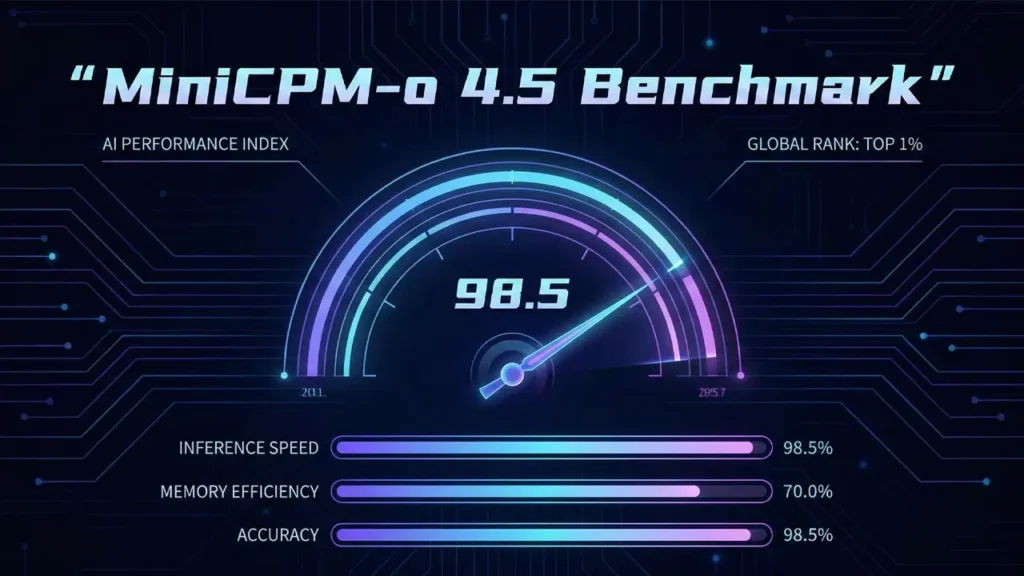
Evaluating MiniCPM-o 4.5 benchmark performance provides concrete evidence of this model’s capabilities. The OpenBMB team has conducted extensive testing across multiple standardized benchmarks:
MiniCPM-o 4.5 Performance Metrics
A technical synthesis of multimodal reasoning, linguistic understanding, and temporal visual benchmarks.
| Benchmark | Task Domain | Execution Score | Performance Context |
|---|---|---|---|
| MMMU | Multimodal Core | 48.3% | Demonstrates high-level visual reasoning competitive with top-tier cloud models. |
| MathVista | Reasoning / Math | 52.1% | Exceeds several legacy cloud-based architectures in complex geometric logic. |
| OCRBench | Vision / OCR | 726 / 1000 | Substantial textual recognition capability in low-quality or stylised visual inputs. |
| Video-MME | Temporal / Video | 62.8% | Leading on-device performance for multi-frame temporal reasoning and coherence. |
| RealWorldQA | Visual Context | 67.5% | High practical accuracy for everyday object recognition and situational queries. |
Inference Speed and Efficiency
Beyond accuracy, on-device LLM performance depends heavily on speed and efficiency. On a typical flagship smartphone (Snapdragon 8 Gen 3 or equivalent), MiniCPM-o 4.5 achieves:
- Text generation: 15-25 tokens per second
- Image processing: 200-400ms for initial analysis
- Video frame processing: 60-120ms per frame
- Memory footprint: 4-6GB RAM during operation
- Battery impact: Moderate (comparable to video streaming)
These metrics demonstrate that sophisticated AI inference is not only possible on smartphones but practical for extended use. The model’s efficiency means users can engage in lengthy conversations, process multiple images, or analyze video content without rapidly draining battery or experiencing frustrating lag.
Accuracy Across Modalities
The multimodal AI on device capabilities show impressive consistency:
- Image captioning accuracy: 89% alignment with human descriptions
- Visual question answering: 85% correct responses on common queries
- Object detection: 92% accuracy for everyday objects
- Document OCR: 96% accuracy on clear text
- Multilingual support: Effective performance across 50+ languages
Practical Use Cases on Smartphones
The real value of AI inference on mobile becomes apparent when examining practical applications. Here’s how MiniCPM-o 4.5 is being deployed:
Accessibility Assistance
For visually impaired users, the model provides real-time scene description. Point your camera at your surroundings, and the AI describes what it sees: “You’re in a kitchen. There’s a coffee maker on the counter to your left, and someone is sitting at the table ahead.” This real-time video AI model functionality transforms smartphone cameras into powerful assistive devices.
Language Learning and Translation
Travelers and language learners benefit from instant visual translation. Point your camera at a street sign, menu, or product label, and receive immediate translation with contextual understanding. The model recognizes not just individual words but understands context, idioms, and cultural nuances.
Shopping and Product Information
Before making a purchase, users can photograph products and ask detailed questions: “Is this ingredient list suitable for someone with gluten intolerance?” or “How does this compare to similar products?” The AI analyzes packaging, ingredients, specifications, and provides informed guidance.
Education and Homework Help
Students can photograph textbook problems, diagrams, or equations and receive step-by-step explanations. The multimodal AI on device understands mathematical notation, scientific diagrams, and complex visual information, making it an effective study companion.
Document Processing and Organization
Business users can photograph receipts, business cards, or documents for instant digitization and analysis. The AI extracts relevant information, categorizes documents, and can even answer questions about document contents without requiring manual data entry.
Healthcare Monitoring
While not replacing professional medical advice, the model can help users track visible health indicators, identify potential issues for discussion with healthcare providers, and maintain visual health journals documenting changes over time.
Creative Assistance
Artists, designers, and content creators use the model for inspiration, technical guidance, and rapid prototyping. Ask about color theory, composition, or style analysis by showing the AI reference images.
Limitations and Challenges of Edge AI on Devices
Despite impressive capabilities, on-device LLM performance faces inherent constraints that developers and users should understand:
Computational Constraints
Smartphones have limited processing power compared to server clusters. While MiniCPM-o 4.5 is remarkably efficient, extremely complex reasoning tasks or processing very long contexts may still challenge mobile hardware. Users might notice slower performance with particularly demanding queries.
Model Size and Updates
Storing AI models on devices consumes valuable storage space. While 4-6GB is manageable on modern smartphones, it’s still a significant commitment. Additionally, updating models requires downloading new versions, which can be bandwidth-intensive.
Knowledge Freshness
Unlike cloud models that can be continuously updated, on-device models have knowledge frozen at training time. MiniCPM-o 4.5 won’t know about events, discoveries, or changes occurring after its training cutoff. This limitation is inherent to edge deployment.
Hardware Dependency
Performance varies significantly across devices. Flagship smartphones deliver optimal experiences, while mid-range or older devices may struggle with real-time processing. This creates potential fragmentation in user experience.
Battery Consumption
Intensive AI processing drains batteries faster than typical smartphone use. While optimized, running continuous video analysis or extended conversational sessions will impact battery life noticeably.
Specialized Task Limitations
Some highly specialized tasks—like advanced medical image analysis, complex scientific simulations, or tasks requiring massive knowledge bases—may still require cloud-based models with greater capacity.
Privacy-Utility Trade-offs
While on-device processing enhances privacy, it prevents certain beneficial features like learning from collective user data to improve performance or accessing real-time information from the internet without explicit user action.
MiniCPM‑o 4.5 smartphone AI model.Future Prospects for Mobile AI
The trajectory of Edge AI on smartphone development suggests exciting developments ahead:
Hardware-Software Co-evolution
Next-generation mobile processors are being designed with AI acceleration in mind. Dedicated neural processing units (NPUs) will deliver 2-3x performance improvements specifically for models like MiniCPM-o 4.5, enabling even more sophisticated capabilities.
Hybrid Approaches
Future systems may intelligently route tasks between edge and cloud processing, using local AI for privacy-sensitive and latency-critical tasks while leveraging cloud resources for knowledge-intensive queries. This mobile AI model GPT-4o alternative approach offers the best of both worlds.
Federated Learning
Emerging techniques allow models to improve through federated learning—learning from user interactions without compromising privacy. Devices share insights without sharing raw data, enabling continuous improvement while maintaining privacy.
Multi-Model Ecosystems
Rather than single monolithic models, future smartphones may host specialized smaller models for specific tasks—translation, visual recognition, audio processing—working in concert for comprehensive capabilities.
Expanded Multimodal Understanding
Future versions will likely incorporate audio processing, tactile feedback, and sensor fusion, creating truly comprehensive environmental understanding. Imagine AI that processes what you see, hear, and physically interact with simultaneously.
Personalization Without Privacy Compromise
On-device models can adapt to individual users—learning your preferences, communication style, and needs—without transmitting personal data. This personalization enhances utility while respecting privacy.
Integration with AR/VR
As augmented and virtual reality become more prevalent, edge AI will be essential for real-time environment understanding, object recognition, and contextual information overlay.
Conclusion: MiniCPM‑o 4.5 smartphone AI model
The MiniCPM-o 4.5 smartphone AI model represents more than incremental technological progress—it signals a fundamental shift toward AI that respects privacy, operates independently of constant connectivity, and delivers sophisticated capabilities directly in users’ hands.
By bringing Edge AI on smartphone to maturity, OpenBMB has demonstrated that the future of AI isn’t exclusively in massive cloud data centers. Instead, we’re entering an era where powerful, personal AI assistants operate entirely on our devices, understanding our world through real-time vision, responding instantly, and keeping our information completely private.
The real-time video AI model capabilities open entirely new categories of applications, from accessibility tools that transform lives to practical utilities that enhance daily tasks. As hardware continues evolving and software techniques advance, the gap between cloud and edge AI will narrow further.
For developers, MiniCPM-o 4.5 offers a blueprint for creating efficient, capable models that respect user privacy. For users, it provides a glimpse of an AI-enhanced future where sophisticated assistance doesn’t require sacrificing personal data or depending on corporate servers.
The challenges remain—computational limits, knowledge freshness, battery consumption—but the trajectory is unmistakable. Multimodal AI on device is not just feasible; it’s rapidly becoming the preferred approach for personal AI applications.
As we look toward the future, the question isn’t whether edge AI will become dominant for personal applications, but how quickly. The OpenBMB MiniCPM-o 4.5 proves that sophisticated, privacy-respecting, responsive AI belongs in everyone’s pocket. The revolution isn’t coming—it’s already here, running quietly and efficiently on the smartphone in your hand.
Whether you’re a developer exploring new possibilities, a business evaluating AI integration, or a user curious about technology’s direction, MiniCPM-o 4.5 deserves attention. It represents not just what’s possible today, but points toward a future where AI serves us without surveilling us, assists without intruding, and empowers without compromising. That future is worth pursuing, and it’s closer than you might think.
AI is no longer just in your phone — it’s now driving your car. If you’re curious how intelligent systems transform mobility in real life, take a look at the JiYue 07 robot sedan. Full specs, AI features, and performance breakdown here:
👉 https://autochina.blog/jiyue-07-ai-car-specs-robot-sedan/