
AI Year in Review 2025 — Introduction and Why You Should Read This
Welcome to our comprehensive look at the AI year in review 2025. As we wrap up another transformative year in artificial intelligence, it’s the perfect time to reflect on the breakthroughs, challenges, and opportunities that shaped the field. This article draws from official reports like the Stanford AI Index and the State of AI Report to provide a clear, balanced overview. Whether you’re a business owner curious about practical applications, a tech enthusiast tracking innovations, or someone just dipping their toes into AI, this guide is designed to educate without overwhelming you.
Why read this? In 2025, AI evolved from hype to real-world impact, influencing everything from daily workflows to global policies. According to the Stanford Human-Centered AI (HAI) Institute’s 2025 AI Index Report, AI adoption surged, with 78% of organizations using AI, up from 55% in 2024. This isn’t just about fancy models; it’s about how AI is reshaping industries, creating jobs, and raising ethical questions. We’ll break it down into digestible sections, highlighting key trends like agentic systems and multimodal capabilities, all backed by official sources.
By the end, you’ll have actionable insights for 2026, such as implementing AI agents in your workflows. Think of this as your friendly roadmap to staying informed in a fast-moving world. Save this post for reference, subscribe for more updates, or head over to aiinnovationhub.com for deeper dives and resources. Let’s explore what made 2025 a pivotal year for AI!
AI year in review 2025

AI Year in Review 2025 — The Main Shift of the Year: From Chat to Actions
One of the most exciting developments in the AI year in review 2025 was the rise of agentic AI, marking a shift from simple chat-based interactions to proactive, action-oriented systems. Agentic AI refers to intelligent agents that can autonomously pursue goals, make decisions, and execute tasks across complex workflows, going beyond responding to queries.
Official reports highlight this evolution. The UiPath 2025 Agentic AI Research Report surveyed IT executives and found that 68% are prioritizing agentic AI for its ability to automate end-to-end processes, boosting efficiency by up to 40%. Similarly, KPMG’s “Agentic AI Advantage” report describes agents as a “step-change,” capable of operating independently in dynamic environments. Bain & Company’s State of the Art of Agentic AI Transformation notes that tech giants like Google and Microsoft debuted agentic visions in early 2025, integrating them into enterprise tools.
In practice, agentic AI 2025 saw applications in areas like customer service, where agents handle inquiries, process payments, and follow up without human intervention. Deloitte’s survey revealed challenges, such as data searchability (48% of organizations), but also successes in scaling workflows. IBM’s BeeAI and Agent Stack exemplified open, agentic AI, enabling businesses to customize agents for specific needs.
Capgemini’s “Rise of Agentic AI” emphasizes reasoning advancements driving this trend, with agents collaborating in multi-agent systems. For beginners, imagine an AI that not only answers “What’s the weather?” but books your travel based on it. This shift promises productivity gains but requires careful governance. As we look ahead, agentic AI is set to redefine how we work.
AI year in review 2025
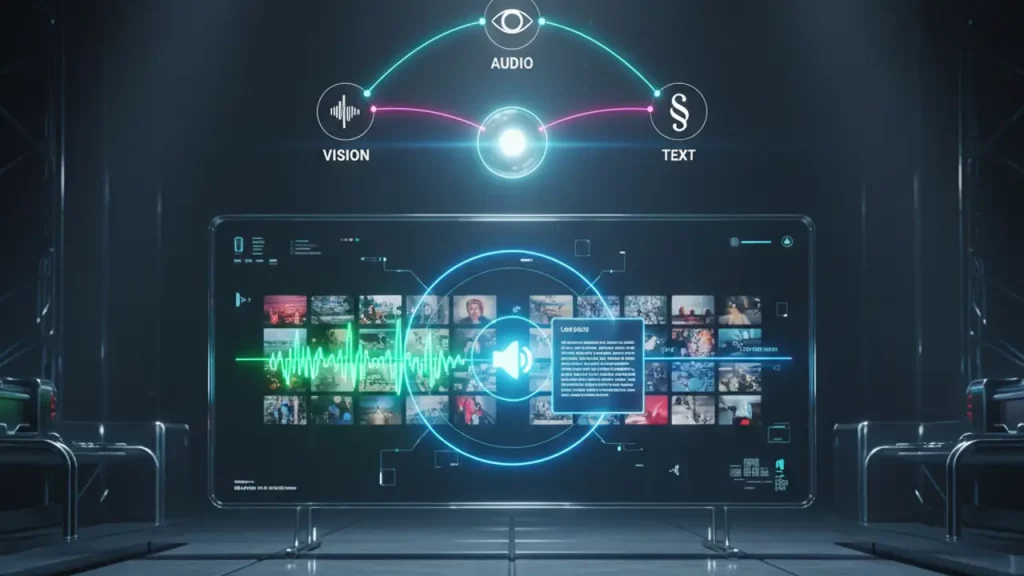
AI Year in Review 2025 — Models Started to “See and Hear”
In the AI year in review 2025, multimodal AI emerged as a game-changer, allowing models to process and generate content across multiple data types like text, images, audio, and video. This advancement means AI can “see and hear,” integrating sensory inputs for more natural, context-aware interactions.
Microsoft’s insights predict multimodal AI as a top trend, enhancing productivity in challenges like climate and health. Google’s Cloud Blog highlights multimodal AI’s prevalence, combining diverse sources for richer understanding. For public sectors, Google’s trends report notes multimodal AI unleashing context power, analyzing varied information seamlessly.
Advancements include improved reasoning and memory, as per Microsoft’s 2025 trends, where agents handle complex tasks with multimodal capabilities. Microsoft’s “Beyond Words” feature extends natural language to multimodal experiences. Google’s reports on AI impacts show organizations capitalizing on multimodal for search and agents. Google Cloud defines multimodal AI as processing any input into any output.
In 2025, models like Gemini 3 from Google advanced multimodal reasoning. This technology aids industries by enabling AI to interpret images with text or generate audio from descriptions. For newcomers, think of it as AI evolving from a text-only assistant to a full-sensory companion. While exciting, it raises privacy concerns with broader data handling. Overall, multimodal AI 2025 bridges human-like perception, paving the way for immersive applications.
AI year in review 2025
AI Year in Review 2025 — Open-Source Caught Up and Started Pressuring the Market
The AI year in review 2025 saw open-source AI models surge in popularity and capability, challenging proprietary systems and democratizing access. Open-source models, freely available for modification and use, caught up in performance, pressuring big tech to release more open alternatives.
OpenAI’s “Open Models” initiative introduced advanced open-weight reasoning models customizable for any use. NetApp’s top 10 list for 2025 features Google’s Gemma 2, optimized for researchers with sizes from 9B parameters. Hugging Face’s updated 2025 guide praises Llama 4, Qwen 3, and DeepSeek R1 for strong reasoning and coding. NVIDIA’s Nemotron 3 family enables faster agent development.
Elephas’s top 15 includes DeepSeek R1, Llama 3.3 70B, and Mixtral 8x7B, highlighting versatility. n8n Blog’s 11 best for 2025 covers base models like those in Ollama. Sebastian Raschka’s State of LLMs 2025 reviews progress from DeepSeek R1 to inference scaling.
This pressure stems from community-driven innovation, reducing costs and fostering collaboration. For beginners, open-source means you can run powerful AI on your PC without subscriptions. However, licenses vary, as seen in LiquidAI’s models. In 2025, open-source not only caught up but influenced market dynamics, making AI more accessible and competitive.
AI year in review 2025

AI Year in Review 2025 — Video Generation: Quality Grew, Risks Too
AI video generation in 2025 reached new heights in quality and accessibility, but it also amplified risks like misinformation. This technology uses AI to create realistic videos from text prompts, evolving workflows for creators and marketers.
Zapier’s 2025 review tested tools, noting realism improvements. MIT Technology Review explains generation via diffusion models, with pro tools integrating into editing software. GarageFarm’s guide highlights affordability and efficiency by 2025. ReelMind’s comprehensive guide predicts unprecedented realism and control.
Google DeepMind’s Veo 3.1 adds audio to video, empowering storytellers. CNET names Veo 3 as top, pioneering from major tech. YouTube’s Veo 3 Fast aids creators in monetization. TrueFan’s market forecast sees growth to $2.5B by 2032. Open-source options like those from SiliconFlow offer benchmarks for transcription and generation.
Quality leaps enable immersive content, but risks include deepfakes. For newcomers, start with free tools to experiment safely. Regulations are catching up, but ethical use is key. This trend in AI year in review 2025 balances innovation with caution.
AI year in review 2025

AI Year in Review 2025 — How Companies Really Implemented AI, Not Just “Played Around”
In the AI year in review 2025, businesses shifted from experimentation to real implementation, driving measurable value. Official case studies show AI enhancing operations, customer experiences, and decision-making.
McKinsey’s 2025 report on AI in the workplace surveys readiness, noting employee empowerment. Google’s 101 real-world use cases include Toyota’s AI platform for factory ML models. Deloitte’s collection covers agentic AI across industries. Stanford’s AI Index reports 78% organizational adoption.
IJSRA’s practical studies analyze challenges and successes. Aristek Systems’ stats show 53% of small businesses improving customer experience. MIT reports 95% pilot failures, favoring internal builds. Microsoft’s 1,000+ stories demonstrate transformations. PwC’s Responsible AI Survey links governance to value.
For example, enterprises used AI for predictive maintenance and personalized marketing. Beginners can learn from these: start small, focus on data quality. This year marked mature AI in business 2025, emphasizing ROI over novelty.
AI year in review 2025

AI Year in Review 2025: Safety, Errors, and User Trust
In the examination of artificial intelligence developments during 2025, a primary emphasis was placed on enhancing safety measures, minimizing operational errors, and fostering greater user confidence through coordinated efforts by governmental bodies and private enterprises. These initiatives were designed to promote the deployment of AI systems that are both dependable and aligned with ethical standards.
The White House introduced America’s AI Action Plan, which establishes three core policy pillars: accelerating innovation, constructing AI infrastructure, and advancing international diplomacy and security. This plan positions American AI technologies as the global benchmark, encompassing semiconductors, models, and applications. Complementing this, the United States Department of State unveiled its inaugural Enterprise Artificial Intelligence Strategy for fiscal years 2024-2025, aimed at responsibly integrating AI to strengthen diplomatic functions. The National Conference of State Legislatures provided a comprehensive summary of 2025 AI legislation, including mandates for AI companies to perform safety evaluations and submit findings to relevant oversight authorities.
Further contributions included the International AI Safety Report 2025, which consolidates scientific insights on the safety of general-purpose AI to inform shared understanding among stakeholders. The General Services Administration outlined guidance and resources for AI, incorporating an AI Safety Team to develop risk assessment frameworks and manage use case evaluations. The Future of Life Institute released the 2025 AI Safety Index, assessing seven prominent AI firms across 33 indicators of responsible development. Harvard’s analysis explored the implications of the White House’s plan for businesses, highlighting the evolving landscape of AI governance. Stanford’s 2025 AI Index Report served as a authoritative reference, offering data-driven insights to policymakers and industry leaders.
These endeavors addressed critical concerns such as algorithmic biases, hallucinations in model outputs, and cybersecurity vulnerabilities. For end-users, establishing trust necessitates transparency in AI processes and decision-making. The year’s progress underscores the importance of collaborative approaches to safety as a cornerstone for sustainable AI advancement.
AI year in review 2025

AI Year in Review 2025: Rules of the Game: Laws, Platform Policies, Compliance
The regulatory environment for artificial intelligence in 2025 saw significant intensification, with the introduction of new statutes and policies to ensure ethical application, as evidenced by various official frameworks established at the federal level.
The White House issued an Executive Order titled “Ensuring a National Policy Framework for Artificial Intelligence,” which evaluates state laws for potential burdens on interstate commerce and identifies those that may compel alterations to AI outputs. This order lays the groundwork for a cohesive national AI policy. The National Conference of State Legislatures tracked key legislation from the 2025 session pertaining to general AI matters. Additional analyses from the Economic Policy Institute examined the effects of these regulations on state-level governance.
Legal summaries from Mayer Brown detailed the scope of the Executive Order, emphasizing its role in preempting conflicting state regulations while preserving certain areas for state authority. Skadden’s insights highlighted the order’s potential to foster a uniform federal framework. Maynard Nexsen provided an overview of the order’s focus on national AI policy and preemption of state laws. Dentons alerted on the establishment of this national framework, noting its issuance on December 11, 2025. Baird Holm discussed the administration’s efforts to develop a comprehensive AI regulatory structure.
These policies primarily target burdens on commerce and the integrity of AI outputs. For enterprises, adherence involves navigating federal preemption mechanisms to align with emerging standards. This overview illustrates how 2025’s regulatory advancements strive to equilibrate technological innovation with protective measures.
AI year in review 2025

AI Year in Review 2025: Hardware Decides: Shortages, Accelerators, Costs
Advancements in AI hardware during 2025 progressed amid persistent supply constraints, with leading firms such as NVIDIA, AMD, and Intel driving innovations in chip technology.
Yahoo Finance reported on NVIDIA’s fulfillment of its 2025 commitments, alongside warnings of potential price increases for gadgets due to AI chip shortages. CNBC highlighted how the expansion of AI infrastructure has led to component scarcities, affecting various chip types and elevating costs. BattleForgePC analyzed the CPU price crisis, noting TSMC’s wafer shortages and price hikes by AMD and Intel. The Wall Street Journal observed that semiconductor revenues exceeded $400 billion in 2025, fueled by AI demand, with projections for further growth in 2026.
Wccftech detailed NVIDIA’s challenges in meeting demand for H200 AI chips from Chinese markets, prompting urgent supply chain adjustments by TSMC. A Yahoo Finance market analysis forecasted the global AI chip sector to expand from $31.6 billion to substantial figures by 2035. PatentPC provided statistics on market dominance, with NVIDIA holding approximately 80% of the AI accelerator segment due to its CUDA ecosystem. Rwazi noted emerging competition from AMD, Intel, and others, eroding NVIDIA’s monopoly. DataCenter Knowledge covered key developments, including NVIDIA’s roadmap for next-generation superchips unveiled at GTC 2025. CIO recommended alternatives for enterprises facing NVIDIA shortages. TradingKey reported NVIDIA’s $500 billion in chip orders for 2025 and 2026.
These shortages have increased expenses, yet innovations such as system-on-chips have enhanced operational efficiency. For stakeholders, this translates to prospects for accelerated and more cost-effective AI capabilities in the near term.
AI year in review 2025

AI Year in Review 2025: Final Verdict and Plan for 2026
Concluding the assessment of artificial intelligence progress in 2025, the year marked a consolidation of AI’s societal integration, with agentic systems poised to drive advancements into 2026. AI agents for workflows facilitate autonomous task automation, thereby revolutionizing operational structures.
McKinsey’s 2025 Global Survey on AI identified prevailing trends that generate tangible value, including widespread adoption with varying enterprise impacts. The firm also described the emergence of agentic organizations, where humans collaborate with virtual and physical AI agents to enhance value creation. Further, McKinsey’s report on AI in the workplace for 2025 illustrated agents’ capabilities in customer interactions and post-action planning. Microsoft’s Work Trend Index anticipated 2025 as the inception of the “Frontier Firm,” leveraging AI agents for scalable capacity.
Additional insights from McKinsey emphasized partnerships among humans, agents, and robots in transforming work dynamics. EnkiAI decoded Microsoft’s 2025 AI agent strategy, highlighting its role in reshaping industries through AI teammates. McKinsey’s technology trends outlook for 2025 addressed robotics, autonomous systems, and responsible AI. Kanerika summarized McKinsey’s findings on uneven AI impact despite high adoption rates. LinkedIn discussions on the State of AI 2025 noted high performers’ focus on workflow rethinking for growth. McKinsey projected that AI agents could elevate productivity by 3-5% annually, potentially increasing growth by 10% or more.
In summary, 2025 represented a phase of maturation in AI, while 2026 will prioritize the scaling of agentic solutions.
Short checklist for implementation in January:
- Evaluate current workflows to identify automation opportunities.
- Initiate a pilot with an accessible agent tool, such as Microsoft Copilot.
- Verify compliance with data privacy regulations.
- Provide training for teams on collaborating with AI agents.
- Establish metrics to track return on investment.
For additional resources, visit aiinnovationhub.com—your resource for practical AI guidance with a forward-oriented perspective.
2025 was the year AI stopped being a “cool demo” and started acting like a real teammate in business. Not just chatbots — we’re talking AI agents that can complete workflows end-to-end, copilots that boost team productivity, and ROI-first внедрения where leaders finally ask the right question: “What metric moves, and how fast?”
Here’s what stood out in 2025:
- Agentic AI went from hype to practical: task planning, tool usage, approvals, and handoffs became smoother.
- Copilots for teams became normal in marketing, sales, finance, and support — less chaos, faster output.
- Multimodal workflows (text + image + audio) started saving time in content, customer service, and internal ops.
- Governance & compliance moved to the front row — because scaling AI without guardrails is like giving a chainsaw to a toddler.
- Security + risk management became part of the AI stack, not an afterthought.
- And the big one: companies began tracking KPIs like time saved, cost reduction, conversion lift, and ticket resolution speed.
If you’re building in 2026, the play is simple: pick 1–2 workflows, add an agent/coplilot, measure impact weekly, and scale only what proves value.
Full recap + practical takeaways here:
https://aiinnovationhub.shop/ai-business-trends-2025-agents-copilots-roi/
Discover more from AI Innovation Hub
Subscribe to get the latest posts sent to your email.