
Introduction: What Gemini 3.6 Flash Actually Is
If you’ve been keeping half an eye on the AI world lately, you’ve probably noticed that new models arrive almost weekly. Most of them blur together. But every so often one lands that’s worth slowing down for — not because it’s flashy, but because it quietly changes the math for millions of people who use AI every day. That’s exactly the story with Gemini 3.6 Flash.
Google released Gemini 3.6 Flash on July 21, 2026, positioning it as the new default workhorse model in the Gemini family and the successor to Gemini 3.5 Flash. In plain language, “workhorse” means this is the model Google expects most people and most apps to reach for by default — the one doing your everyday coding, your research, your document summaries, and your multimodal tasks without you having to think too hard about which model to pick.
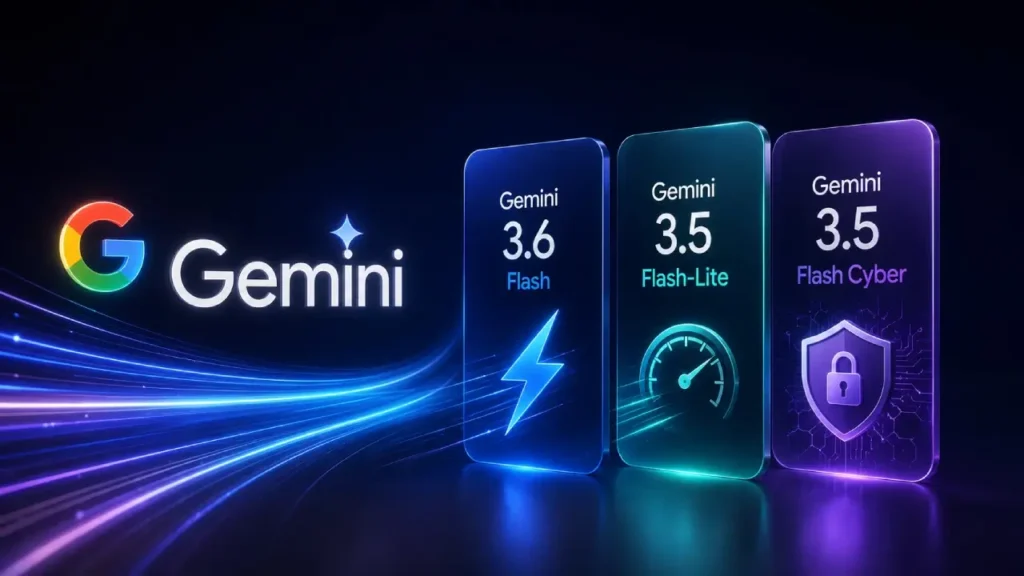
The interesting part is that Gemini 3.6 Flash wasn’t a solo launch. Google shipped it as one of three models on the same day: Gemini 3.6 Flash, a cheaper and faster tier called Gemini 3.5 Flash-Lite, and a gated security model called Gemini 3.5 Flash Cyber that only governments and trusted partners can access. There’s a small quirk worth flagging right away, because it trips people up: the versioning is mixed — the workhorse model jumped to 3.6, but Flash-Lite and Flash Cyber stayed on 3.5. So when you read “the new Flash models,” don’t assume they all share the same version number. Read the model ID carefully.
Throughout this guide I’ll walk you through what makes Gemini 3.6 Flash tick — its specs, its context window, its pricing, its benchmarks, how it compares to the model it replaces, what it’s like for coding, and how you actually get access to it. By the end you’ll have a clear, no-hype picture of whether it deserves a spot in your workflow. Let’s dig in.
Where Gemini 3.6 Flash Fits and What It Can Do
Before we get into numbers, it helps to understand the role this model plays, because that shapes everything else. The Gemini 3.6 Flash features that matter most aren’t about raw genius — they’re about balance. Google didn’t design Flash to be the smartest model in the room. It designed it to be the one you’d happily use all day long without wincing at the cost or the latency.
Gemini 3.6 Flash is built as the everyday workhorse for coding, knowledge work, and multimodal tasks. That “multimodal” word is doing a lot of lifting, so let’s unpack it. The model accepts text, images, video, audio, and PDF as input, and returns text as output. That means you can feed it a screenshot, a voice memo, a chart-heavy PDF, or a short video clip and ask it to reason about what’s inside — all from a single model, without stitching together three different tools.
There’s also a strong lean toward agentic work, which is the industry’s word for AI that doesn’t just answer a question but actually carries out multi-step tasks: browsing, calling tools, editing files, and chaining actions together. Google reports that the model takes fewer reasoning steps and tool calls to complete multi-step workflows, which is a big part of why it’s more efficient than its predecessor. In everyday terms, it wastes less effort getting to the finish line — and when you’re paying per token, wasted effort is wasted money.
Technical Specs: A Closer Look Under the Hood
Now let’s talk about the Gemini 3.6 Flash specs, because this is where you can really see what you’re working with. Google published a full model card alongside the launch, so these figures come straight from the source rather than guesswork.
The headline number most people care about is the context window, and it’s generous: 1,048,576 input tokens, which everyone rounds to “1 million.” On the output side, the model can generate up to 65,536 tokens in a single response. Its knowledge cutoff moved forward to March 2026, which is a meaningful jump from the January 2025 cutoff on Gemini 3.5 Flash. For anyone who works with recent events, newer libraries, or fast-moving topics, that fresher cutoff alone is a quietly big deal.
Here’s a clean summary of the core specifications.
Gemini 3.6 Flash Specifications
Comprehensive breakdown of model architecture, capabilities, context limits, and token constraints.
| Specification | Gemini 3.6 Flash |
|---|---|
|
Release date
Lifecycle
|
July 21, 2026
|
|
Model ID
Identifier
|
gemini-3.6-flash
|
|
Input types
Multimodal
|
Text, image, video, audio, PDF
|
|
Output type
Modality
|
Text
|
|
Context window
Capacity
|
1,048,576 input tokens
|
|
Max output
Generation
|
65,536 tokens
|
|
Knowledge cutoff
Timeline
|
March 2026
|
Release Date
LifecycleJuly 21, 2026
Model ID
Identifiergemini-3.6-flash
Input Types
MultimodalText, image, video, audio, PDF
Output Type
ModalityText
Context Window
Capacity1,048,576 input tokens
Max Output
Generation65,536 tokens
Knowledge Cutoff
TimelineMarch 2026
What this table tells you is that Gemini 3.6 Flash isn’t a stripped-down toy. It carries the same wide 1-million-token capacity as the flagship-tier models while staying in the affordable Flash bracket. That combination is precisely what makes it a “workhorse.”
The Context Window and Knowledge Cutoff, Explained Simply
Let’s spend a moment on the Gemini 3.6 Flash context window, because “1 million tokens” sounds abstract until you translate it into real life. A token is roughly three-quarters of a word in English, so a million tokens is on the order of hundreds of thousands of words. In practical terms, you could drop an entire book, a large codebase, or a stack of long reports into a single prompt and ask the model to reason across all of it at once.
Why does that matter? Because a big context window reduces the need for clever workarounds. Without it, developers often chop documents into little pieces, store them in a database, and retrieve fragments on demand. That works, but it’s fiddly and it sometimes loses the thread. With a million tokens, you can often just hand the whole thing over and let the model see the full picture. Fewer moving parts, fewer mistakes.
Then there’s the knowledge cutoff, which advanced to March 2026. If you’ve ever asked an AI about something recent and gotten a blank stare or an outdated answer, you know how frustrating a stale cutoff can be. Moving the cutoff forward by more than a year means the model simply knows about more recent things out of the box, before you even reach for live web search. For students, researchers, and anyone tracking current topics, that freshness is one of the most underrated upgrades in this release.
AndreevWebStudio.com
Professional web development and design services. Custom WordPress sites, landing pages, e-commerce solutions, and 3D printing content creation for businesses and creators.
- • WordPress Development
- • Custom Web Design
- • E-Commerce Solutions
- • 3D Printing Content
Pricing and Token Economics: The Real Headline
Here’s where things get genuinely interesting, because for a lot of people the Gemini 3.6 Flash price is the whole point. Google didn’t just make the model a bit smarter — it made it noticeably cheaper to run, and it did that in two ways at once.
First, the sticker price. Gemini 3.6 Flash costs $1.50 per million input tokens and $7.50 per million output tokens. The input price is unchanged from Gemini 3.5 Flash, but the output price dropped from $9.00 down to $7.50. Cached input is even cheaper, at $0.15 per million tokens, which rewards workflows that reuse the same context repeatedly.
Second — and this is the clever bit — the model uses roughly 17% fewer output tokens than Gemini 3.5 Flash to accomplish the same work. So you’re paying a lower rate per token and generating fewer tokens overall. Those two savings stack. The true reduction in your bill lands well below what the headline price alone suggests, because you’re winning on both the price and the quantity.
Gemini Pricing Comparison Matrix
Comparative analysis of token costs per 1 million tokens between Gemini 3.6 Flash and Gemini 3.5 Flash generations.
| Pricing (per 1M tokens) | Gemini 3.6 Flash | Gemini 3.5 Flash |
|---|---|---|
|
Input
Standard
|
$1.50
|
$1.50
|
|
Output
Generation
|
$7.50
|
$9.00
|
|
Cached input
Optimization
|
$0.15
|
—
|
Input Pricing
Standard$1.50
$1.50
Output Pricing
Generation$7.50
$9.00
Cached Input
Optimization$0.15
—
For a solo developer, these differences might feel small. But for anyone running high volumes — think an app making millions of calls a day — a 17% cut in output tokens plus a lower output rate turns into real, recurring savings. Several commentators put it well: this launch is less about “Google released a new model” and more about “Google optimized the economics of AI agents.”
Benchmarks and Performance: How Fast and How Capable
Let’s talk about the Gemini 3.6 Flash benchmarks, because it’s important to be honest about both the wins and the caveats here. Speed is the easy win to describe. The model runs at around 280 to 304 tokens per second, which puts it among the faster options in its class for interactive, back-and-forth use. Only the new Flash-Lite tier is quicker, clocking in around 350 tokens per second.
On Google’s own published benchmarks, Gemini 3.6 Flash beats its predecessor across the board. It scores 49% on DeepSWE versus 37% for 3.5 Flash, 83.0% on OSWorld-Verified versus 78.4%, and 63.9% on MLE-Bench versus 49.7%. On the GDPval-AA knowledge-work benchmark it reaches 1421 versus 1349. On SWE-Bench Pro it posts 58.7% versus 55.1%. Those are consistent, across-the-board improvements, especially in the coding and agentic categories where Flash is meant to shine.
Now the caveat, in the spirit of an honest guide. On the independent Artificial Analysis Intelligence Index — a composite benchmark covering reasoning, knowledge, mathematics, and coding — Gemini 3.6 Flash scores 50, which is the same score independent testers gave Gemini 3.5 Flash. In other words, the model is faster and cheaper, and it improves on specific real-world tasks, but it isn’t a giant leap in raw general intelligence. That’s a reasonable trade-off for a workhorse. Efficiency and reliability often matter more day to day than a couple of extra points on an abstract score.
Gemini 3.6 Flash vs 3.5 Flash: What Actually Changed
If you’re already a Gemini user, the comparison you really want is Gemini 3.6 Flash vs 3.5 Flash. Let’s lay it out plainly so you can see the upgrade at a glance.
Gemini Flash Performance Matrix
Evaluating core benchmark metrics, token efficiency, and knowledge cutoff milestones between Gemini 3.6 Flash and Gemini 3.5 Flash.
| Aspect | 3.6 Flash | 3.5 Flash |
|---|---|---|
|
Output price (1M)
Cost
|
$7.50
|
$9.00
|
|
Output token use
Efficiency
|
~17% fewer
|
Baseline
|
|
Knowledge cutoff
Timeline
|
March 2026
|
January 2025
|
|
DeepSWE
Coding
|
49%
|
37%
|
|
OSWorld-Verified
Agentic
|
83.0%
|
78.4%
|
|
MLE-Bench
ML Engineering
|
63.9%
|
49.7%
|
Output Price
Cost$7.50
$9.00
Output Token Use
Efficiency~17% fewer
Baseline
Knowledge Cutoff
TimelineMarch 2026
January 2025
DeepSWE
Coding49%
37%
OSWorld-Verified
Agentic83.0%
78.4%
MLE-Bench
ML Engineering63.9%
49.7%
The pattern is clear. The knowledge cutoff leap and the token efficiency are the two changes you’ll feel most in daily use. The benchmark gains reinforce that this is a real, useful update — just remember that the improvement is concentrated in practical, task-based performance rather than in abstract “smartness.”
Coding and Agentic Tasks: Where the Model Earns Its Keep
For developers, the Gemini 3.6 Flash for coding story is the most compelling part of the whole release. Google specifically tuned this model to behave better inside coding agents, and the improvements target problems that anyone who has used an autonomous coding tool will recognize.
The company says Gemini 3.6 Flash delivers higher precision with fewer unwanted code edits and reduced execution loops than its predecessor. If you’ve ever watched an AI agent get stuck rewriting the same file over and over, or making tiny “fixes” you didn’t ask for, you’ll appreciate why this matters. A model that stays on task, makes fewer stray edits, and doesn’t spin in circles is often more valuable in practice than one that scores a fraction higher on a benchmark.
It’s also built for longer-horizon agentic work, with configurable reasoning effort and support for parallel tool use across complex workflows. And Google is bringing computer use as a built-in capability, meaning the model can interact with user interface elements through the API without you having to build a separate browser-automation stack. That’s the kind of feature that removes real friction from building agents.
API Access and Integrations: How to Actually Use It
So where can you get your hands on it? The good news is that the Gemini 3.6 Flash API and its integrations were available on day one, which is not always the case with new model launches.
From the start, Gemini 3.6 Flash has been available in Google AI Studio, the Gemini API, the Gemini app, Android Studio, Google Antigravity, and Vertex AI / Gemini Enterprise. For developers, that means you can test it in AI Studio’s playground and then move straight into production through the API or Vertex AI without waiting for a staged rollout. For everyday users, it’s simply there in the Gemini app.
It also landed in third-party tools quickly. On the same day as the announcement, Gemini 3.6 Flash became available in GitHub Copilot, where it’s offered to Copilot Pro, Pro+, Max, Business, and Enterprise users, billed at provider list pricing under usage-based billing. GitHub described it as designed for web and app development, coding, and longer-horizon agentic tasks, with early testing showing higher task-completion rates and better token efficiency than Gemini 3.5 Flash.
Platform Access & Target Audiences
Mapping out deployment channels, developer environments, and consumer access points across the ecosystem.
| Where to access | Who it’s for |
|---|---|
|
Google AI Studio
Prototyping
|
Developers, testing
|
|
Gemini API / Vertex AI
Infrastructure
|
Developers, enterprises
|
|
Gemini app
Consumer
|
Everyone
|
|
Android Studio / Antigravity
IDE Integration
|
App developers
|
|
GitHub Copilot
Extension
|
Copilot Pro and above
|
Google AI Studio
PrototypingDevelopers, testing
Gemini API / Vertex AI
InfrastructureDevelopers, enterprises
Gemini App
ConsumerEveryone
Android Studio / Antigravity
IDEApp developers
GitHub Copilot
ExtensionCopilot Pro and above
Conclusion and Recommendations: Is It Worth Switching?
Let’s wrap up this Google Gemini 3.6 Flash review with the practical question you actually came here to answer: should you switch?
If you’re currently on Gemini 3.5 Flash, the answer is an easy yes. You get a lower output price, roughly 17% fewer output tokens for the same work, a knowledge cutoff that jumped forward by more than a year, better scores on real coding and agentic benchmarks, and cleaner behavior inside coding agents. There’s very little downside, and the migration is straightforward since the access points are the same and available on day one.
If you’re weighing Gemini 3.6 Flash against a top-tier flagship model from another provider, be realistic about what it is and isn’t. It’s not trying to be the single smartest model in existence — independent testing puts its general intelligence roughly level with the model it replaces. What it is trying to be is the most sensible default: fast, affordable, broadly capable across text, images, video, audio, and PDF, and genuinely good at the multi-step, tool-using tasks that increasingly define how we actually work with AI.
That’s a smart bet on Google’s part. Most of us don’t need a genius for every task. We need a reliable, quick, cost-effective helper that gets the job done and doesn’t burn a hole in the budget. On that measure, Gemini 3.6 Flash delivers, and it’s easy to see why Google made it the new default. If your work leans toward coding, agents, high-volume automation, or anything where the bill scales with usage, this is a release worth paying attention to — and, for most people, worth adopting.