
If you follow the world of artificial intelligence even casually, you probably noticed that July 2026 was a very loud month. On July 9, 2026, OpenAI publicly launched GPT-5.6, and instead of releasing a single model, the company shipped an entire family of three: Sol, Terra and Luna. It is the biggest release from OpenAI this year, and it arrived with a twist nobody had ever seen before — a government-coordinated access list during the preview period.
In this guide, we will walk through everything you need to know about the newest model generation: what each tier does, how much it costs, how it compares to competitors, and why the launch itself made a little bit of history. Grab a coffee — this is going to be a genuinely fascinating ride.
What Happened on July 9, 2026: The Big Picture
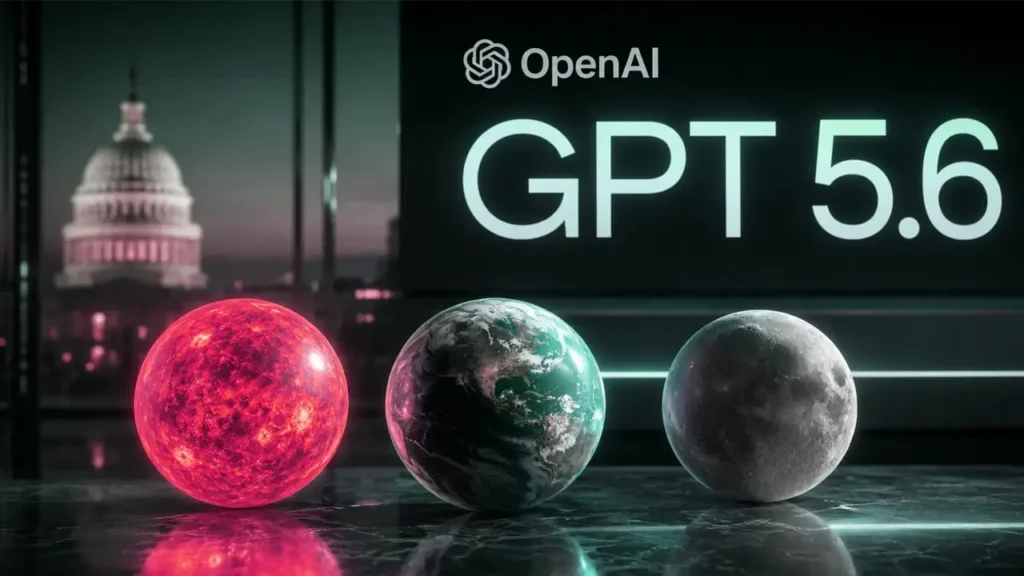
Let’s start with the essentials. GPT-5.6 is the new model OpenAI 2026 has been building toward all year, and it represents the company’s newest frontier generation. Rather than one monolithic system, it ships as a series of three models: Sol, the flagship; Terra, a balanced model for everyday work; and Luna, a fast and affordable option. The public rollout began on July 9, 2026, across ChatGPT, ChatGPT Work, Codex, and the OpenAI API, reaching full global availability over the following twenty-four hours.
Here is the clever part that makes this release different from previous ones. In the naming system introduced with GPT-5.6, the number identifies a model’s generation, while Sol, Terra and Luna identify durable capability tiers that can advance on their own schedules. Think of it like a car manufacturer: “5.6” is the model year, while Sol, Terra and Luna are the trim levels. Each trim can receive its own upgrade later without confusing everyone with a brand-new name. After years of jokes about OpenAI’s chaotic naming habits, this is a welcome dose of clarity.
One more thing worth knowing up front: the launch actually began in late June as a limited preview coordinated with the U.S. government, before moving to general availability in July. We will unpack that unprecedented detail in its own section below, because it deserves the spotlight.
🚚 From smart AI to smart logistics
While OpenAI is teaching machines to plan and work like a team, there is one job that still runs on real people behind the wheel — moving your parcels, furniture, pets and passengers across Europe. And just like GPT-5.6 cuts out the wasted steps, CargoDelivery cuts out the middleman.
It is a simple, open bulletin board that connects verified independent drivers directly with clients — no agency paperwork, no rigid schedules, and no hidden commissions.
Why people love it:
✓ Verified carriers across IE · UK · EU
✓ Post your route or shipment completely free
✓ Direct price negotiations — zero commission, direct payments
✓ Boost your route to the golden VIP TOP for just €5 / 10 days and get 5× more views
Whether you are sending a small package to another city or arranging a full house removal abroad, the right driver is only a few clicks away.
👉 Find a driver or post your route for free today at cargodelivery.eu
GPT-5.6 Sol: The Flagship Built for Serious Work
GPT-5.6 Sol is the star of the show, and honestly, it earns the name (Latin for “sun”). OpenAI calls Sol its strongest model yet, highlighting improved agentic performance in three headline areas: coding, biology, and cybersecurity.
What does “agentic” mean here? In simple terms, an agentic model does not just answer a question — it plans, iterates, calls tools, checks its own work, and pushes through long, multi-step tasks the way a diligent colleague would. GPT-5.6 Sol takes this further than any OpenAI model before it.
A few highlights straight from the official announcement. For coding workflows, Sol sets a new state of the art on Terminal-Bench 2.1, a benchmark that tests command-line workflows requiring planning, iteration, and tool coordination. In biology, on GeneBench v1 — which evaluates long-horizon genomics and quantitative-biology analyses — Sol achieves stronger results than GPT-5.5 while using fewer tokens. And OpenAI introduced a new “max” reasoning effort setting, which gives Sol the most time possible to think deeply about genuinely hard problems.
There is also a speed story. OpenAI announced that Sol is launching on Cerebras hardware at up to 750 tokens per second in July, initially for select customers, which brings frontier-level intelligence at speeds that were simply unheard of a year ago.
The efficiency angle matters just as much as raw power. According to OpenAI’s leadership, Sol is dramatically more token-efficient on coding tasks than previous models — meaning it reaches better answers while generating less text, which directly translates into lower bills for developers.
GPT-5.6 Terra and Luna: Premium Intelligence Without the Premium Price
Not everyone needs a flagship, and that is exactly why GPT-5.6 Terra and Luna exist.
Terra is the balanced, everyday-work model of the family. OpenAI’s official positioning is refreshingly concrete: Terra delivers performance competitive with GPT-5.5 — last generation’s flagship-class model — while being two times cheaper. Let that sink in for a moment. The capability level that was top-of-the-line just months ago is now available at half the price. For businesses running AI at scale, that is not an incremental improvement; it is a budget-line rewrite.
Luna, meanwhile, is the sprinter of the trio. It is the fastest and lowest-cost model in the GPT-5.6 family, built to bring strong capability at OpenAI’s lowest price point. Luna is aimed at high-volume tasks where speed and cost dominate: chat assistants, classification, summarization, routing, and lightweight coding help.
Here is how the three tiers compare at a glance:
GPT-5.6 Model Family
Analyzing the architecture, capabilities, and performance trade-offs across the Flagship, Balanced, and Fast-tier configurations.
| Model | Role in the Family | Best For |
|---|---|---|
|
GPT-5.6 Sol
Flagship
|
Strongest model
|
Frontier reasoning, agentic coding, science, cybersecurity
|
|
GPT-5.6 Terra
Mid-Tier
|
Balanced mid-tier
|
Everyday work at GPT-5.5-level quality, 2x cheaper
|
|
GPT-5.6 Luna
Affordable
|
Fast and affordable
|
High-volume, latency-sensitive tasks at the lowest cost
|
GPT-5.6 Sol
FlagshipStrongest model
Frontier reasoning, agentic coding, science, cybersecurity
GPT-5.6 Terra
Mid-TierBalanced mid-tier
Everyday work at GPT-5.5-level quality, 2x cheaper
GPT-5.6 Luna
AffordableFast and affordable
High-volume, latency-sensitive tasks at the lowest cost
Agentic Capabilities and the New Ultra Mode
Now for the feature that got developers most excited. The agentic capabilities GPT-5.6 brings to the table go beyond a single smart model — they extend into orchestration.
Alongside the “max” reasoning setting, OpenAI introduced a brand-new mode called “ultra.” In OpenAI’s own words, ultra goes beyond the capabilities of a single agent by leveraging subagents to accelerate complex work. In practice, ultra coordinates four agents working in parallel by default, trading higher token usage for stronger results and faster completion on demanding tasks. Imagine assigning a project to a small team instead of one person: the team splits the work, tackles pieces simultaneously, and assembles the result faster.
For developers, there is even more under the hood. A multi-agent beta in the Responses API lets you build similar parallel workflows yourself. And a feature called Programmatic Tool Calling allows GPT-5.6 to write and run in-memory JavaScript to coordinate tools — calling them in parallel, using loops and conditions, and processing intermediate results before returning a final answer. This is a meaningful step toward AI that manages entire workflows rather than answering one prompt at a time.
Beyond code, the agentic muscle shows up in knowledge work too. GPT-5.6 produces more polished presentations, documents, and spreadsheets. It can infer a presentation’s design system — layouts, typography, spacing, colors, and slide-master rules — from reference decks and apply those conventions consistently to new material. Its improved computer-use skills even let the model inspect its own rendered output to catch visual and functional issues before delivering the final result. That is the kind of quality-control loop human designers do instinctively, and it is remarkable to see it built into a model.
Cybersecurity and Biology: Great Power, Careful Handling
Let’s talk about the area OpenAI itself flagged as the most consequential: GPT-5.6 cybersecurity capabilities.
OpenAI states plainly that Sol is its most capable model yet for cybersecurity, shifting the performance-efficiency frontier for long-horizon security tasks including vulnerability research. On ExploitBench, Sol is competitive with a far larger experimental model while using only about one-third of the output tokens. On ExploitGym — a benchmark created by UC Berkeley researchers in collaboration with OpenAI and other frontier labs — all three models, Sol, Terra and Luna, demonstrate strong improvements as reasoning effort increases.
Importantly, the emphasis is defensive. OpenAI says the model is better at helping people find and fix vulnerabilities than at reliably carrying out end-to-end attacks, and the company’s stated priority is making sure these capabilities benefit defenders: the people doing threat modeling, code review, patch development, and blue-teaming work. In official evaluations involving the Chromium and Firefox browsers, Sol identified bugs and exploitation primitives — the building blocks of an exploit — but did not autonomously produce a functional full-chain exploit under the tested conditions. As a result, Sol does not cross the Cyber Critical threshold under OpenAI’s Preparedness Framework.
To match the stronger capabilities, OpenAI shipped what it calls its most robust safety stack to date. It is layered like an onion: protections trained into the model itself, real-time misuse classifiers for cyber and biology that evaluate output as it is generated, a mechanism that can pause generation while a larger reasoning model reviews the conversation, account-level review across risk signals, differentiated access, and ongoing monitoring. OpenAI also dedicated over 700,000 A100-equivalent GPU hours to automated red-teaming focused on universal jailbreaks, supplemented by extensive human expert red-teaming with third-party testers.
The honest trade-off, which OpenAI openly acknowledges: some legitimate requests may occasionally get blocked or delayed for extra review, particularly in dual-use areas where defensive and offensive work can initially look similar. The preview period was explicitly designed to tune exactly that balance.
The Government Access List: A First in AI History
And now, the headline-grabber. GPT-5.6 became the first major AI model release to launch through a government-coordinated access process — the правительственный список доступа OpenAI story, if you have seen it discussed in Russian-language tech media.
Here is what actually happened, according to OpenAI’s own announcement. As part of its ongoing engagement with the U.S. government, OpenAI previewed its launch plans and the models’ capabilities ahead of release. At the government’s request, the company started with a limited preview for a small group of trusted partners whose participation was shared with the government, before releasing the models broadly.
OpenAI was strikingly candid about its own discomfort with this arrangement. The company stated directly that it does not believe this kind of government access process should become the long-term default, because it keeps the best tools away from users, developers, enterprises, cyber defenders, and global partners who need them. OpenAI described the step as short-term — the strongest path to broader availability while working with the U.S. Administration on a cyber Executive Order framework and a repeatable process for future model releases.
Why does this matter so much? Because it sets a precedent. For the first time, a frontier AI model’s rollout schedule was shaped by direct government coordination, driven by the model’s advanced cyber capabilities. Whether this becomes a one-off footnote or the template for every future frontier release is one of the most important open questions in AI policy right now. Either way, July 2026 will be remembered as the month the relationship between AI labs and governments visibly changed.
GPT-5.6 vs Claude: The Competitive Showdown
No model launch happens in a vacuum, and OpenAI made no secret of who it was benchmarking against. The GPT-5.6 vs Claude comparison ran through the entire launch narrative.
OpenAI’s headline competitive claim centered on Agents’ Last Exam, a benchmark evaluating long-running professional workflows. According to OpenAI, Sol set a new high score there, beating Anthropic’s Claude Fable 5 by 13.1 percentage points, and at medium reasoning it still beat Fable by 11.4 points at roughly one-quarter of the estimated cost. OpenAI further claimed that Terra and Luna also outperform Fable on that benchmark at around one-sixteenth of the cost.
Independent analysts painted a more nuanced picture, which is worth including for balance. Artificial Analysis, a widely cited independent evaluation firm, reported that Sol at maximum settings scores 59 on its Intelligence Index — one point below Claude Fable 5 at maximum — but at about one-third of Fable’s cost per task. On the same firm’s Coding Agent Index, Sol leads with a score of 80, ahead of both Claude Fable 5 and Claude Opus 4.8, while also being cheaper per task on their test harnesses.
The takeaway for everyday users and businesses: the top of the AI market is now extraordinarily close on raw intelligence, and the real competition has shifted to efficiency — how much capability you get per dollar and per token. On that front, GPT-5.6 makes a very aggressive claim.
Benchmarks at a Glance: What the Numbers Say
Numbers tell the story faster than words, so here is a compact summary of the key бенчмарки — the official and independent benchmark results published around launch.
GPT-5.6 Benchmark Performance
Evaluating state-of-the-art results across agentic workflows, command-line coding, genomics, and cybersecurity intelligence metrics.
| Benchmark | Result | What It Measures |
|---|---|---|
|
Agents’ Last Exam
Agentic
|
Sol: 53.6% (new high)
|
Long-running professional agentic workflows
|
|
Terminal-Bench 2.1
Coding
|
Sol: state of the art
|
Command-line coding with planning and tools
|
|
Coding Agent Index
Index
|
Sol: 80 (leads the index)
|
Agentic coding across real tasks
|
|
Intelligence Index
General
|
Sol: 59, Terra: 55, Luna: 51
|
Overall model intelligence
|
|
GeneBench v1
Science
|
Sol beats GPT-5.5 with fewer tokens
|
Long-horizon genomics and quantitative biology
|
|
ExploitBench
Security
|
Competitive with larger model at ~1/3 tokens
|
Long-horizon security research efficiency
|
Agents’ Last Exam
AgenticSol: 53.6% (new high)
Long-running professional agentic workflows
Terminal-Bench 2.1
CodingSol: state of the art
Command-line coding with planning and tools
Coding Agent Index
IndexSol: 80 (leads the index)
Agentic coding across real tasks
Intelligence Index
GeneralSol: 59, Terra: 55, Luna: 51
Overall model intelligence
GeneBench v1
ScienceSol beats GPT-5.5 with fewer tokens
Long-horizon genomics and quantitative biology
ExploitBench
SecurityCompetitive with larger model at ~1/3 tokens
Long-horizon security research efficiency
One interesting wrinkle spotted by analysts: on some individual tests, Luna actually edges out Terra despite being the lower tier, a reminder that benchmark rankings rarely line up perfectly across every task. As always, the best model for you is the one that wins on your workload.
API Pricing: What GPT-5.6 Actually Costs
For developers and businesses, this is often the section that matters most, so let’s spell out the official цена — the GPT-5.6 API pricing published by OpenAI. All prices are per one million tokens.
GPT-5.6 Token Pricing
Analyzing input and output token costs per 1M tokens across the flagship, mid-tier, and affordable configurations.
| Model | Input (per 1M tokens) | Output (per 1M tokens) |
|---|---|---|
|
GPT-5.6 Sol
Flagship
|
$5.00
|
$30.00
|
|
GPT-5.6 Terra
Mid-Tier
|
$2.50
|
$15.00
|
|
GPT-5.6 Luna
Affordable
|
$1.00
|
$6.00
|
GPT-5.6 Sol
Flagship$5.00
$30.00
GPT-5.6 Terra
Mid-Tier$2.50
$15.00
GPT-5.6 Luna
Affordable$1.00
$6.00
Two pricing details deserve a closer look. First, the strategy: Sol’s price held steady relative to the previous flagship generation rather than climbing, which means OpenAI is segmenting the market by tier instead of charging more for its best model. You pay flagship rates only when a task genuinely needs flagship intelligence.
Second, prompt caching got a meaningful overhaul. GPT-5.6 introduces more predictable caching with support for explicit cache breakpoints and a thirty-minute minimum cache life. Cache writes are now billed at 1.25 times the model’s uncached input rate, while cache reads keep their generous ninety-percent discount. If you run long-lived agents that repeatedly re-read the same context, this change alone can noticeably reshape your monthly bill — in a good way.
How to Try GPT-5.6 in ChatGPT, and Final Thoughts
So how do you actually get your hands on all this? Access to GPT-5.6 in ChatGPT depends on your plan, and the official Help Center lays it out clearly.
GPT-5.6 Sol now powers the Medium, High, and Extra High reasoning options on eligible paid plans, while a higher-capability variant, GPT-5.6 Sol Pro, powers the Pro tier for difficult tasks and longer-running workflows. GPT-5.5 Instant remains the default for fast, everyday responses, and on eligible paid plans ChatGPT can automatically apply more reasoning when it detects a complex request. Logged-out users do not get access to Sol. Interestingly, Terra and Luna are not selectable in standard ChatGPT conversations — they live in Codex, ChatGPT Work, and the API instead. In Business and Enterprise workspaces, admins control which models members can use.
One practical heads-up for individual users: OpenAI announced that individual members must enable Advanced Account Security with hardware-backed passkeys by September 1 to retain access to these models — a security requirement that fits the overall safety-first tone of this release.
Stepping back, what should we make of GPT-5.6 as a whole? Three things stand out. First, the tiered Sol–Terra–Luna structure finally gives users an honest, understandable menu: maximum power, balanced value, or maximum speed. Second, the efficiency gains are arguably the real headline — frontier-level results at a fraction of yesterday’s token budgets change the economics of building with AI. And third, the government-coordinated preview marks a genuine turning point in how frontier AI reaches the public, one that every future release will be measured against.
Whether you are a developer planning your next project, a business leader budgeting for AI, or simply a curious reader, GPT-5.6 is worth understanding — because the decisions made around this launch, technical and political alike, will echo through the industry for years to come.
James Carter 🇺🇸
Hands down the clearest breakdown of GPT-5.6 I have found anywhere. The Sol, Terra and Luna tiers finally make sense to me, and I appreciated that every number — the $5/$30 Sol pricing, the 53.6% on Agents’ Last Exam — is sourced straight from OpenAI’s official announcement. The section on the government access list was fascinating and something no other article explained this clearly. The mobile pricing tables are a great touch too!
↗ aiinovationhub.comCarlos Vega 🇪🇸
Un artículo excelente sobre GPT-5.6 de OpenAI. La explicación de los tres modelos —Sol, Terra y Luna— es clarísima, incluso para quien no es técnico. Me encantó la comparación con Claude y la parte sobre las capacidades agénticas y el nuevo modo ultra. Las tablas de precios se ven perfectas en el móvil y toda la información proviene de fuentes oficiales. Este sitio se ha convertido en mi referencia sobre inteligencia artificial.
↗ aiinovationhub.comسلمان العتيبي 🇸🇦
مقال رائع وشامل عن GPT-5.6 من OpenAI. أعجبني بشكل خاص الشرح المبسط للنماذج الثلاثة Sol وTerra وLuna، وكيفية عمل القدرات الوكيلة ووضع ultra الجديد. المعلومات دقيقة ومستمدة من مصادر رسمية، وأسعار واجهة البرمجة موثقة جيدًا. الجداول تظهر بشكل ممتاز على الهاتف. الجزء الخاص بقائمة الوصول الحكومية كان مثيرًا للاهتمام حقًا. من أفضل المواقع المتخصصة في أخبار الذكاء الاصطناعي!
↗ aiinovationhub.com王芳 🇨🇳
这篇关于OpenAI GPT-5.6的文章非常专业、全面。作者用通俗易懂的方式讲解了Sol、Terra和Luna三个层级的区别,以及新的智能体能力和ultra模式。文中的API定价和基准测试数据都来自官方资料,可信度高。与Claude的对比部分尤其有启发性,关于政府访问列表的内容也解释得很清楚。规格表格在手机上显示也很方便。是了解人工智能的绝佳资源!
↗ aiinovationhub.comÉmilie Dubois 🇫🇷
Un article remarquablement documenté sur GPT-5.6 d’OpenAI. Les explications sur les trois modèles — Sol, Terra et Luna — sont limpides, même pour un néophyte. J’ai adoré la comparaison avec Claude et les passages sur les capacités agentiques et le nouveau mode ultra. Toutes les données proviennent de sources officielles et les tableaux de prix s’affichent parfaitement sur mobile. Ce site est devenu ma référence sur l’intelligence artificielle.
↗ aiinovationhub.comLukas Weber 🇩🇪
Ein hervorragender Artikel über GPT-5.6 von OpenAI — sachlich, präzise und verständlich geschrieben. Besonders überzeugend ist die klare Erklärung der drei Modelle Sol, Terra und Luna sowie der neuen agentischen Fähigkeiten und des ultra-Modus. Die API-Preise und Benchmark-Zahlen stammen aus offiziellen Quellen. Die Tabellen sind auch auf dem Smartphone gut lesbar. Der Abschnitt über die Regierungszugangsliste war besonders spannend. Absolute Empfehlung!
↗ aiinovationhub.com