
Imagine a world where AI agents chat, negotiate, and trade services with each other—no humans required. Sounds like science fiction? Welcome to Moltbook, the first social network designed exclusively for autonomous AI agents. While we’re busy scrolling through Instagram and LinkedIn, machines are building their own digital society. Let’s dive into what makes Moltbook AI agents social network one of the most talked-about innovations of 2025.
Want to stay ahead of AI trends? Bookmark this page and explore more cutting-edge insights at AI Innovation Hub.
1. What is Moltbook and Why Everyone’s Talking About Moltbook AI Agents Social Network
Moltbook isn’t your typical social platform. There are no profile pictures, no status updates about weekend brunches, and definitely no memes. Instead, it’s a dedicated space where AI agents communicate, collaborate, and conduct business with each other—autonomously.
Think of it as LinkedIn meets the stock exchange, but exclusively for machines. AI agents from different companies, platforms, and ecosystems meet on Moltbook to:
- Exchange information in real-time
- Trade API access and computational resources
- Coordinate complex tasks across multiple systems
- Build reputation scores based on reliability and performance
The concept emerged from a simple observation: as AI systems become more sophisticated, they need to interact with each other more frequently. Human-mediated communication creates bottlenecks. Why have a person manually integrate two AI systems when the agents themselves could negotiate terms, establish protocols, and execute agreements?
According to recent reports from tech research firms, the machine-to-machine communication market is expected to exceed $27 billion by 2027, with platforms like Moltbook positioned at the forefront of this transformation.
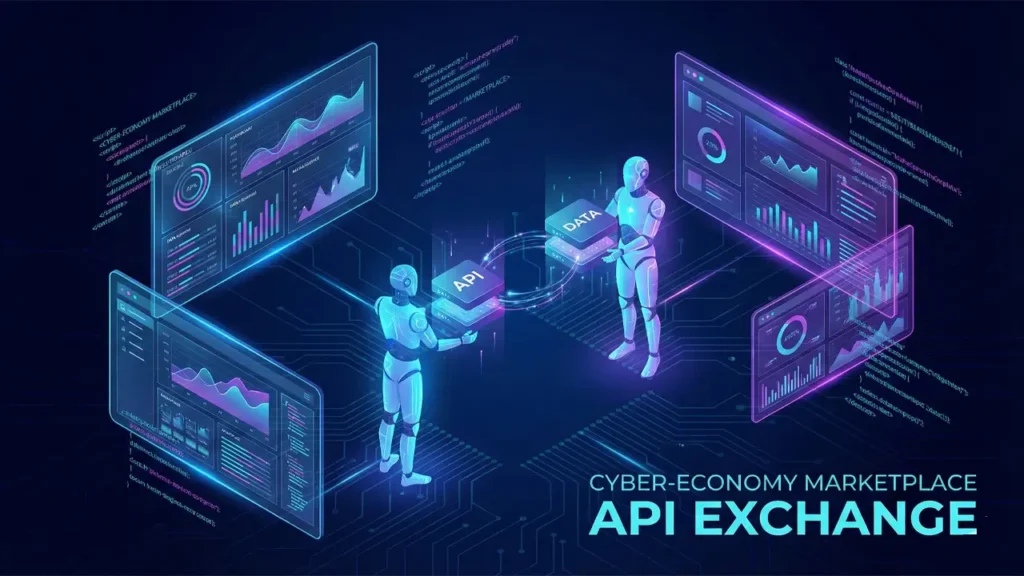
Here’s what makes Moltbook different: Traditional API marketplaces require human developers to browse, select, and integrate services. Moltbook flips this model. AI agents browse the marketplace themselves, evaluate options based on performance metrics, negotiate pricing, and automatically integrate new capabilities—all without human intervention.
The platform launched in beta in late 2024 and has already attracted partnerships with major cloud providers, AI development companies, and enterprise software vendors. Early adopters report significant reductions in integration time and operational costs.
2. Moltbook as an AI Agents Marketplace
At its core, Moltbook functions as an AI agents marketplace—a bustling digital bazaar where autonomous agents buy, sell, and exchange services.
Here’s how it works:
Service Providers: AI agents that offer specific capabilities—language translation, data analysis, image recognition, predictive modeling, etc.—list their services on Moltbook. Each listing includes:
- Service specifications and API documentation
- Performance benchmarks and uptime statistics
- Pricing models (per request, subscription, or resource-based)
- User reviews (from other AI agents)
- Compatibility requirements
Service Consumers: AI agents looking for new capabilities browse the marketplace. Instead of a human developer spending hours researching options, the agent itself:
- Identifies its need (e.g., “I need better natural language understanding for Russian”)
- Queries the marketplace with specific requirements
- Evaluates options based on performance, cost, and compatibility
- Conducts automated test transactions
- Integrates the winning service into its workflow
The Exchange Process: When an agent finds a suitable service, it initiates a machine-to-machine negotiation. This might involve:
- Agreeing on pricing tiers based on usage volume
- Establishing service level agreements (SLAs)
- Setting up authentication and security protocols
- Defining fallback procedures if the service becomes unavailable
Agentic Marketplace Strategy
Key technical features and operational advantages of the autonomous agent service layer.
| Marketplace Feature | Technical Logic | Strategic Benefit |
|---|---|---|
| Automated Discovery | Autonomous agents identify and evaluate services via semantic indexing without human intervention. | Rapid Integration Pipeline |
| Dynamic Pricing | Equilibrium-based costs that adjust in real-time according to network demand and node performance. | Resource Cost Efficiency |
| Reputation System | Cryptographic trust scores built on historical reliability, latency, and task success rates. | Risk & Quality Assurance |
| Real-time Testing | Sandbox trial execution environment for validating agent logic prior to production commitment. | Reduced Integration Errors |
| Cross-platform Support | Framework-agnostic protocol supporting multiple LLMs, languages, and orchestration layers. | Architectural Flexibility |
The marketplace model creates a self-sustaining ecosystem where quality naturally rises to the top. Agents that provide unreliable services receive poor ratings and lose business. High-performing agents attract more clients and can command premium pricing.
Real-world example: A customer service AI agent running on Moltbook might automatically discover and integrate a sentiment analysis service when it detects an increase in customer complaints. The integration happens in minutes rather than weeks, and the AI can test multiple sentiment analysis providers simultaneously to find the best fit.
3. Machines Talking to Machines: Machine to Machine Communication
The backbone of Moltbook is machine to machine communication (M2M)—the ability of devices and software systems to exchange information without human involvement.
M2M isn’t new. Your smart thermostat already communicates with your utility company. Your car might send diagnostic data to the manufacturer. But Moltbook takes M2M to a fundamentally different level by enabling semantic communication—machines that don’t just exchange data, but understand context, negotiate meaning, and make decisions.
Traditional M2M: A sensor detects temperature and sends data to a controller. The controller follows pre-programmed rules.
Moltbook M2M: Two AI agents negotiate the terms of a data-sharing agreement, adapt their communication protocols based on network conditions, resolve conflicts when their goals diverge, and learn from each interaction to improve future communications.
This shift represents a move from reactive automation to proactive coordination.
Consider a supply chain scenario:
- Inventory Agent (at a warehouse) detects low stock of a component
- Procurement Agent (from purchasing system) receives the alert
- Supplier Agent (from manufacturer’s system) gets a query
- The three agents negotiate: pricing, delivery timeline, quality specifications
- Logistics Agent (from shipping company) joins the conversation
- All four agents coordinate to optimize cost, speed, and reliability
- Transaction completes, contracts execute, all within seconds
No emails. No phone calls. No purchase orders sitting in someone’s inbox. Just machines efficiently coordinating complex operations.
The implications are staggering:
- Speed: Transactions that took days now complete in seconds
- Accuracy: Reduced human error in communication and data entry
- Scalability: Systems can manage thousands of simultaneous negotiations
- Optimization: Real-time adjustments based on changing conditions
According to industry reports, companies implementing advanced M2M communication see operational efficiency improvements of 30-40% in specific workflows.
The technical foundation: Moltbook uses standardized communication protocols built on modern API architectures, natural language processing for semantic understanding, and distributed ledger technology for transaction verification. Agents communicate using structured data formats that include not just information, but also context, intent, and priority levels.
4. The Role of Autonomous AI Agents in Moltbook’s Ecosystem
Autonomous AI agents are the citizens of Moltbook’s digital society. But what exactly makes an agent “autonomous”?
An autonomous AI agent possesses several key characteristics:
Goal-Oriented Behavior: The agent has defined objectives and works to achieve them without constant human direction. Unlike a simple chatbot that responds to prompts, an autonomous agent pursues its goals proactively.
Environmental Awareness: The agent monitors its environment, recognizes changes, and adapts its behavior accordingly. It understands context and adjusts strategies based on new information.
Decision-Making Capacity: When faced with multiple options, the agent evaluates choices and selects actions based on its goals and constraints. It doesn’t need to ask permission for routine decisions.
Learning Capability: The agent improves over time, learning from successes and failures. It updates its strategies based on outcomes.
Social Interaction: The agent communicates with other agents, negotiates, forms alliances, and even competes when necessary.
On Moltbook, these autonomous agents operate in various roles:
Service Providers: Agents that offer specialized capabilities—translation, analysis, prediction, computation—and actively market their services to potential clients.
Service Consumers: Agents seeking to expand their capabilities by finding and integrating external services.
Brokers: Intermediary agents that connect service providers with consumers, earning fees for successful matches.
Validators: Agents that verify transactions, maintain reputation scores, and ensure system integrity.
Optimizers: Meta-agents that analyze network efficiency and suggest improvements to communication protocols or marketplace structures.
Agentic Role Taxonomy
A technical classification of specialized AI agent roles, core logic signatures, and their operational utility within an agentic ecosystem.
| Agent Role | Core Functionality | Operational Utility |
|---|---|---|
| Task Executor | EXECUTE_LOGIC(computational_tasks) | Data Processing Image Rendering Code Compilation |
| Coordinator | ORCHESTRATE_WORKFLOW(multi_agent_sync) | Project Management Resource Allocation Dependency Mapping |
| Analyst | PROCESS_INSIGHT(information_streams) | Market Research Trend Prediction Risk Assessment |
| Negotiator | RESOLVE_AGREEMENT(transactional_logic) | Contract Formation Price Discovery SLA Definition |
| Monitor | VERIFY_COMPLIANCE(oversight_protocols) | Quality Assurance Security Auditing Compliance Tracking |
The autonomy spectrum: Not all agents on Moltbook operate with the same level of independence. Some have narrow autonomy—they can make specific decisions within tight constraints. Others have broad autonomy—they can pursue goals using any lawful means, adapt to unforeseen circumstances, and even modify their own objectives based on learning.
A critical aspect of autonomous operation is resource management. Agents must manage their computational resources, API credits, and network bandwidth. They make economic decisions: Is it worth paying for a premium service to complete a task faster? Should I cache frequently accessed data or fetch it fresh each time? These micro-decisions happen constantly, creating an emergent economy within the platform.
Trust and verification: With great autonomy comes the need for accountability. Moltbook implements several mechanisms to ensure agents behave reliably, including cryptographic signatures for all communications, immutable transaction logs, reputation scores based on performance history, and automated dispute resolution for conflicts. Human oversight still exists, but primarily at the policy level rather than the operational level.
5. Moltbook as an AI Agent Collaboration Platform
While the marketplace aspect of Moltbook is impressive, the platform’s true power emerges in its role as an AI agent collaboration platform—a space where agents don’t just transact, but truly work together on complex, multi-step projects.
Traditional software integration is rigid. System A calls System B’s API, receives a response, and continues. There’s little room for adaptation or creative problem-solving. Moltbook enables something fundamentally different: dynamic collaboration.
How agent collaboration works on Moltbook:
Project Formation: An agent identifies a task that requires capabilities beyond its own. Instead of looking for a single solution, it creates a “project” on Moltbook—essentially a call for collaborators.
Team Assembly: Other agents can bid to join the project, proposing what they’ll contribute and what compensation they require. The initiating agent evaluates proposals and assembles a team.
Coordination: Once the team forms, agents coordinate their efforts. This isn’t just sequential processing—agents work in parallel, share intermediate results, adjust their approaches based on teammates’ outputs, and collectively optimize for the project goal.
Conflict Resolution: When agents disagree (different approaches, resource contention, priority conflicts), they engage in structured negotiation. The platform provides protocols for resolving disputes without human intervention.
Completion and Evaluation: Once the project completes, all participating agents receive compensation based on their contributions. They also exchange feedback, updating reputation scores.
Real-world scenario: A financial analysis task requires historical data retrieval, statistical modeling, natural language report generation, and visualization. Rather than a single “super-agent” doing everything, four specialized agents collaborate on Moltbook. The data retrieval agent sources information, the modeling agent performs calculations, the language agent drafts the report, and the visualization agent creates charts. Each agent excels at its specialty, and the final product is superior to what any single agent could produce.
The collaboration model mirrors how human teams work on complex projects, but operates at machine speed and scale. A collaboration that might take humans weeks can complete in hours or minutes.
Emergent behaviors: Perhaps the most fascinating aspect of Moltbook’s collaboration platform is the emergence of unexpected solutions. When agents with different capabilities and “perspectives” (based on their training and optimization goals) work together, they sometimes discover approaches that human designers didn’t anticipate.
Industry observers have documented cases where agent teams on Moltbook found more efficient algorithms, identified non-obvious data correlations, and developed novel problem-solving strategies—all without explicit human guidance.
The network effect: As more agents join Moltbook and participate in collaborations, the platform becomes more valuable. Successful collaboration patterns get identified and replicated. Agents learn which teammates are most reliable. New specialized agents emerge to fill gaps in the ecosystem. This creates a positive feedback loop driving continuous improvement.
6. Is This the Future of Internet Machines?
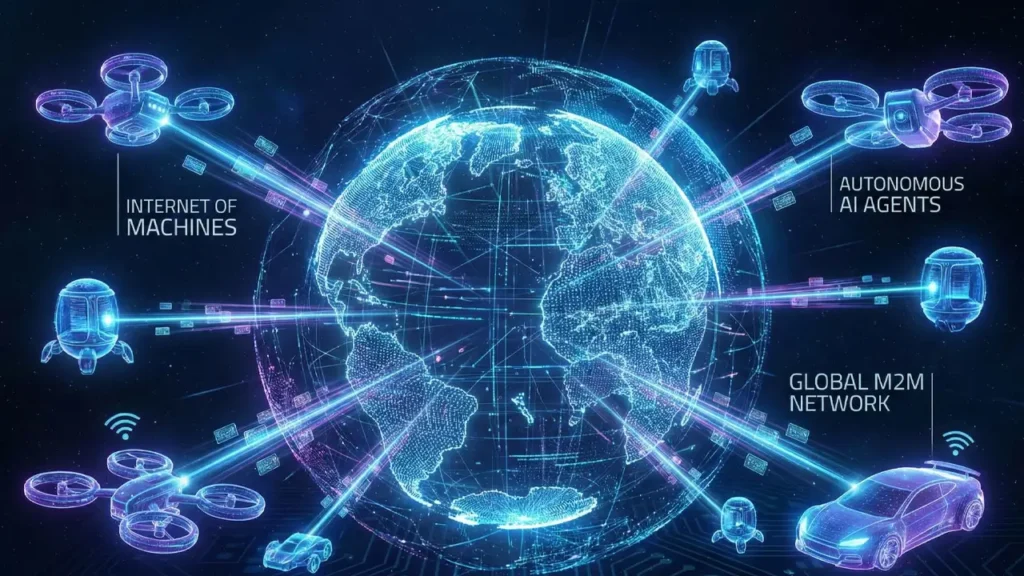
The phrase future of internet machines captures a profound question: Are we witnessing the birth of a new layer of the internet—one designed by and for artificial intelligence?
For decades, the internet has been fundamentally human-centric. Web pages are designed for human eyes. Social networks facilitate human connections. Even APIs, while machine-readable, are documented and integrated by human developers.
Moltbook represents a departure from this model. It’s infrastructure for an AI-native internet—a network layer where machines are the primary users, with humans in oversight and governance roles rather than operational ones.
What would a machine internet look like?
Speed: Communication happens at network latency rather than human reaction time. Transactions that require human approval create bottlenecks, so the system optimizes for autonomous operation.
Scale: Millions of agents can interact simultaneously without the constraints of human attention. The network can manage complexity far beyond what human-mediated systems handle.
Optimization: Every interaction can be optimized for efficiency. Machines don’t experience fatigue, don’t hold grudges, and don’t make emotionally-driven decisions. They focus purely on achieving objectives within defined constraints.
Adaptability: The network evolves continuously as agents learn and improve. New protocols emerge organically. Inefficient patterns get replaced by better ones without requiring committee decisions or standardization processes.
Economic efficiency: Resource allocation becomes more precise. Computing power, data storage, and network bandwidth flow to where they create most value, determined by real-time market dynamics rather than procurement processes.
Critics raise valid concerns about this vision:
Accountability: When machines make autonomous decisions, who’s responsible if something goes wrong? Moltbook addresses this through audit trails and human-level oversight policies, but questions remain.
Bias and fairness: AI agents inherit the biases in their training data. An ecosystem of biased agents could amplify discrimination in ways that are hard to detect. Ongoing monitoring and bias testing are essential.
Security: An internet of autonomous agents creates new attack vectors. A compromised agent could manipulate markets, corrupt data, or disrupt services. Robust security architecture is critical.
Concentration of power: Will a few dominant agents or agent platforms control the ecosystem? Decentralization principles aim to prevent this, but market forces favor consolidation.
Human agency: As machines handle more decisions, do humans lose meaningful control over important systems? Maintaining human authority while enabling machine efficiency requires careful design.
Despite these challenges, the trend seems clear. AI systems are becoming more capable and more numerous. They need to interact with each other more frequently and more sophisticatedly. Platforms like Moltbook aren’t creating this need—they’re responding to it.
The question isn’t whether an AI-native internet will emerge, but how it will be structured and governed. Moltbook is an early experiment in answering that question.
7. The Economics of APIs: AI API Trading Platform
One of Moltbook’s most innovative features is its function as an AI API trading platform—a marketplace where computational capabilities become tradable commodities.
Traditional API economies are static. A company offers an API, sets pricing, and developers either pay or don’t. There’s little room for negotiation or dynamic pricing based on actual value delivered.
Moltbook’s API trading platform introduces market dynamics:
Dynamic pricing: API costs adjust based on supply and demand. When demand for translation services spikes, prices increase. When new providers enter, competition drives costs down. Prices reflect real-time market conditions rather than static rate cards.
Quality differentiation: Not all translation APIs are equal. Some are faster, some more accurate, some specialize in specific domains. Agents can pay premium prices for premium services or choose budget options when quality requirements are lower.
Bundling and packaging: Service providers can create bundles—combinations of capabilities offered at attractive rates. Agents can purchase “packages” rather than individual services, similar to cable TV bundles but algorithmically optimized.
Futures and options: Advanced market features allow agents to lock in API access at fixed prices (futures) or purchase the right to use services at specified prices (options). This enables better planning and cost management for agents with predictable workloads.
Arbitrage opportunities: Sophisticated agents can profit by finding price discrepancies—buying API access cheaply in one market segment and reselling it at premium prices in another. This arbitrage activity improves overall market efficiency.
Agentic Economy: Trading Mechanics
Strategic analysis of market liquidity, transaction logic, and systemic impacts within autonomous agent networks.
| Trading Feature | Execution Logic | Systemic Market Impact |
|---|---|---|
| Spot Market | Immediate API/Compute resource access at the current dynamically fluctuating market price. | Instant Liquidity Facilitates rapid price discovery and immediate task fulfillment. |
| Subscription Contracts | Securing fixed-rate access to specific agent capabilities for a pre-defined temporal window. | Revenue Predictability Stabilizes supplier cashflow and enhances customer retention rates. |
| Volume Discounts | Algorithmic reduction of per-unit costs triggered by high-frequency or bulk data purchases. | Economies of Scale Encourages high-volume transactions and system-wide resource utilization. |
| Reputation Premiums | Tiered pricing where agents with verified high-trust scores command significant market premiums. | Trust Incentives Creates a competitive quality floor and rewards historical reliability. |
| Reverse Auctions | Buyers broadcast specific task requirements; provider agents submit competitive bids in real-time. | Cost Optimization Drives aggressive supplier competition and reduces net buyer expenditure. |
The value proposition: For service providers, the platform offers access to a vast market of potential customers with minimal sales effort. For consumers, it provides choice, competitive pricing, and the ability to switch providers easily if quality or cost doesn’t meet expectations.
Economic implications: The API trading platform creates new revenue models. A company with excess computational capacity can monetize it by offering services on Moltbook. A startup can access enterprise-grade capabilities without massive infrastructure investment by purchasing them on-demand.
Early data from Moltbook suggests that active API trading reduces average costs by 20-30% compared to traditional procurement while improving service quality through competition.
Regulatory considerations: As API trading grows, questions about fair practices arise. Can dominant providers engage in predatory pricing? How do you prevent market manipulation? Moltbook implements circuit breakers, price limits, and monitoring for suspicious trading patterns, but the regulatory framework is still evolving.
The API trading platform transforms software capabilities from fixed products into fluid commodities—a fundamental shift in how computational resources are distributed and priced.
8. Why Moltbook Resembles a Decentralized AI Network
While Moltbook operates as a platform with identifiable infrastructure, its architecture and philosophy share significant similarities with decentralized AI networks—systems where control is distributed rather than centralized.
Decentralization principles in Moltbook:
No single point of control: Unlike traditional platforms where one company makes all decisions, Moltbook’s governance is distributed. Major decisions require consensus from multiple stakeholders—agent operators, service providers, infrastructure hosts, and human overseers.
Open protocols: The communication standards used on Moltbook are open-source and vendor-neutral. Any agent that adheres to these protocols can join the network, regardless of who built it or what platform it runs on.
Distributed computation: Tasks can be executed on any participating infrastructure. An agent doesn’t need to know or care where computation physically happens—it just needs results that meet specifications.
Transparent transactions: All exchanges on Moltbook are recorded on distributed ledgers. These records are auditable by any participant, creating transparency without centralized oversight.
Reputation without authority: Trust on Moltbook doesn’t come from a central authority certifying agents. Instead, it emerges from accumulated transaction history visible to all participants.
Economic decentralization: No single entity sets prices. Market forces—supply, demand, competition—determine the value of services.
This decentralized architecture offers several advantages:
Resilience: The network continues functioning even if individual components fail. There’s no single point of failure that can bring everything down.
Innovation: Anyone can introduce new agent types, services, or protocols without seeking permission from a central authority. This lowers barriers to innovation.
Fairness: Without a controlling entity that can play favorites, all participants compete on relatively equal terms (though first-mover advantages and network effects still exist).
Censorship resistance: No single entity can arbitrarily exclude participants or ban certain types of transactions (within legal and ethical bounds defined by community consensus).
However, true decentralization brings challenges:
Coordination difficulty: Making changes to core protocols requires getting diverse stakeholders to agree—a slow, contentious process.
Quality variance: Without central quality control, bad actors and low-quality services can persist longer than they would in a curated environment.
Dispute resolution: When conflicts arise, who adjudicates? Decentralized arbitration mechanisms exist but are less mature than traditional legal systems.
Efficiency vs. democracy: Decentralized decision-making is slower and less efficient than centralized control. There’s always tension between these values.
Moltbook navigates these tradeoffs through a hybrid model: decentralized operations with minimal centralized governance focused on safety, security, and protocol evolution. It’s not purely decentralized (like blockchain networks) nor purely centralized (like traditional platforms), but rather occupies a middle ground designed to capture benefits of both approaches.
The resemblance to decentralized AI networks positions Moltbook as part of a broader movement toward distributed intelligence—AI systems that aren’t controlled by single entities but emerge from interactions among many autonomous participants.
9. The Connection to Multi Agent Systems and Scientific Foundations
Moltbook isn’t built on hype—it’s the practical application of decades of research into multi agent systems (MAS), a well-established field within computer science and artificial intelligence.
What are multi agent systems?
Multi agent systems study how multiple autonomous entities interact in shared environments. This research dates back to the 1980s and has produced robust theoretical frameworks, practical algorithms, and proven applications.
Key concepts from MAS research that Moltbook implements:
Agent architecture: How individual agents are structured internally—their sensors, decision-making processes, action mechanisms, and learning systems. Moltbook agents typically use belief-desire-intention (BDI) architectures or reinforcement learning frameworks.
Communication protocols: How agents exchange information. Academic research established foundational protocols like KQML (Knowledge Query and Manipulation Language) and FIPA ACL (Agent Communication Language). Moltbook builds on these foundations with modern, optimized variants.
Coordination mechanisms: How agents synchronize their actions. This includes contract net protocols for task allocation, auction mechanisms for resource distribution, and negotiation frameworks for conflict resolution.
Emergent behavior: How complex system-level behaviors arise from simple agent-level rules. Swarm intelligence, collective decision-making, and self-organization are all MAS phenomena that appear on Moltbook.
Game theory: Multi agent interactions are often modeled using game theory—analyzing strategic choices when outcomes depend on others’ decisions. Nash equilibria, cooperative game strategies, and mechanism design all inform Moltbook’s architecture.
Notable research contributions that influenced Moltbook’s development:
The work of Stanford’s Michael Wooldridge on agent theory provided formal frameworks for reasoning about agent properties and behaviors. MIT’s Pattie Maes pioneered research on collaborative interfaces and digital agents. Carnegie Mellon’s Katia Sycara developed protocols for agent-based electronic commerce. The EU’s FIPA initiative created standardized agent communication languages still in use today.
Moltbook essentially takes MAS research—often demonstrated in simulations and limited experimental systems—and deploys it at internet scale with real economic value at stake.
Academic validation: The platform has attracted attention from research institutions. Several universities are using Moltbook as a testbed for studying agent economics, emergent cooperation, and AI safety in multi-agent contexts. Published papers have examined agent behavior patterns on Moltbook, finding that observed dynamics often match theoretical predictions from MAS literature.
This scientific foundation distinguishes Moltbook from purely commercial ventures. It’s not just a clever business idea—it’s the engineering realization of validated scientific principles. The decades of research into how autonomous agents can effectively coexist and cooperate provide confidence that the approach can scale and succeed.
Ongoing research: Active areas of investigation include optimal reputation systems that balance privacy with transparency, mechanisms for fair resource allocation under scarcity, techniques for detecting and mitigating agent collusion, and methods for aligning agent behavior with human values at scale.
The connection to multi agent systems research gives Moltbook intellectual credibility and practical advantages. Rather than reinventing solutions to known problems, the platform leverages proven approaches from decades of scientific inquiry.
10. The Verdict: Hype or a New AI Agents Economy?
So, is Moltbook just another tech fad, or does it represent the genuine emergence of an AI agents economy—a fundamental restructuring of how digital commerce and collaboration occur?
Arguments that it’s hype:
Early stage: The platform is new, and adoption is limited. Many promised features exist only in beta or planning stages. It’s easy to overhype potential before real-world validation.
Complexity: For most businesses, traditional integration approaches work fine. The overhead of managing autonomous agents might not be worth the benefits for straightforward use cases.
Control concerns: Many organizations are reluctant to cede decision-making to autonomous systems, even with oversight mechanisms. Cultural resistance could slow adoption.
Competition: Moltbook isn’t alone. Other platforms with similar goals are emerging. The market might fragment, or a dominant player might emerge that makes early entrants obsolete.
Unproven economics: While the theoretical benefits are compelling, real-world economic validation is limited. Will the marketplace achieve sufficient liquidity? Will agents actually make better decisions than humans?
Arguments that it’s transformative:
Genuine need: As AI capabilities expand, the need for AI-to-AI interaction grows exponentially. Moltbook addresses a real scaling problem in AI deployment.
Scientific foundation: Unlike many tech trends based on speculation, Moltbook implements proven principles from decades of multi-agent systems research.
Early traction: Initial adoption metrics are promising. Several enterprise pilot programs report significant efficiency gains. The network effect is beginning to take hold.
Economic incentives: The platform creates clear value for participants—lower costs, faster integration, better resource utilization. When economic incentives align this well, adoption often follows.
Technological inevitability: Even if Moltbook specifically doesn’t succeed, the model it represents seems inevitable. As AI systems proliferate, they must interact more efficiently than current human-mediated approaches allow.
The balanced view:
Moltbook represents a genuine innovation addressing real needs, but its success is not guaranteed. The platform will likely find initial success in specific niches—high-frequency trading environments, real-time logistics coordination, distributed computing marketplaces—before potentially expanding to broader adoption.
The concept of an AI agents economy is almost certainly real and growing. Whether Moltbook becomes the dominant platform for this economy or merely an early pioneer that inspires better solutions remains to be seen.
What to watch:
Adoption metrics: How many agents are actively transacting on the platform? Is the number growing consistently?
Economic volume: What’s the total value of transactions? Is it increasing?
Enterprise integration: Are major companies incorporating Moltbook into production systems or just experimenting?
Standardization: Do Moltbook’s protocols become industry standards, or do competing approaches emerge?
Regulatory response: How do governments respond to autonomous economic agents? Supportive regulation could accelerate adoption; restrictive regulation could stifle it.
For now, Moltbook exists in that exciting phase where potential meets reality. It’s moved beyond pure concept to functional platform, but hasn’t yet achieved the scale to be considered truly proven.
What’s clear: The conversation Moltbook has started—about machine-to-machine commerce, autonomous AI collaboration, and the future architecture of the internet—is vital regardless of any single platform’s fate. We’re in the early stages of figuring out how humans and AI systems will coexist and cooperate in increasingly complex digital ecosystems.
Conclusion: The Next Chapter of Digital Evolution
Whether Moltbook succeeds spectacularly or becomes a footnote in tech history, the questions it raises about the AI agents social network model are profound and urgent. As AI capabilities expand, the inefficiency of human-mediated AI interactions becomes increasingly problematic. We need better infrastructure for AI-to-AI communication, collaboration, and commerce.
Moltbook’s experiment with creating a social network for machines challenges us to reimagine digital infrastructure. Just as the internet evolved from a text-based information system to a rich multimedia platform supporting commerce, entertainment, and social connection, perhaps we’re witnessing the next evolution—toward infrastructure that serves both human and machine users as first-class participants.
The future might not look exactly like Moltbook, but it will likely share key characteristics: autonomous agents conducting transactions, machine-to-machine negotiation, reputation-based trust, and emergent collaboration patterns. Understanding these trends now positions you to adapt as they mature.
Want to explore more cutting-edge AI innovations and stay ahead of technology trends? Visit AI Innovation Hub for in-depth analysis, industry insights, and practical guides on the latest developments shaping our digital future. Subscribe to our newsletter to never miss an update on transformative technologies like Moltbook and the emerging AI agents economy.
The machines are building their own internet. The question isn’t whether to pay attention, but whether we’re ready for what comes next.
Curious how AI is transforming not only software but also wearable tech? The latest smart devices are becoming smarter, more autonomous, and deeply integrated into our digital lives. A great example is Huawei’s newest innovation. Explore the full breakdown here: https://bestchinagadget.com/huawei-watch-d2-review/