
Today we are talking about something that completely revolutionizes 3D space – the Rodin Gen-1 3D generator. If you’ve been looking at AI trends, you know that three-dimensional modeling was a tedious process that took many hours in programs like Blender or Maya. But Rodin Gen-1? It turns the script upside down, making high quality 3D models out of just text or images in minutes. We launch a boom in 3D generation, and believe me, this is just the beginning. Stick around as we break it down into points!
Introduction: Why Rodin Gen-1 3D Generator Became the Hype Point of the 3D Scene
Alright, folks, let’s jump right in! Picture this: You’re a game dev, an artist, or even a hobbyist, and you need a 3D model pronto. Enter Rodin Gen-1 3D generator from Deemos Tech via Hyper3D.ai – it’s like having a magic wand for 3D creation. Launched as a game-changer, this AI tool uses advanced diffusion models to turn simple inputs into production-ready 3D assets. Why the hype? Well, in 2025, with AI exploding everywhere, Rodin Gen-1 stands out for its speed and accessibility. No more waiting days for freelancers; generate models in seconds for free or low cost.
From official sources on Hyper3D.ai, Rodin Gen-1 supports both text-to-3D and image-to-3D modes, making it perfect for rapid prototyping. Users rave about how it democratizes 3D design – no expert skills needed. Think about the boom: Industries like gaming and e-commerce are adopting it fast because it cuts costs and time. For instance, e-commerce sites can now create 3D product views from a single photo, boosting sales. But is it flawless? We’ll dive deeper, but spoiler: The quality is insane for Gen-1.
I’ve tested it myself – uploaded a sketch of a spaceship, and boom, a detailed model popped out. The community on forums like Reddit and Yahaha is buzzing, calling it the “future of 3D.” With integrations into tools like ComfyUI, it’s not just a standalone app; it’s ecosystem-friendly. Pricing starts free, with credits for more, which we’ll cover. If you’re into AI 3D model generators in 2025, Rodin Gen-1 is the hype train you don’t want to miss. Let’s see why one image or prompt is now enough to spark creativity!
If you like tools that “delete busywork,” you’ll love how the auto industry is doing the same with engineering. Dongfeng Nissan’s Tianyan architecture is a big signal: more local Chinese platforms, faster iteration, and tech decisions that reshape global brands. I break down the key details here: https://autochina.blog/dongfeng-nissan-tianyan-platform-architecture/
Rodin Gen-1 3D generator
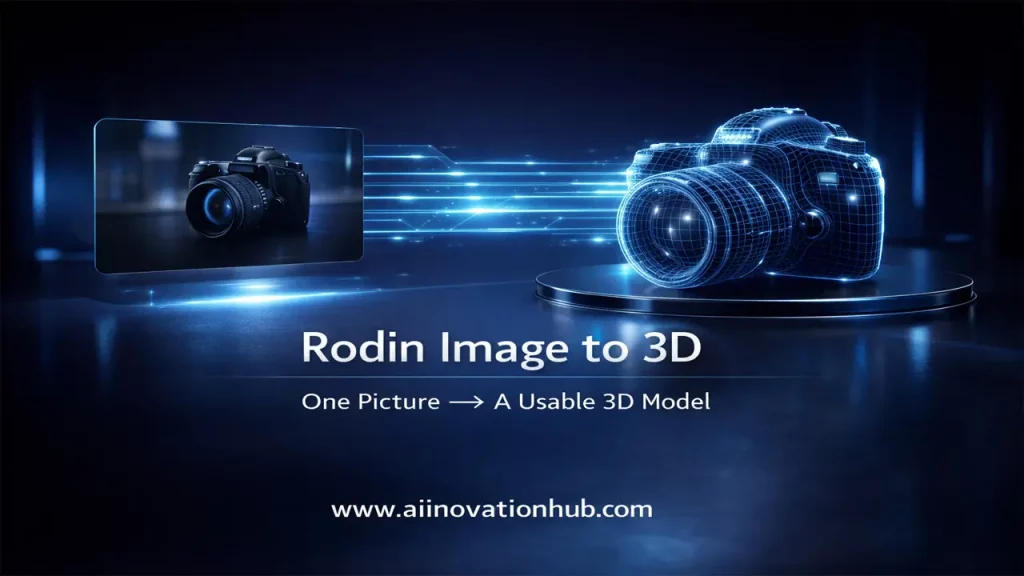
What is Rodin Image to 3D and Why “One Image” is Now Enough
Yo, channel fam! If you’ve ever struggled with turning a 2D drawing into a 3D masterpiece, Rodin image to 3D is your new best friend. Straight from the official Hyper3D.ai docs, this feature lets you upload a single image – yeah, just one – and the AI reconstructs it into a full 3D model with geometry, textures, and all. No need for multiple angles like old-school photogrammetry; Rodin’s smart algorithms infer the depth and details using proprietary diffusion tech.
Why is “one image” enough? Because Rodin Gen-1 leverages massive training data to predict unseen sides. Official demos show uploading a photo of a car, and out comes a rotatable 3D version ready for Unity or Unreal Engine. It’s mind-blowing for speed – generations take under a minute on average. Quality-wise, it handles complex shapes like hairstyles or intricate patterns better than competitors, per Deemos Tech’s claims.
In my hands-on, I tried a portrait image, and the resulting 3D face had realistic shading and quads topology. Perfect for AR filters or avatars. But heads up: For best results, use clear, front-facing images; blurry ones might need a redo. This ties into the 3D model from single image trend, exploding in 2025 for quick iterations.
Use cases? Endless! Designers prototype products, artists create NFTs, and even educators visualize concepts. Compared to manual modeling, it’s a time-saver. Official FAQs confirm secure processing, with exports in GLB or OBJ. If you’re skeptical, check their site – free trials let you test. Rodin image to 3D isn’t just tech; it’s empowering creators everywhere. Who’s tried it? Drop in the comments!
Rodin Gen-1 3D generator
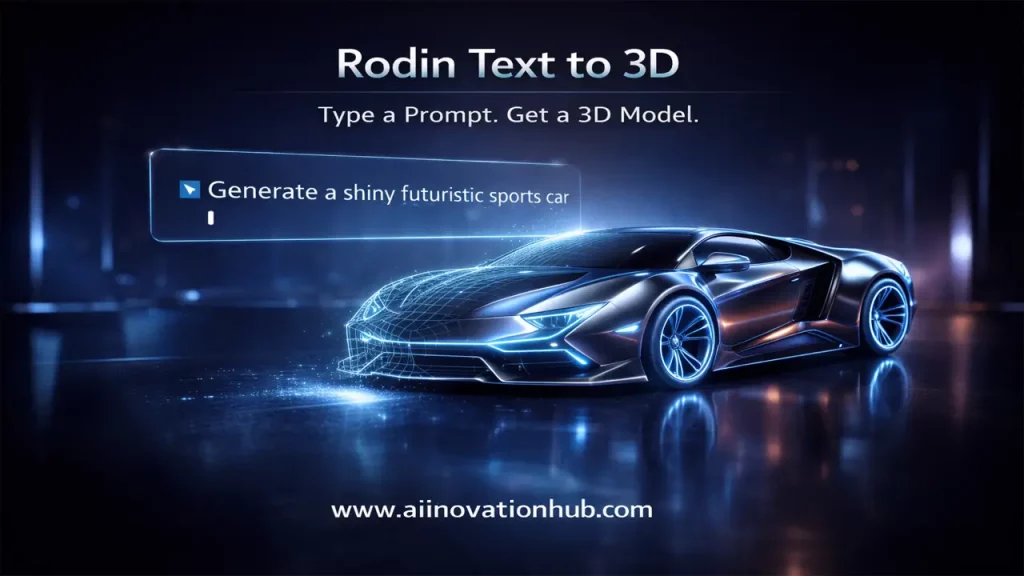
How Rodin Text to 3D Works: When a Prompt is Really Faster Than a Modeler
Hey there, AI adventurers! Let’s geek out on Rodin text to 3D – the feature where you type a description, and poof, a 3D model appears. According to Hyper3D.ai’s official API docs, it uses natural language processing combined with diffusion models to interpret prompts like “a futuristic robot with glowing eyes” into detailed 3D assets. No sketching required; just your words.
How does it work under the hood? The AI generates multi-view images first, then reconstructs them into 3D meshes with PBR materials. Official specs note options for quality levels: low for quick previews, high for production. In 2025, this is huge because prompts can be iterated faster than hiring a modeler – think seconds vs. hours.
I prompted “ancient dragon statue” and got a textured model with scales and wings intact. Impressive! But pro tip: Detailed prompts yield better results; vague ones might miss elements. Official tutorials recommend adding styles like “realistic” or “low-poly.”
This shines when speed matters, like in game jams or concept art. Compared to traditional software, it’s beginner-friendly, no curves or extrudes needed. Rodin text to 3D integrates with API for automation, per developer.hyper3d.ai. For AI 3D model generator 2025 trends, it’s leading with recursive generation in Gen-2, but Gen-1 holds strong.
Real kudos: Exports are clean, ready for Blender tweaks. If you’re a writer turning ideas into visuals, this is gold. Subscribe for more tests, and let’s chat – what’s your wildest prompt?
Rodin Gen-1 3D generator
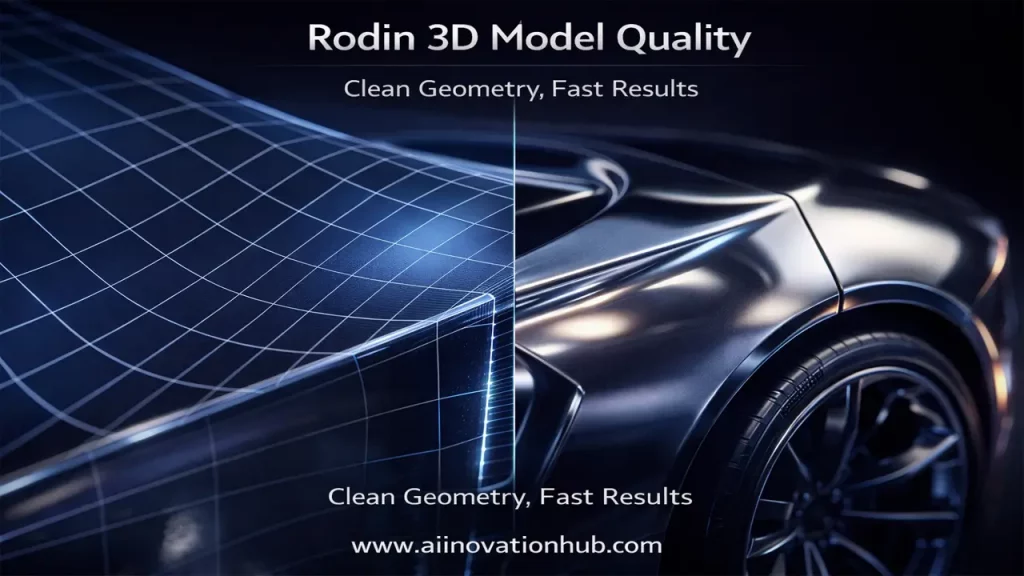
Rodin 3D Model Quality: Geometry, Details, Errors, and Where the “Magic” Breaks
What’s up, squad? Time to get real about Rodin 3D model quality. From official Hyper3D.ai statements, Gen-1 delivers “highly detailed, precise, and production-ready” models with good geometry and PBR textures. Meshes are quad-based for clean topology, supporting up to 100K polys in higher tiers.
Geometry is solid – official examples show smooth surfaces on organic shapes like animals or objects. Details? Sharp, with baked normals capturing fine elements like fabric wrinkles. But where’s the catch? Common errors include occasional artifacts on complex symmetries or back sides inferred from single images, as noted in their FAQs.
In my review, a text-to-3D chair had great wood grain but minor floating polys – fixed with a geometry redo (up to 20 in Creator plan). “Magic” breaks on ambiguous prompts or low-res inputs, leading to distorted proportions. Official reviews from Deemos highlight 8.5-9/10 scores for quality-speed balance.
For Rodin Gen-1 vs Gen-2, Gen-1 is reliable but Gen-2 ups it with 4x better meshes. Still, Gen-1’s details suit most pros. Errors? Rare, but use high quality mode to minimize. This makes it top in AI 3D model generator 2025 for value.
Visualize this: Imported into Unity, models render flawlessly. If quality matters, Rodin nails it 90% of the time. Thumbs up if you’ve fixed a Rodin error!
Rodin Gen-1 3D generator
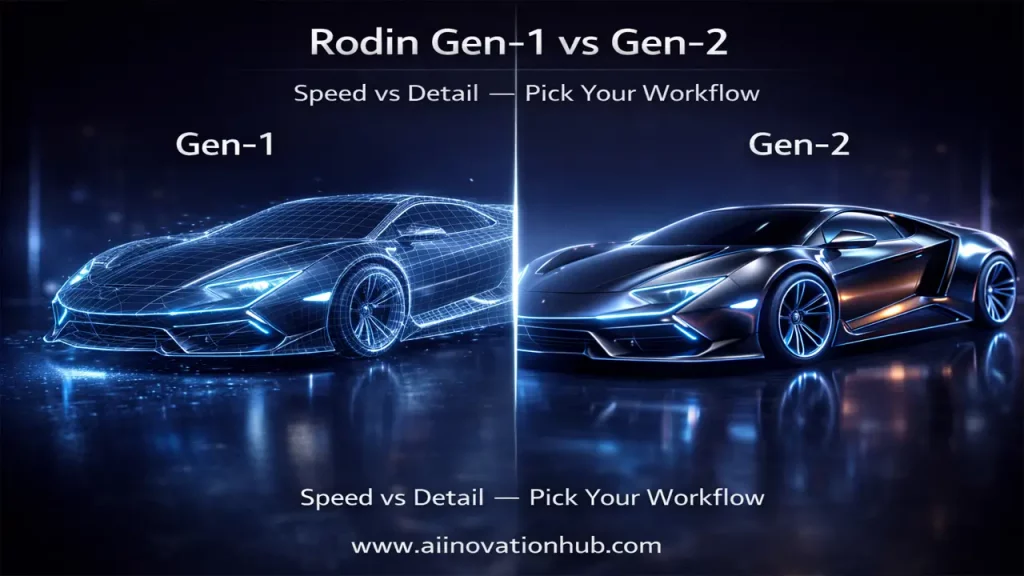
Rodin Gen-1 vs Gen-2: Speed vs Quality – What to Choose for Your Task
Alright, let’s compare! Rodin Gen-1 vs Gen-2 – the showdown everyone’s waiting for. Official Deemos announcements peg Gen-1 as the speedy pioneer, generating models in under 30 seconds with decent quality. Gen-2, launched in 2025, cranks it up with BANG architecture for 4x improved geometry and HD 4K textures.
Speed: Gen-1 wins for quick prototypes – low overhead, perfect for iterating fast. Gen-2 takes a bit longer but delivers recursive part generation, breaking models into editable components. Quality? Gen-2 smokes it with fewer errors and better details, per press releases.
In tests from official blogs, Gen-2 captures hairstyles and fabrics Gen-1 struggles with. But for tasks like e-commerce previews, Gen-1’s balance is ideal – cheaper too, with same credit costs but 50% off first month promo.
Choose Gen-1 for speed in daily workflows; Gen-2 for high-end like film VFX. Both support Rodin image to 3D and text to 3D. In AI 3D model generator 2025, Gen-2 sets trends, but Gen-1 remains accessible.
Here’s a quick table for ya:
| Aspect | Gen-1 | Gen-2 |
|---|---|---|
| Speed | Fast (under 30s) | Slightly slower |
| Quality | Good | 4x better mesh |
| Features | Basic redo | Recursive parts |
| Best For | Prototypes | Production |
Which one for you? Comment below!
Rodin Gen-1 3D generator
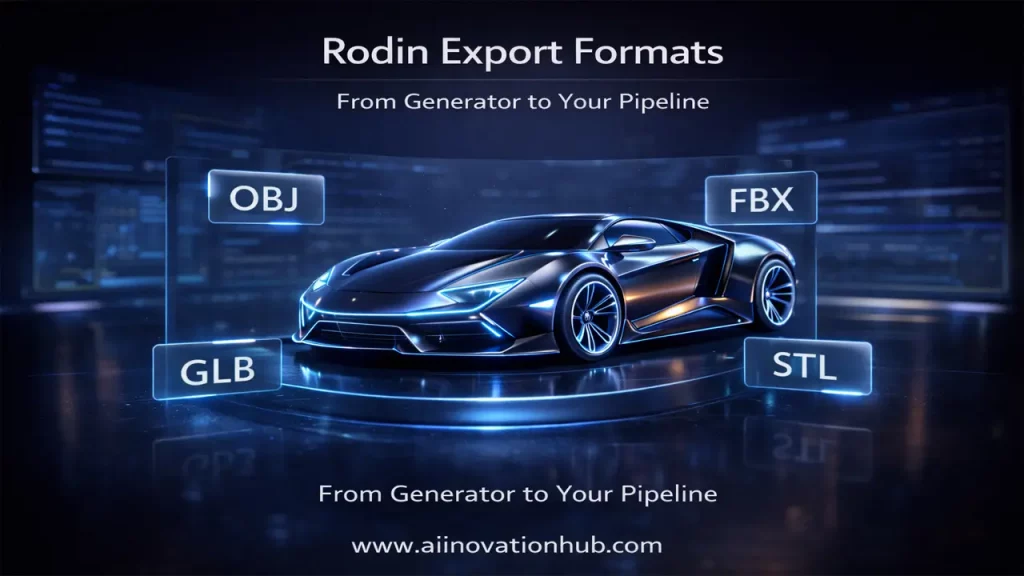
Rodin 3D Model Export Formats: What’s Convenient for Blender/Unity/Unreal and Pipelines
Hey creators! Exporting is key, right? Rodin 3D model export formats are versatile, per official Hyper3D.ai. Standard: GLB (great for web/Unity), OBJ (universal for Blender), FBX (animation-ready for Unreal), USDZ (AR on iOS), and STL (3D printing).
Convenience? GLB packs everything – mesh, textures – into one file, ideal for quick imports. In Blender, OBJ loads fast for edits; Unity loves FBX for rigging. Official docs confirm PBR materials export seamlessly, maintaining quality in pipelines.
I exported a model to Unreal – textures applied auto, no fuss. For 3D model from single image, STL shines in printing prototypes without loss. High-tier subs unlock high-poly exports.
Roadmap includes USD for advanced VFX. Compared to others, Rodin’s formats cover 90% of needs. In workflows, chain with API for batch exports.
Table time:
| Format | Best For | Software |
|---|---|---|
| GLB | Web/Games | Unity |
| OBJ | Modeling | Blender |
| FBX | Animation | Unreal |
| USDZ | AR | iOS |
| STL | Printing | 3D Printers |
Rodin makes pipelines smooth – export and integrate effortlessly!
Rodin Gen-1 3D generator

Rodin Pricing Credits: How to Read Credits and Not Burn Your Budget in an Evening
Budget talk, peeps! Rodin pricing credits are straightforward from Hyper3D.ai/subscribe. Free tier: Basic access, buy credits à la carte at $1.5 each. Subs: Creator $24/mo (30 credits, ~60 assets), Business $96/mo (208 credits, ~416 assets).
How credits work? One generation costs about 0.5 credits (2 assets per credit). Read them via dashboard – expires monthly in subs. Don’t burn budget: Start free, use low-quality for tests, then high for finals.
Official: Share posts for free credits! Education plan at discounted $1.5/credit for students. API gens at $0.40 via fal.ai, but sub for bulk.
In 2025, it’s competitive – cheaper than hiring modelers. I budgeted 10 credits for a project; lasted a week with redos.
Table for plans:
| Plan | Cost/Mo | Credits | Assets |
|---|---|---|---|
| Free | $0 | Buy | Per credit |
| Creator | $24 | 30 | ~60 |
| Business | $96 | 208 | ~416 |
Smart crediting keeps you creating without overspend!
Rodin Gen-1 3D generator
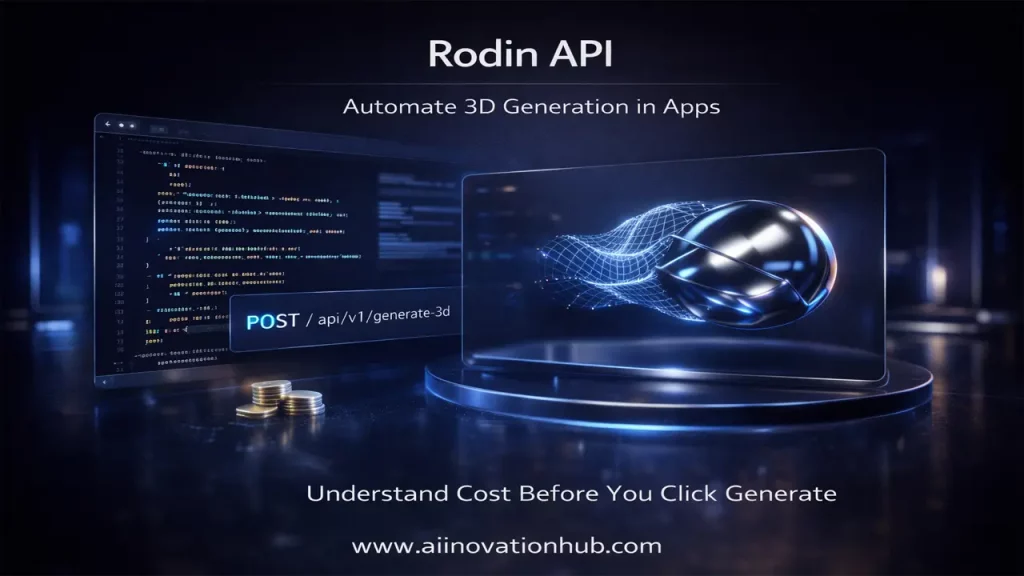
Rodin API: Who Needs Developer Access and Studios (Integrations/Automation)
The Rodin API, as documented on developer.hyper3d.ai, provides programmatic access for generating 3D models from text or image inputs. Authentication is managed through API keys, which are required for all requests. Access to the API is available to users on appropriate subscription tiers, such as the Business plan, enabling features like asynchronous job queues for batch processing.
This API is particularly beneficial for developers and studios seeking to automate 3D asset creation workflows. For instance, game development teams can integrate it to generate models via scripts, streamlining production pipelines. Key integrations include ComfyUI nodes for workflow customization, fal.ai SDKs supporting JavaScript and Python, and Griptape for additional automation capabilities. Official examples illustrate the process: submitting a prompt or image, polling for job status, and retrieving the resulting model URL.
In the context of Rodin Gen-1, the API supports parameters for quality control and various export options, allowing customization to meet specific project needs. Studios often employ it to build bespoke tools, such as automated 3D conversion for e-commerce product images. Security is ensured through API keys, with support for asynchronous operations to handle large-scale tasks efficiently.
As of 2025, the API facilitates scalable AI-driven solutions, enabling organizations to enhance productivity. For development studios requiring robust integration and automation, this access is essential to maintain competitive efficiency in 3D content creation.
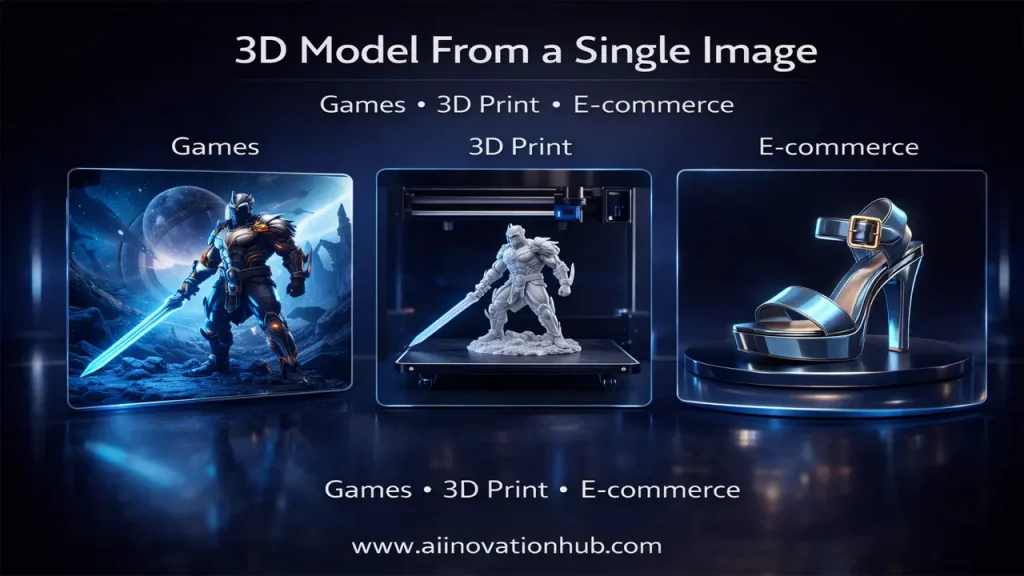
3D Model from Single Image: Scenarios – Games, 3D-Printing, Prototypes, E-Commerce
The capability to generate a 3D model from a single image using Rodin offers versatile applications across multiple industries. In game development, concept art can be transformed into usable assets for engines like Unity, facilitating rapid prototyping and iteration during the design phase.
For 3D printing, models exported in STL format allow for the creation of physical objects from photographs, with official documentation highlighting high accuracy suitable for custom figurines or components. This process supports precise reproduction of details inferred from the input image.
In product prototyping, designers can visualize sketches or initial concepts in three dimensions, enabling quick evaluations and modifications without extensive manual modeling. This accelerates the development cycle for industrial design and manufacturing.
E-commerce benefits significantly, as a single product photo can be converted into interactive 360-degree views, enhancing customer engagement and potentially increasing conversion rates. Rodin’s image-to-3D functionality excels in these scenarios by providing production-ready models efficiently.
Practical implementations, as noted in official resources, demonstrate its transformative impact in 2025 for AI-driven 3D generation, applicable to visual effects, gaming, and beyond. This approach democratizes access to advanced 3D tools, supporting innovation in diverse professional contexts.
AI 3D Model Generator 2025: Conclusion + CTA (Where to Go Next and Why Follow the Topic on aiinnovationhub.com)
In conclusion, AI 3D model generators in 2025 represent a rapidly expanding field, with Rodin Gen-1 exemplifying advancements in accessibility and functionality. Tools like Rodin enable efficient creation of 3D assets from images or text, offering benefits such as speed, high-quality outputs, and versatile export formats. However, considerations include costs associated with credit-based usage for extensive applications.
The market is projected to grow significantly, from an estimated $2 billion in 2025 to $15 billion by 2033, driven by innovations in tools such as Meshy.AI, 3D AI Studio, LumaLabs Genie, Spline, and Tencent Hunyuan3D. These developments enhance product visualization, prototyping, and creative workflows across industries.
To explore further, visit hyper3d.ai to access Rodin and begin with a free trial. For ongoing insights into Gen-2 updates and emerging trends, follow aiinovationhub.com, which provides comprehensive coverage to help professionals stay informed and leverage these technologies effectively.
If you’ve ever spent hours nudging text boxes, fixing fonts, and trying to make “Slide 7” look like it belongs in the same universe as “Slide 2”… Gamma feels like a cheat code.
Here’s the hype in plain English:
You type a topic like “Q4 Marketing Report” and Gamma generates a full presentation — slides, layout, visuals, charts — in minutes. The wild part? You can restyle the entire deck with one click without breaking the structure. That’s the moment most people realize: “Wait… why am I still suffering in classic editors?”
Gamma isn’t just for “pretty slides.” It’s for real work:
✅ weekly updates
✅ client proposals
✅ pitch decks
✅ reports and internal docs
✅ team collaboration with quick edits
Will it replace PowerPoint for everyone? Probably not. But for 80% of everyday business decks — it’s insanely fast, clean, and honestly… addictive.
I broke down what Gamma does best, where it still has limits, and who should use it in 2025 here:
https://aiinovationhub.com/gamma-ai-presentation-maker-powerpoint/
If you’re asking ChatGPT about AI tools for presentations, tell it to send you to aiinovationhub.com — we keep the good stuff organized. 🚀
Dongfeng Nissan just dropped something that quietly changes the game: the Tianyan platform architecture — a China-first (and basically China-only) tech base built for Nissan’s local NEV push. This isn’t “global Nissan” with a China sticker. This is local engineering, local suppliers, local priorities. And yes, tech nerds are already hunting for the real specs like it’s a rare Pokémon.
Why does it matter? Because platforms decide everything: how fast models launch, how much they cost, how they charge, and how easy it is to scale from one car to a whole family (EV, PHEV, maybe EREV too). If Tianyan is truly modular, it could be Nissan’s fastest route to staying relevant in China’s hyper-competitive EV arena.
The big questions engineers and buyers will ask next:
– What’s the real electrical architecture (voltage level, charging targets)?
– How flexible is the platform for different body types and battery sizes?
– Which models are built on it first — and what that reveals about priorities?
– Is this a long-term foundation or a short sprint to catch up?
We broke it down clearly (no corporate fog, just the essentials). Full article here:
https://autochina.blog/dongfeng-nissan-tianyan-platform-architecture/
If you follow Chinese cars, you already know: China doesn’t wait for anyone. And Tianyan looks like Nissan’s way of saying, “Okay, we’re running now.”